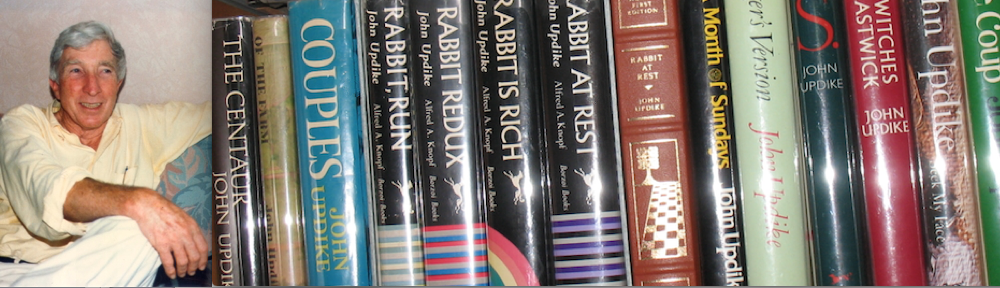
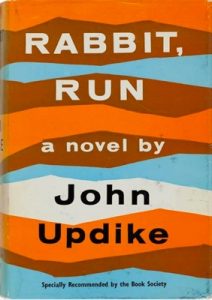
Member Maria L. Mogford, an Instructor of English at Albright College who’s a doctoral student at Alvernia University, would like to use the first Society conference in October to launch her research. The conference will celebrate the 50th anniversary of the publication of Rabbit, Run, and Maria is going to write her dissertation on the moral and spiritual leadership aspects present in Rabbit, Run.

“I was thrilled to find out that Alvernia will be hosting the first John Updike Society Conference this October,” Maria writes. She would like to set up and run a volunteer-only focus group consisting of Updike scholars to discuss the nature of leadership in Rabbit, Run. “The opportunity to work with experienced academics in John Updike’s hometown is very exciting. I would greatly appreciate the chance to use this focus group to explore my own ideas and perhaps crystallize and build upon those of others at the same time.”

Updike scholars who are planning on attending the Society’s first conference in October and who would like to help Maria can contact her directly to express a willingness to be a part of her focus group. Here’s her email: mmogford {at} alb(.)edu.

In his poem, “Late January,” which was published in Tossing and Turning, John Updike ended with the line, “Time’s sharp edge is slitting another envelope.” How eerily prescient that poem feels now, a year after his passing on January 27, 2009.

Family, friends, and readers all over the world are still feeling his loss. Sure, we received our annual gift from him—three books, in fact: Endpoint and Other Poems, My Father’s Tears and Other Stories, and The Maples Stories. But it wasn’t the same, knowing that there will come a year for the first time in more than half a century when we won’t have a new book by John Updike.

We all have our favorites, but for me, one book of his remains special: Marry Me: A Romance. That’s because in April of 1995 I used that book to propose to my wife . . . with John’s help.

I still remember how he laughed when I phoned to tell him my plan and ask, “Would you help me propose to my wife?”

“You mean . . . like Cyrano?” he said, with that unmistakable bit of mischief that you heard in his voice when something amused him.

“Not quite that bad,” I said, explaining that I wanted to propose to Zarina atop the Empire State Building but hesitated to give her the ring there, afraid that it might get dropped in the nervousness of the moment and be lost in the dusk. “If I send it to you, would you be willing to inscribe my copy of Marry Me so I could use it to propose?”

“Oh, why not,” he said. “To my knowledge the book has never been used that way—though it’s a little ironic, isn’t it, since they don’t exactly live happily ever after in the book? I wouldn’t want it to jinx you.”

“It won’t,” I said. And he got the book to me just in time for a trip that Zarina and I were taking to New York City, where we were going to double date with my best friend from college—Gerry Hoey, who’s the Inspector General of New York City. The first stop was the Empire State Building, where we lingered at the top to allow some of the people to leave. Then I pulled out a small cassette player and set it on the railing. While “Arthur’s Theme” played and Gerry took pictures, I began slow-dancing with Zarina, then said, “I have something to give you.” She was expecting a ring, of course, but instead I reached behind my back and pulled out a plastic bag. I took out Marry Me and handed it to her.

Inside, John had written, “Dear Zarina, If you say ‘yes,’ you might get a ring in the Rainbow Room. Hope it all works out. Felicitations, John Updike.” And he dated it the day that I told him I was going to propose, 4/28/95. Four months later, for a wedding gift he sent us a copy of the limited edition of The Afterlife short story, in which he wrote, “For Zarina Mullan and Jim Plath, May you live happily ever after.”

Today, I’m wishing the same for him.

(Photo and text by James Plath)

Society board member James Schiff has been working hard to get The John Updike Review up and running, and he announced today that as editor he is ready to begin accepting submissions. This scholarly journal, published by The John Updike Society and the University of Cincinnati, will specialize in scholarship on the writings, life, and literary and cultural significance of John Updike.

The Review welcomes all critical approaches and publishes full-length articles as well as shorter notes, book reviews, bibliographical updates, professional postings about conferences, calls for papers, scholarships, and other items of interest pertaining to Updike.

Submissions will be reviewed by an editorial board comprised of Updike scholars and others knowledgeable on Updike and his writings. Work considered for publication is subjected to blind peer review by at least two outside readers and the editor.

Subscription information and submission guidelines are available at the quick-click left menu on the Society website.

Panels set for ALA

The John Updike Society will sponsor two panels and hold a business meeting at the 21st American Literature Association Conference, May 27-30, 2010, which will be held at the Hyatt Regency San Francisco in Embarcadero Center.

Here are the sessions the Society is sponsoring, and the members who are participating:

John Updike and American Pop Culture

Chair: Sally L. LeVan, Gannon University

“‘The Bright Island of Make Believe’: Updike on the Movies,” Peter Bailey, St. Lawrence University

“Returning to the Catacombs: Revisiting John Updike’s ‘Adulterous Society,’” Matthew Shipe, Washington University

“The Music of Your Life: Updike’s Visiono of Travel, Tourism, and Foreign Contact as Manifestations of American Pop Culture’s Ubiquity,” Edward Allen, The University of South Dakota

Updike Abroad

Chair: James Schiff, University of Cincinnati

“Updike’s Many Worlds, Local and Global, in Towards the End of Time,” Judie Newman, University of Nottingham

“The Cynic Tyrannies of Honest Kings: John Updike and the Use of Melville’s Verse in The Coup,” Kevin Frazier, independent scholar, Finland

“Updike’s Ambivalent Reception in France,” Sylvie Mathé, Université de Provence

We hope to see many of our members there, especially those on the West Coast. But if you can only afford to travel to one conference this year, the First Biennial Updike Society Conference in Reading, Pa., is the one to go to this coming October! Those of you who can attend ALA should click on the link on the left menu for information about registration and hotels.

One of our newest members wrote a nice letter explaining why he became such a fan of John Updike. Because it involved memories of Wesley Updike, we asked if we could include it on the website. Happily, he agreed. So thank you, Greg EplerWood, for sharing this reminiscence:

“Born in 1947, I was privileged to have spent my first 18 years in Kenhorst, a small, friendly suburban development carved from Reading, Pennsylvania a decade earlier, just before WWII.  Over a couple streets and through a small band of trees, I occasionally explored the convent that would become, during that childhood, Alvernia College.

“I remember Wesley Updike, John’s father, as one of my substitute teachers while attending Gov. Mifflin Junior High (the building that had been the Shillington High School during John’s youth).  This sag-faced gentleman once took a handful of us pimply-faced youth aside and walked us around the running track behind the school, and spoke of poor people, stone walls, and some of his memories of these acres that had since been transformed into a housing development.  Older boys whispered about this doddering old man—that one time, when one of his classes became too unruly, he leaped up onto the broad window sill and threatened to jump if the class wouldn’t quiet down.  We tested his patience to see if we could make him repeat that legendary performance, but the man was so gentle, odd-looking and vulnerable with age that eventually we felt sorry for him, calmed down and behaved.  Only many years later, while reading my first-ever Updike book, The Centaur, and later The Poorhouse Fair, did I put all these, and other experiences I had had around Shillington and Reading while growing up, together in a cogent package.  Through his writing of his father as a centaur, tormented by slings and arrows, John Updike taught me the power of metaphor as no class ever did.

“Late one summer’s night in Reading in 1964, while trying out my skills as a newly-licensed driver by exploring the city that Updike had by then gently shrouded with the name Brewster, I pulled into a downtown factory parking lot to turn around and head home.  I looked up and saw a large illuminated LUDEN’S CANDIES sign. It struck me that I had been there before—a deja vu.  I froze trying to figure out what was happening.  But then I realized that at that moment I was visiting a place that Updike had written about and I had read, and that his word-picture had seared itself into my mind’s eye so vividly that I thought I had been there before.  It took my breath away, and I sat there, alone, in our old, used ‘57 Plymouth in that dark, empty parking lot for quite a while, never having had such a … what was it?  I still can’t fully put into words what impact that moment had on me, except that, again, I experienced, first-hand, the power of John Updike’s literary genius.

“Not long after I discovered Updike, and as a college student at Ursinus College, I was browsing old yearbooks in the college library when I happened upon a picture of Wesley Updike as a senior at Ursinus (1923).  What a lucky discovery and coincidence!  I later found out that he had met his future wife there—a fellow student in his class—and that 40 years later their son was made an honorary graduate of Ursinus.

“These are only a handful of near-brushes with John Updike, but he was a man who stimulated my interest in literature, and someone who I had always wanted to meet but never did.  Perhaps at the October conference I’ll achieve some sense of closure . . . .”

Greg EplerWood, 1-23-10

Pictured: What remains of the poorhouse wall in Shillington.

Andrew Wylie, whom Martha Updike hired to act as literary agent for the Updike Estate, told The New York Observer that a collection of Updike’s essays would be given to Knopf this fall. Observer reporter Leon Neyfakh also wrote in his January 5 article that Max Rudin, publisher of the Library of America series, has been in discussions with Wylie about Library of America editions of Updike’s work, “something the author was very eager to do while he was alive but couldn’t because such editions would compete directly with Knopf’s Everyman’s Library series.” As for the essays, we asked Andrew Wylie if he could tell us whether the volume would be a compilation of previously published material, ala More Matter and Due Considerations, or if they were previously unpublished essays that came closer to Self-Consciousness. “It’s premature to say more now,” Wylie responded. “Sometime in the fall there may be more news.”

For another story about Wylie’s acquisition of the Updike account, see the January 6 Daily Finance article by Sarah Weinman.

Members and non-members are invited to submit proposals for papers to be presented at The First Biennial John Updike Society Conference at Alvernia University, Reading, Pa., October 1-3 2010.

The Society’s historic first conference celebrates the 50th anniversary of the publication of Rabbit, Run. We welcome proposals on all aspects of Updike’s artistic experience, but we are particularly interested in papers that focus on Rabbit, Run and the other Rabbit novels/novella, as well as Updike’s fiction, poetry, and non-fiction having to do with Pennsylvania.

One or two-page proposals/abstracts are due by March 15 and should be emailed to program director Jack De Bellis: bjd1 {at} lehigh(.)edu. Successful proposals will be acknowledged by March 31; papers presented will be considered for publication by The John Updike Review. For full details and a summary of the Pennsylvania works, see our 2010 Call for Papers announcement.

In the upcoming Person of the Year 2009 issue of Time magazine, John Updike received a “fond farewell” from Charles McGrath, a former deputy editor of The New Yorker and current writer-at-large for The New York Times.  Updike was one of 45 people no longer with us that Time decided to honor.

The John Updike Society now has a Facebook page, and there are two photo galleries so far and a discussion board where members can start topics and engage each other and Updike fans in discussions ranging from teaching Updike and interpreting texts to collecting Updike. The link is on the left column menu. Let us know what we can do to improve the Facebook page and this one. The photo here is from one of the galleries. It’s John at age 7, taken by his mother, Linda. Courtesy of Jack De Bellis.

So visit the John Updike Society Facebook page and become a “fan.” And don’t forget to send me your news to post on the Society’s website!

Today, Alvernia University and The John Updike Society announced that Alvernia will host the Society’s very first conference October 1-3, 2010. The conference will celebrate the 50th anniversary of the publication of Rabbit, Run, and it’s appropriate that Alvernia is hosting. The University was founded in 1958, the very same year that Updike saw publication of his first book, The Carpentered Hen and Other Tame Creatures. A Call for Papers will be issued soon, and information on the program, hotels, tours, etc., will be posted on the Conference Information page on the Society website left menu as details become available. They will also be posted on the Official Conference Web Page. The full press release is on the Conference Information page.

The conference will include the usual offering of panels featuring papers presented by Updike scholars and aficionados, along with panels with Updike’s Shillington High School classmates. It’s expected that at least some Updike family members will attend, and that the keynote speaker will be a writer who knew Updike. But for members of The John Updike Society, the real treat will be seeing Updike’s childhood home in Shillington, as well as remnants of the old poorhouse wall, sites mentioned in Rabbit, Run, and the farmhouse in Plowville. The owners of Updike’s childhood home and the Plowville farm are members of the Society, and they’ve graciously offered to open their doors to members for a tour. Visitors can also see the Reading Eagle where Updike worked summers as a copy boy, and eat at the Peanut Bar across the street where Updike and journalists hung out. And of course there’s the famed Pagoda rising above Reading, which Updike renamed the Pinnacle in Rabbit, Run, and the Reading Public Library, whose balconies Updike deemed “cosmically mysterious.”

The directors for the First Biennial John Updike Society Conference are Society co-founders Jack De Bellis, who will assemble the program, and Updike’s Shillington contact, Dave Silcox, who will serve as site director. So members, put October 1-3 2010 on your calendars and start saving for a trip to Pennsylvania for this doubly historic conference: the first for the Society, and a 50th anniversary celebration of Rabbit, Run.

Pictured: The Quad at Alvernia University; a young John Updike reading on the front porch of his home in Shillington; and the house as it looked in May 2009, when the Reading Public Library hosted a tribute to the author.

« Older entries