Podcast explores Updike’s novel ‘The Coup’

On “Ninety-Nine Novels: The Coup by John Updike,” Graham Foster explained, “In 1984, Anthony Burgess published Ninety-Nine Novels, a selection of his favourite novels in English since 1939. The list is typically idiosyncratic, and shows the breadth of Burgess’s interest in fiction. This podcast, by the International Anthony Burgess Foundation, explores the novels on Burgess’s list with the help of writers, critics and other special guests.

“In this episode, Andrew Biswell talks to writer and critic Bob Batchelor about The Coup by John Updike, a novel Anthony Burgess called ‘a beautifully written disturbing lyric composition’. . . .

Bob Batchelor has written 16 books on subjects as wide as The Great GatsbyJim Morrison and the Doors, the Prohibition, and comic book writer Stan Lee. He has written extensively about John Updike, including the book John Updike: A Critical Biography. He has also presented the podcast series John Updike: American Writer, American Life. He is currently Assistant Professor in the Department of Communication, Media, and Culture at Coastal Carolina University.”

Booker winner David Szalay credits Amis and Updike

In “David Szalay: ‘If you want to be a proper writer, you have to deal with the sordid; The Booker prize-winning author of Flesh on class, punctuation, and what he learned from Amis and Updike,” Observer book critic Anthony Cummins wrote,

“Asked about the influences on Flesh during the post-prize press conference on Monday night, Szalay – fielding questions from reporters from Italy, Canada and China – said that there were lots but wasn’t able to name any. In fact he’s already namechecked several, including Virginia Woolf’s experimental novel Jacob’s Room, but it’s long been a source of speculation whether he had Stanley Kubrick’s film Barry Lyndon in mind when writing Flesh. Szalay says he has seen it – when he was about 20 – ‘and the rags-to-riches arc was an influenc’. The novel Ultraluminous, by the American writer Katherine Faw, is another . . . .”

But, as Cummins added, “Szalay attributes his attraction to unsavoury subject matter to reading Martin Amis and John Updike in his teens. ‘Maybe I took from them the lesson that if you want to be a proper writer, you have to deal with the sordid. But I think it’s also that I’m always on my guard against dealing only with supposedly elevated subjects’.”

Read the whole article

Ink Spill spotlights more Updike on Thurber

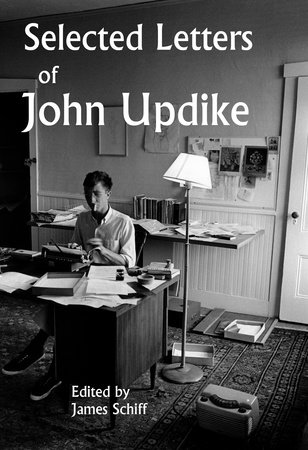
On one of their “Thurber Thursdays,” Ink Spill: New Yorker Cartoonists News, History, and Events was inspired by the recent publication of the Selected Letters of John Updike to do a little sleuthing and post the results.

A footnote on page 333 of Letters mentions Updike’s piece “On Meeting Writers” as being retitled “Writers I Have Met” and published in The New York Times Book Review on August 11, 1968. It “included drawings of Updike and the various writers he discusses: Joyce Cary, James Thurber, and E.B. White.”

“Thinking that Updike had drawn a self portrait along with sketches of Cary, Thurber, and White (drawings I did not recall ever seeing!) I scurried over to the Updike books here and pulled Picked-up Pieces off the shelf. ‘On Meeting Writers’ is the very first picked up piece in the book — it appears on page 3. But alas…no drawings.

“I then went to The New York Times archive and found the piece as it appeared in the paper (what an incredibly wonderful resource that is). I can’t reproduce the page here, but I can tell you I was thrilled, initially, to see drawings (I thought by Updike) accompanying it.

“They didn’t really look at all like Updike drawings, but I’ve become used to seeing how he had explored a variety of styles throughout his life — I supposed this was another exploration. But when I zoomed in on the credit for the drawings, I found the drawings were not by Updike, but by (and I mean no disrespect here by expressing disappointment) Jim Spanfeller . . . . So no Updike Thurber and E.B. White drawing, but –bonus — I learned about Mr. Spanfeller.

Atlas Obscura maps John Updike’s headstone

Atlas Obscura recently added a location for the “Headstone of John Updike; A unique tombstone, lovingly made by the author’s son, honors his literary talents.”

“Nestled in a churchyard in the small Pennsylvanian town of Mohnton, a peculiar gravestone stands out among the sturdy and square monuments of modern times. The black slate stone is an uncanny homage to the early grave markers of Puritan New England. It even includes a death’s head motif, but with a twist. Instead of a gaunt, ghastly skull with wings, it features the wide, smiling face of the interred: author John Hoyer Updike. . . .

“His unique headstone was carved by his son, Michael. In an interview with Northshore Magazine, he remarks on his father’s fear of death, which prompted him to capture his grin indefinitely.  John’s different monikers fill the empty space in an easygoing, curling script. Michael even inscribed one of John’s early poems on the backside. It reads:

Why the Telephone Wires Dip and the Poles Are Cracked and Crooked

The old men say
young men in gray
hung this thread across our plains
acres and acres ago
But we, the enlightened, know
in point of fact it’s what remains
of the flight of a marvelous crow
no one saw:
each pole, a caw.

“The headstone is not only a touching tribute to a father and author, but to a man’s undying love of New England and its iconography.”

Updike + Twain = Poetry for IWU professor James Plath

James Plath is best known to fellow Updike enthusiasts as president of The John Updike Society and an Updike scholar who edited two books of Updike interviews. But he’s also a creative writer, and after spending two weeks at Quarry Farm, the place where Mark Twain summered with his family for 20+ years, in addition to doing proposed research to write a comparative essay on how Twain modeled being both a celebrity and a writer for Updike, Plath felt compelled to write poems as well. The result: At Quarry Farm, a full-length collection published by Kelsay Books in 2025. He gave a reading on the campus of Illinois Wesleyan University, where he has taught American literature, journalism, creative writing, and film since 1988. The school’s student-run newspaper, The Argus, covered the event. Updike is mentioned in one of the poems.

Read the story

BBC’s ‘Front Row’ interviews James Schiff about the Updike letters

The Nov. 11 episode of BBC’s Front Row spotlighted art historian Andrew Graham-Dixon on Vermeer and radical Christianity, James Schiff on Selected Letters of John Updike, and director Edgar Wright on the new dystopian film The Running Man.

The Updike material begins around the 13:30 mark when the interviewer talks with writer Gish Jen, one of many who received letters from Updike.

Listen to the episode

GOATPoets features Updike spending “An Oddly Lovely Day Alone”

There are so many interesting websites, blogs, and YouTube channels that you can find something “new” every day, it seems.

Today that new discovery was GOATPoets, which featured John Updike reading “An Oddly Lovely Day Alone,” a poem that has echoes of Richard Maple making due while Joan is off and about.

Have a look and listen


Sociology professor offers his take on Updike’s ‘Toward the End of Time’

On Feb. 1, 2026, Martin Wenglinsky, an Emeritus Professor of Sociology at Quinnipiac University, posted on his blog the first of his two-part examination of John Updike’s futuristic novel, Toward the End of Time, which he called a “deficient” or “deformed” epic.

“Let me explain,” Wenglinsky wrote. “An epic is a story of war and family and a journey and one or more heroic protagonists and what might be endlessly elaborated episodes that convey some deep meaning about human nature, while novels, which are another kind of deformed epics, have protagonists whose histories are never retold but made up and just trying to manage life.”

In Toward the End of Time, Wenglinsky wrote, “The war envisioned is a limited exchange of atomic weapons between China and the United States that takes place a few decades in the future of the time the novel was published. The people in the novel are civilians trying to cope with the aftermath, which makes sense because the war that engulfed the world in the second half of the twentieth century was the Cold War, which had hot skirmishes in Korea and Vietnam and the Soviet incursion in Afghanistan, but unlike in other wars mostly in prospect, a full out exchange never happening even if many predicted it, imaginations filled with the nuclear apocalypse just thirty minutes away from total mutual destruction. So this war is a science fiction war, and Updike’s innovation is that there is a limited exchange so that the United States has had severe but not total annihilation, which is different from apocalyptic science fiction projections as happens in Shute’s On the Beach (1957), or Christopher’s No Blade of Glass (1956) or Wyndham’s The Day of the Triffids (1951) or to my mind the most scary documentary style BBC production, Mick Jackson’s Threads (1984)) which showed the reduction of England to a medieval economy and society. Rather, the United States, in Updike’s imagination, remains organized even if diminished and it is unclear whether it will recover or fall into anarchy.

“Updike’s novel is no reduction of a society into Hobbesian anarchy. Seafood is shipped from the East Coast to the decimated Midwest. Commerce also continues in that protection rackets spring up and young women openly advertise their personal services in the major newspapers and a local scrip has replaced the United States dollar but there are still country clubs and Federal Express and mail service  and a diminished food market in some stands around downtown Boston. What Updike retains from the apocalyptic genre, which is only somewhere in the epic mode, as is the case with “Sir Gawain and the Green Knight” (c. 1400), which is full of foreboding about what will be the fatal mistake of the hero, is a sense of dread and despair: that something even worse will happen and that  the eventual fate cannot be avoided however people battle on to restore what was once normal life. Achieving that tone in a less than complete apocalypse is a considerable achievement for Updike.

“But there is much more going on than that,” Wenglinsky wrote.

Read Part 1 of his essay, “John Updike: Toward the End of Time


Updike died . . . and got better, writer says

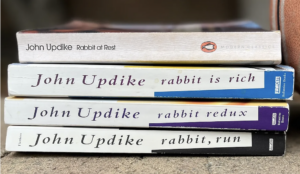
In “How John Updike Died and Got Better,” an essay that’s both artful and thoughtful, Alexander Sorondo wrote, “John Updike wrote and published constantly for 40 years. More than 70 titles. Thousands of articles. Mostly for The New Yorker. He sold millions of books and his Rabbit Angstrom quartet is celebrated as a pillar of American literary achievement in the 20th century. . . . Couples was a hit. It earned him $1 million if you include the $400,000 movie rights. . . . It got him on the cover of Time magazine. He was on there again in 1982 when Rabbit Is Rich won a Pulitzer and a National Book Award and a National Book Critics Circle Award. Ten years later he published a sequel and they gave him another Pulitzer for it (only the third American to ever win it twice). Then a PEN/Faulkner Award after that and he got a Guggenheim too at some point. He appeared multiple times on Dick Cavett and Charlie Rose and he was the subject of documentaries and biographies and critical anthologies and an academic periodical that endures to this day.

“He died in 2009.

“And then everyone stopped reading him.

“I think they’ll start again,” Sorondo wrote.

Read the rest of his 16-part essay

Writer says Updike changed his literary life

William J. Donahue just published a piece on his blog that first appeared in the fall/winter 2024 edition of Neshaminy: The Bucks County Historical and Literary Journal as part of a feature story about John Updike, who was born in adjacent Berks County.

In “The Writer Who Changed Me More Than Any Other,” Donahue wrote, “Prior to the summer of 2009, the name John Updike meant almost nothing to me. All I knew was that he belonged to a certain class of writer—white, male, and, as of January 27 of that year, dead.”

“Everything changed when a college professor friend introduced me to one of Updike’s best-known short stories, ‘A&P,'” he wrote. “A coming-of-age story about herring snacks, Queenie’s scandalously bare shoulders, and Sammy’s gesture of occupational seppuku, ‘A&P’ opened my eyes to something new. It also compelled me to explore Updike’s short-story collections, followed by his longer works: the Rabbit novels, Couples, Of the Farm, Marry Me, S., A Month of Sundays, etc. His novel-slash-collection The Maples Stories, which catalogs the adolescence, life, death, and afterlife of a specific New England couple’s marriage, had the greatest impact on me.

“Like his other novels, Maples features rich prose that reminds me of a well-crafted poem. The story follows Joan and Richard Maple, imperfect spouses who struggle and persevere, expand and contract, destroy themselves, and then find their respective paths to post-divorce reinvention. As someone who spent much of his thirties wrestling with his own personal and professional bugbears, I found Maples inspiring, if not prescriptive.”

Read the whole article