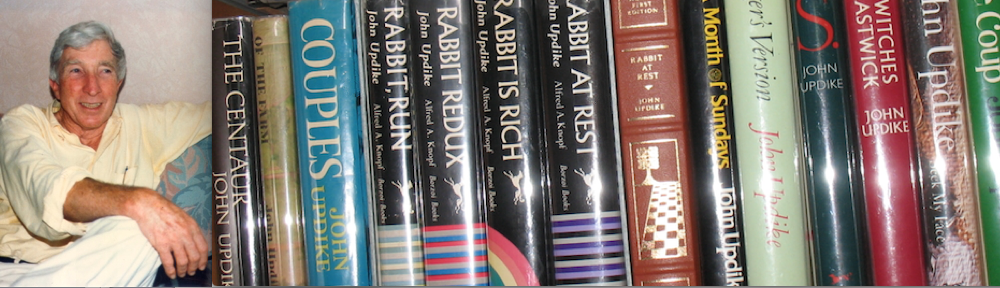
WSJ: Updike’s Rabbit provides a life lesson

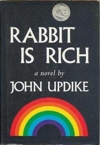
Writing on “Five Best: Life Lessons” for The Wall Street Journal, Andrew Wilkinson, author of Never Enough: From Barista to Billionaire, shared five of the best life lessons he found in fiction. The first entry, from John Updike, came from the Pulitzer Prize-winning Rabbit Is Rich (1981):

“The third installment of John Updike’s ‘Rabbit’ series finds Harry ‘Rabbit’ Angstrom finally comfortable—or at least financially secure—amid the tumultuous backdrop of 1979’s oil crisis and stagflation. ‘How can you respect the world when you see it’s being run by a bunch of kids turned old?’ the narrator observes, capturing the novel’s eerie contemporary resonance: interest rates and real-estate climbing skyward—and staying there—and a gnawing certainty that the next generation won’t have it quite so good. Updike’s prose transforms the mundane rhythms of middle-class life into something approaching poetry as he excavates middle-class anxiety and success. Rabbit’s car dealership is printing money thanks to the Japanese vehicles he sells, even as his own prejudices and racial anxieties bubble beneath the surface. His son Nelson is adrift, the world seems to be coming apart at the seams and Rabbit’s own biases reflect the tensions of a changing America. The novel won Updike both the Pulitzer Prize and the National Book Award for its devastating precision in capturing what it means to ‘make it’ while watching the ladder get pulled up behind you.”

New Yorker at 100 revisits Updike’s ‘Hub Fans’

The New Yorker celebrates its centennial in 2025 and the literary party is going on all year long. On March 9, Louisa Thomas wrote about the significance of John Updike’s “Hub Fans Bid Kid Adieu,” which a subhead noted was “described as the best piece about baseball The New Yorker ever printed.”

Thomas wrote, “On a dreary Wednesday in September, 1960, John Updike, ‘falling in love, away from marriage,’ took a taxi to see his paramour. But, he later wrote, she didn’t answer his knock, and so he went to a ballgame at Fenway Park for his last chance to see the Red Sox outfielder Ted Williams, who was about to retire. For a few dollars, he got a seat behind third base.
He spent the following five days writing about what happened next: Williams, after enduring a sorry little ceremony to say goodbye, came to bat for the last time, in the bottom of the eighth inning, and hit a home run—low, linear, perfect. ‘It was in the books while it was still in the sky,’ Updike wrote, and it is still in the sky, sixty-five years later, because of the arresting vividness of his depiction. Updike captured not only the ball’s trajectory and its monumental effect but also the moment’s mix of jubilation and relief.”
Thomas added that “it was Updike’s insight to see that everyone had expected [the last-bat home run], and in fact it was that shared expectation that held them in their seats. . . . So much of the best sportswriting since then bears the hallmarks of Updike’s example: an elegant, natural tone; precise, surprising descriptions; pacing that neither impedes the drama nor does too much to drive it.”

UK Times writer: Rabbit still stunningly good

In an opinion piece for The Times (UK), Benjamin Markovits writes that he doesn’t remember reading John Updike’s Rabbit, Run when it first came out in 1960, partly because he was “suspicious” of the book’s popularity and was hesitant about such things as the “breathless present tense” of the narrative or the opening scene that has Rabbit knocking down a jump shot without even taking off his double-breasted jacket. “But then, just recently, I reread it and was stunned again by how good it is. The basic story hasn’t grown old either.”

“After a certain number of pages, you stop being aware of the medium of the prose and it starts to seem like the world. And the density allows Updike to do one of the hardest things for a writer to get away with, which is to make you (or at least, me) interested in the ordinary passage of his characters’ time. The hour spent, for example, hanging out with a couple Rabbit doesn’t particularly like at a bar, even if the stakes are low and nothing particularly dramatic happens. You start to feel like Rabbit, stuck in that time and place, and desperate to get out of it.”

Read the whole review article.

Washington Post book critic looks back, recalls Updike and others

Today’s Washington Post featured a Q&A, “Post critic Michael Dirda turns a page: Dirda discusses the life of a critic, and his decision for a change of pace after 30 years of weekly columns,” in which John Updike merited a brief mention.

Asked if he has a favorite instance of when one of his reviews led to correspondence with the book’s author, Dirda responded, “In general, I avoided getting to know authors I admired because then I’d have to recuse myself from reviewing their books. Still, I counted James Salter and Tom Disch as good friends, was something of a gossipy pen pal with A.S. Byatt, and enjoyed many long telephone conversations with Angela Carter. Among the best six or seven hours of my adult life were those I spent talking books and writers with Guy Davenport at his home in Lexington, Kentucky. I was also gobsmacked when John Updike sent me a two-page letter complimenting me about my memoir, An Open Book.

Read the whole interview

Colin’s Review tackles Rabbit, Run

First U.K. Edition

The “about” tab says it all: “The concept of Colin’s Review is pretty self-explanatory. My name is Colin, and I review things. So, why should you care? Professional criticism is a dying industry. Ask any journalist or newspaper staff-writer and they’ll unfortunately tell you the same thing. However, there still exists a large contingency of readers who long for the golden era when criticism itself was just as artful as the topics the authors were reviewing. That’s what I strive to provide on this blog.”

So far he’s only reviewed four books (and Updike might be cringing somewhere to discover that Philip Roth’s Sabbath’s Theater merited an A while Rabbit, Run was awarded an A-), but Colin seems insightful, somewhat bold, and quite readable. In his review, after summarizing Updike’s first Rabbit novel in two sentences, Colin writes,

“It makes for a very funny premise, and when told through Updike’s extremely poetic and occasionally profound style, it makes for a very compelling read. After all, the masculine urge for escape is relatable to everyone. Or, rather, Updike’s such a talented writer that Rabbit’s masculine impulses are easy to empathize with. The further he self-destructs, the more human he becomes.

“Then again, Rabbit isn’t exactly the most likable protagonist . . . . Watching him constantly take advantage of those around him would be quite exhausting if it wasn’t for Updike’s wit and clarity. Not to mention the book’s present tense P.O.V., which keeps Rabbit’s cycle of assholery refreshing despite its repetition—an uncomfortable and entertaining read.

“Back in 1960, Rabbit, Run provided a fresh perspective: a window into the soul of American men disillusioned with the middle-class WASP lifestyle, searching for spirituality but lacking religion, obsessed with sex yet scared of commitment, desperate for meaning in a seemingly meaningless world. Admirable cowards, self-righteous fools.”

Colin notes that Updike had such an “immense” influence that “thousands of similar characters” have “taken up Rabbit’s running-away-from-family mantle. From American Pastoral to Cosmopolis to Five Easy Pieces, there’s no shortage of problematic white male protagonists. Then again, I can’t blame Updike for a half-century of imitators.”

The brisk review is made even brisker with sections on “Further Reading,” “Stray Observations (including Spoilers),” and “Quotes from Rabbit, Run.”

Read the full review

Rushdie memoir includes Updike mention

Updike Society member Lang Zimmerman was reading Salman Rushdie’s Knife: Meditations After an Attempted Murder (Random House, 2024) when he came upon a second-chapter account of the birth of the PEN America World Voices Festival:

Rushdie wrote, “I’ll just say that if Norman Mailer hadn’t been president of PEN back in 1986—if he hadn’t raised a ton of money and invited a glittering array of the world’s greatest writers to New York City for that legendary Congress at which Günter Grass and Saul Bellow got angry with each other about poverty in the Bronx, and John Updike used the little blue mailboxes of America as a metaphor of freedom and his coziness irritated a substantial segment of the audience, and Cynthia Ozick accused the American ex-chancellor Bruno Kreisky (a Jew himself) of anti-Semitism because he had met with Yasser Arafat, and Grace Paley got angry with Norman for putting too few women on the panels, and Nadine Gordimer and Susan Sontag disagreed with Grace because ‘literature is not an equal opportunity employer’ . . . .”

Amazon link to Knife

Essay on Updike receives Pushcart nomination

Jeff Werner, of Patch, writes that the editors of Neshaminy: The Bucks County Historical and Literary Journal nominated two essays for The Pushcart Prizes, as literary magazines are allowed to do. One, by Lee Bigelow Davis and Melissa D. Sullivan, was on “Operation ’64: A Matter of Civic Pride.” The other was an essay by Don Swaim:  “John Updike—One Walks by Faith, and One Writes by Faith.”

Swaim’s essay was published in the Fall/Winter 2024 issue of Neshamany: The Bucks County Historical and Literary Journal.

Writer recalls lunch with Updike

Writer Clyde Haberman posted on social media yesterday that the death at age 92 of André Soltner, “the great chef who presided over Lutece in New York,” reminded him of a lunch he had there with John Updike.

“In 1996 I interviewed John Updike there, a restaurant he chose because it was near his publisher, Knopf. ‘There was sort of a symbiosis between the Knopf editorial board and Lutece,’ Updike said. Then he added, ‘I’ve never felt comfortable in here. I feel gourmet food is sort of wasted on me.'”

In “At Lunch With/John Updike; On Reading, Writing and Rabbit,” which appeared in The New York Times on March 6, 1996, Haberman wrote, “A sandwich and a glass of cranberry juice will do for lunch when [Updike] is at home, on 11 isolated acres in Beverly Farms, Mass., about 25 miles north of Boston. At this point, Mr. Updike said, he has to watch his waistline almost as much as his language.

“‘There’s no disguising the fact that a writer’s life is a sedentary one and prone to incessant snacking if you work at home,’ he said. ‘The little break of going down to get another oatmeal cookie is almost irresistible. So I try to make up for the cookies by not eating much at lunch.’

“Even when he was a boy in Shillington, Pa., outside the working-class town of Reading, literature and food converged. ‘I was a great peanut-butter lover from childhood on,’ he recalled. ‘The way I used to read was, we had an old sofa in the house, and I’m make a sandwich consisting of peanut butter and raisins. You’d eat one of those while you read John Dickson Carr or some other mystery writer, or James Thurber of Robert Benchley. In that way, many a happy afternoon went by.'”

Despite Updike’s talk of watching his caloric intake, Haberman wrote, “Let it be noted that he held up fine under the gustatory strain of Lutece, polishing off a serving of grouper after a cup of pumpkin soup and a puff pastry of sweetbreads and spinach. He did draw the line at dessert.”

In his 1-19-25 social media post, Haberman remarked, “That lunch with Updike . . . was one of those times when I enjoyed myself thoroughly and marveled that I actually got paid for such moments. I felt the same after interviewing Umberto Eco in Bologna a few years earlier.”

Writer suggests Updike invented Brat culture

Could John Updike be responsible for, or at least on the cutting edge of a cultural shift toward individualism? English columnist and writer Sarah Ditum was inclined to think so. Born roughly 50 years after Updike, Ditum wrote in unHerd that Harry Angstrom’s problem was “the typical problem of a 26-year-old Western man living in 1959, when John Updike’s novel Rabbit, Run is set.” In the late 1950s, she wrote, “making the passage from youth to adulthood in your twenties was not merely possible—it was compulsory. In a culture that was tentatively embracing personal freedom, (marriage, a job, and a first child at 23) could feel more like prison than possibility.”

Ditum reminded readers of the impetus behind Updike’s writing of the novel: “Jack Kerouac’s On the Road came out in 1957, and without reading it, I resented its apparent injunction to cut loose; Rabbit, Run was meant to be a realistic demonstration of what happens when a young American man goes on the road—the people left behind get hurt. There was no painless dropping out of the Fifties’ fraying but still tight social weave.”

Rabbit’s run, Ditum suggested, was “less a rebellion, more a rush towards the new kind of conformity, scratched out against the great dominating influence of mass-media but nonetheless shaped by it. The moment Rabbit decides to make his escape is probably when he gets home to see his wife slumped in front of a children’s TV show” and “Rabbit is appalled at the banality. . . . His drive towards freedom is soundtracked by the radio.”

“It’s a commonplace that the Fifties invented the teenager, but really the teenager was only a side-product of the decade’s greater creation: the individual in lifelong pursuit of self-realization. An age of personal freedom, carved against the backdrop of screens that declared how a person should be: mass media defined a mean reality, and taught its consumers how to want the things that would mark them as an individual like everybody else. . . . Rabbit’s predicament feels alien now partly because the things that hemmed him in are now almost exotically elusive for young people, but also because the media landscape he’s both repulsed by and defined by doesn’t exist in the same way anymore. At the very least, his disappointing wife would have been scrolling TikTok as well as watching television; Rabbit would probably have been listening to podcasts.”

Bottom line? “The rush to individualism that Rabbit embodied has turned everyone back into a version of him. The TV host’s message to Rabbit—”know yourself”—becomes its inverse: be knowable to the world. And by being knowable, buyable. The consumer and the consumable in one perfect whole.”

Read the whole essay.