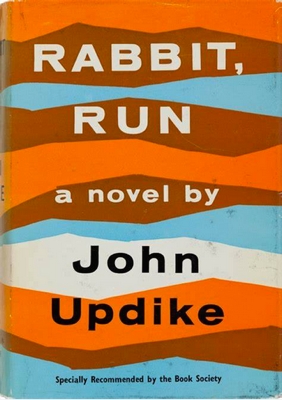
First U.K. Edition
The “about” tab says it all: “The concept of Colin’s Review is pretty self-explanatory. My name is Colin, and I review things. So, why should you care? Professional criticism is a dying industry. Ask any journalist or newspaper staff-writer and they’ll unfortunately tell you the same thing. However, there still exists a large contingency of readers who long for the golden era when criticism itself was just as artful as the topics the authors were reviewing. That’s what I strive to provide on this blog.”
So far he’s only reviewed four books (and Updike might be cringing somewhere to discover that Philip Roth’s Sabbath’s Theater merited an A while Rabbit, Run was awarded an A-), but Colin seems insightful, somewhat bold, and quite readable. In his review, after summarizing Updike’s first Rabbit novel in two sentences, Colin writes,
“It makes for a very funny premise, and when told through Updike’s extremely poetic and occasionally profound style, it makes for a very compelling read. After all, the masculine urge for escape is relatable to everyone. Or, rather, Updike’s such a talented writer that Rabbit’s masculine impulses are easy to empathize with. The further he self-destructs, the more human he becomes.
“Then again, Rabbit isn’t exactly the most likable protagonist . . . . Watching him constantly take advantage of those around him would be quite exhausting if it wasn’t for Updike’s wit and clarity. Not to mention the book’s present tense P.O.V., which keeps Rabbit’s cycle of assholery refreshing despite its repetition—an uncomfortable and entertaining read.
“Back in 1960, Rabbit, Run provided a fresh perspective: a window into the soul of American men disillusioned with the middle-class WASP lifestyle, searching for spirituality but lacking religion, obsessed with sex yet scared of commitment, desperate for meaning in a seemingly meaningless world. Admirable cowards, self-righteous fools.”
Colin notes that Updike had such an “immense” influence that “thousands of similar characters” have “taken up Rabbit’s running-away-from-family mantle. From American Pastoral to Cosmopolis to Five Easy Pieces, there’s no shortage of problematic white male protagonists. Then again, I can’t blame Updike for a half-century of imitators.”
The brisk review is made even brisker with sections on “Further Reading,” “Stray Observations (including Spoilers),” and “Quotes from Rabbit, Run.”
Read the full review
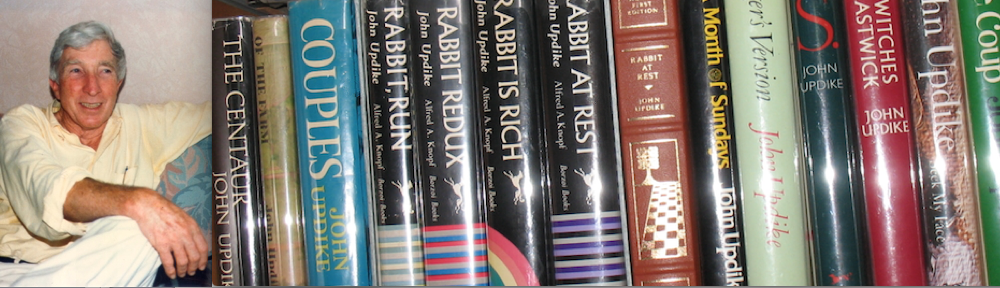
 In an opinion piece for The Times (UK), Benjamin Markovits writes that he doesn’t remember reading John Updike’s Rabbit, Run when it first came out in 1960, partly because he was “suspicious” of the book’s popularity and was hesitant about such things as the “breathless present tense” of the narrative or the opening scene that has Rabbit knocking down a jump shot without even taking off his double-breasted jacket. “But then, just recently, I reread it and was stunned again by how good it is. The basic story hasn’t grown old either.”
 Today’s Washington Post featured a Q&A, “Post critic Michael Dirda turns a page: Dirda discusses the life of a critic, and his decision for a change of pace after 30 years of weekly columns,” in which John Updike merited a brief mention.
 Updike Society member Lang Zimmerman was reading Salman Rushdie’s Knife: Meditations After an Attempted Murder (Random House, 2024) when he came upon a second-chapter account of the birth of the PEN America World Voices Festival:
 Jeff Werner, of
  Ditum reminded readers of the impetus behind Updike’s writing of the novel: “Jack Kerouac’s On the Road came out in 1957, and without reading it, I resented its apparent injunction to cut loose; Rabbit, Run was meant to be a realistic demonstration of what happens when a young American man goes on the road—the people left behind get hurt. There was no painless dropping out of the Fifties’ fraying but still tight social weave.”
 Chase Replogle, pastor of Bent Oak Church in Springfield, Mo., posted a chapter excerpt that didn’t make the final cut of his book, A Sharp Compassion. “I think it still matters, he wrote. “It is taken from the chapter on affirmation and examines how the church has been tempted to avoid what offends.”
 John Updike Society board member Sylvie Mathé was profiled in the series “Persistence of Character — Major interview: Archaeology of a journey” in e-Rea, electronic journal of studies on the English-speaking world. The series, published in French, tracks the breadth of an entire career of distinguished intellectuals, including early influences. An English translation exists in PDF form, but in a file to big to upload and no link to share. Here is the link to a French version online:
  Mathé talks about the full trajectory of her career, including the experience of spending her senior year in high school in Rock Island, Ill. “Compared to my final year in French, the amount of work was nothing like it was, nor the demands of the homework,” she told the interviewer. She shared that her host family was “extremely puritanical,” with the mother “surprised, even horrified, that I had read texts by Hemingway, or Sanctuary by Faulkner…It must be said that 1968 in a small town in Illinois was still the 50s. It had nothing to do with what was happening on campuses at the same time, with women’s lib, demonstrations against the Vietnam War, for civil rights, etc.” In summary, “Let’s say that compared to my final year in French, or my life in France, which was essentially focused on high school, work and success, it was a much more varied life, more entertaining…I was doing things I had never done before: I was caught up in the rhythm, I went to matches according to the football, basketball, baseball seasons,” and she dated, went to parties where there was drinking and marijuana brownies, and was generally inducted into American culture.
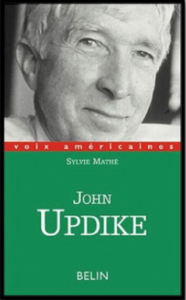 Mathé’s introduction to John Updike came when she went to Oxford and studied “Puritanism in John Updike’s Fiction” with Jeanne-Marie Santraud, “who was the only Americanist at Paris IV.” She would go on to write her master’s thesis on Updike and compose a monograph for the American Voices series edited by Marc Chénetier titled John Updike: Nostalgia for America.