 Sometimes the most interesting takes on an author come from great thinkers outside the field of literature. Such is the case with an article by Kali DuBois that was published in Medium: “What If Gore Vidal and John Updike Had a Lovechild? Why Chop Dog-Eared These Pages Like a Hungry Man on a Cheeseburger Vagina.”
“Gore Vidal and John Updike reshaped what it meant to be a man in America—and they did it from opposite ends of the battlefield,” wrote DuBois, who holds a Master’s degree in human sexuality and certifications in biological psychology, biofeedback, kinesiology, neuro-semantics, tantra, yoga, mind codes, and martial arts.
“Gore Vidal taught men that the personal was political, and that sex was never just about pleasure but about power. He forced men to see hypocrisy in the mirror, questioning the structures they benefitted from while often feeling trapped within them. He mocked American masculinity — its obsession with conquest, its fear of vulnerability, its addiction to empire — and invited men to see themselves not as rulers of the world but as products of it,” DuBois wrote.
“Vidal’s men were sharp, politically aware, often bisexual or morally fluid, understanding that identity was both a performance and a prison. He planted in men’s minds the belief that if you weren’t willing to challenge the system, you were part of it — and if you wanted freedom, you had to face uncomfortable truths about who you were, what you desired, and what you were complicit in.
“John Updike, meanwhile, told men it was okay to feel.
“His men were confused, lustful, terrified of aging, perpetually restless in their marriages, and looking for transcendence in the bodies of women they often did not deserve. Updike gave men permission to see their boredom, their longing, their sexual frustrations, not as shameful failings, but as a fundamental part of being alive.
“But he also left men with the belief that their inner turmoil was something the world should revolve around, that their dissatisfaction was profound, and that the search for pleasure and meaning in the domestic was a noble, if doomed, quest.
“Between them, these two men planted conflicting beliefs into American men:
- That sex is power (Vidal) and sex is salvation (Updike).
- That politics is personal (Vidal) and personal suffering is political enough (Updike).
- That masculinity is a performance to be deconstructed (Vidal) and masculinity is a tragic inheritance to be endured (Updike).
Men who read Vidal learned to distrust the system. Men who read Updike learned to distrust themselves. Together, they created a generation of men who wanted to be both aware and desired, critical and romantic, cynical and yearning.
Read the whole article.
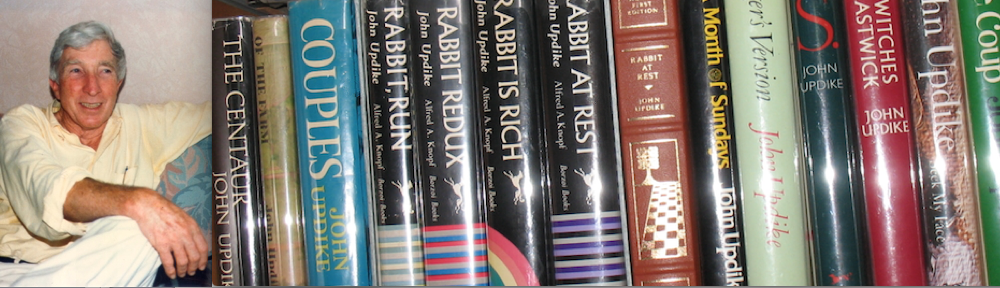
 “The critic Ted Gioia recently posted a Substack called Is Mid-20th Century American Culture Getting Erased? He noted that among those being forgotten are literary giants like John Cheever and Saul Bellow; musicians like Duke Ellington and Charlie Parker; and movies like Citizen Kane. John Updike not long ago was one of America’s most prominent living writers, yet reading him today would be, in Gioia’s words, ‘an act of rebellion.’



 John Updike Society president James Plath spent two weeks as a fall 2023 Quarry Farm Fellow working on an essay detailing how Twain modeled being a celebrity writer for both Hemingway and Updike. Plath conducted that research, but also felt compelled to write poems about the house and its inhabitants. Not surprisingly, Updike found his way into one of the poems:
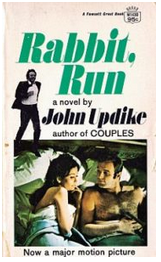 “His Rabbit quartet of novels . . . is among the peerless accomplishments of 20th century fiction in its chronicle of living through the confusion of the Viet Nam war, feminism, civil rights and the sexual revolution in the person of the series’ titular character, Rabbit Angstrom. Not deep of thought but rich in resentment, Angstrom was an analog of American culture itself, a congested vein of self-seeking that never recovered from the raw sensation of youthful vigor; Angstrom, like the country itself, resentfully fumbled about for years ruing the loss of vitality and trying to replace it with new things, the crabby possessiveness of the middle class.”
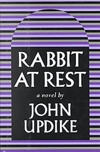 Heer had written, “Not too long ago, the Fourth of July was a festive occasion: a day of national celebration, hot dogs and parades, flag-waving and fireworks. John Updike memorialized the traditional July 4 holiday in Rabbit at Rest (1990), the