Updike’s Couples in the news again?

The Gothamist recently published a small news-muse item about an establishment in Berlin, Connecticut that was “busted for violating the town’s ordinances on sexually oriented businesses.”

Couple swapping is apparently legal there, but not charging an entry fee for swingers. “Gotta love suburbia,” The Gothamist wrote, adding, “John Updike literally wrote the book on couple swapping: Couples. And The Ice Storm featured key parties and wife-swapping (read the book or watch the film).”

Updike’s Rabbit Angstrom makes Goodreads’ 100 Best Books of All Time

“Popular” and “classic” are relative terms in the world of books, because the bottom line is often whether a book or an author is still being read. That appears to be very much the case with John Updike’s Rabbit Angstrom tetralogy. Updike’s story of an American middle-class Everyman landed on “Goodreads’ 100 Best Books of All Time” list. Goodreads’ lists are compiled by readers who visit the site and use it to rate books and chart their own reading progress.

See who else made the Goodreads’ 100 Best Books of All Time list.

Influential German musician cites Updike as an influence

A Time News entertainment piece spotlighted Bernd Begemann, a “‘boy from the provinces,’ as he never tires of emphasizing, from East Westphalia to be more precise. He was also the first punk in Bad Salzuflen. Tocotronic and all the economic champions of the Hamburg school would be unthinkable without Begemann and his urban folk-electro album called Rezession, Baby! from 1993. He is a pioneer and also a bit of a knight of the sad figure, he gallops through the musical landscape with his own unshakable personality, always a tip of his nose ahead, often a gallop too far.”

“In more than 20 albums and over 400 songs, he sings of love, preferring to be ‘twice second choice’ to being content with the monotony of monogamy. . . . The man in the gold silk shirt is a charmer and a crooner wild at heart and somehow, thanks to generosity, also a feminist, because he leaves women spoiled for choice in song and life. He admires Bert Kaempfert and offers Berlin, Passing, Barmstedt and Ostfildern insights into what is not so loud and garish in life: a big heart, a noble spirit, drama and cappricci. He sharpened his senses as a reader of Balzac, Updike and, quite gallantly, Prince Valiant, as he explains . . . . “

On John Updike, he said:

“A brilliant writer who seems unread today, which is a shame. Maybe because the kind of relationship his books are about doesn’t seem to exist anymore. But of course the patterns in monogamous couple relationships are still the same, they are the sweet futilities embedded in the structure of a neighborhood, a city, an economic cycle. John Updike shows us this with ease. He’s basically the Blueprint for Jonathan Franzen and so on.

“I think 1968’s Couples is Updike’s first big hit book, before the Rabbit series. At the time it was a silent revolution. There are no loud things happening in the book, no big explosions, no train derailments. He says how we live – and that’s breathtaking and that’s very dangerous, even though it looks so ordered. I appreciate the book very much.”

Voice of Protestant denominations recommends Updike novel

According to their website, “Day 1 with host Peter Wallace is the voice of the historic Protestant denominations. Through sermons, blogs, and video & audio resources, Day 1 proclaims God’s hope for a hurting and divided world. Formerly ‘The Protestant Hour.'”

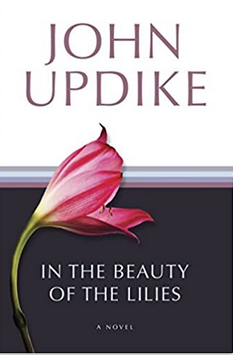
The lesson for June 13, 2023 was “Science for the Church: Summer 2023 Reading Favorites,” with one of the staff—Greg Cootsona—focusing on John Updike’s novel In the Beauty of the Lilies.

“Though I highlighted it previously in Christianity Today, the book is so good, my recommendation bears repeating,” Cootsona wrote. “Updike’s novel explores how certain technologies—particularly films—have affected American perceptions of what is real and what is transcendent. In the first of four sections, (each follows a different generation of the same family), the early 20th century Presbyterian pastor Clarence Wilmot “felt the last particles of faith leave him. The sensation was distinct—a visceral surrender, a set of dark sparkling bubbles escaping upward.” This happens at the very moment that the silent film actress, the 17-year-old Mary Pickford faints while filming at local landmark Lambert Castle.

“Clarence finds he can no longer serve as a Minister of Gospel and literally cannot speak when he’s called to deliver sermons. Instead, he seeks transcendence in watching the technological marvel of the silver screen. So, if you’re ready for a bit of Updike’s normal palette of sexual and other transgressions, I think you’ll find that this initial episode begins an eloquent and challenging narrative of American life as the novel’s characters seek to live out faith—or perhaps lose it—in an increasingly technological 20th century.”

Updike’s coven makes another best witch movie list

John Updike’s The Witches of Eastwick has become one of the author’s most popular books over the past decade, and maybe that’s because the 1987 film version has become a bit of a coven classic. Yesterday another list of top witch movies included the Eastwick bunch.

“The magic of Witch Movies: A Look at the best films about Witches,” by Deepak Kumar, was posted June 3, 2023 on the Fansided website. The George Miller-directed film was the fourth one listed, after The Witch (2015), The Craft (1996), and Hocus Pocus (1993). Of the film, Kumar wrote, “The Witches of Eastwick is a dark fantasy-comedy film released in 1987. Based on the novel by John Updike, the story is set in the fictional town of Eastwick, Rhode Island and centers around three women who unexpectedly discover they possess supernatural powers.” By getting divorced, one might add.

The film had plenty of star power, with Jack Nicholson as Daryl Van Horne, Cher as Alexandra Medford, Susan Sarandon as Jane Spofford, and Michelle Pfeiffer as Sukie Ridgemont. Future Best Actor Oscar nominee Richard Jenkins played Clyde Alden, editor of the local newspaper. Though it didn’t wow critics or audiences, The Witches of Eastwick received Oscar nominations for Best Sound and Best Original Score (John Williams). And it won a BAFTA for Best Special Effects.

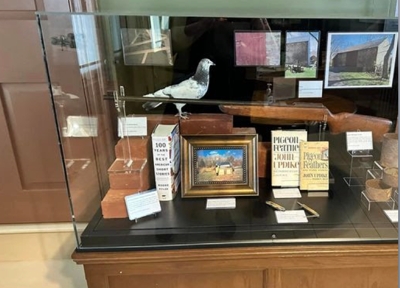
If you visit The John Updike Childhood Home in Shillington, Pa., look for The Witches of Eastwick original theater poster. Nearby, in a case that also contains items related to Updike’s appearance on The Simpsons, will be a concert program used as a prop in the film.

Daiquiri recipe article cites a Rabbit, Run passage

Given an article about the daiquiri, it would be reasonable for a lover of literature to expect to read about Ernest Hemingway and one of his two favorite Havana, Cuba bars: La Floridita, “Cradle of the Daiquiri cocktail.” The Floridita is here as a vintage photograph, but the writer mentioned isn’t “Papa” Hemingway, who is commemorated in a statue at that bar. Instead, the writer is John Updike.

In “The Spirits #17: The Cardamon Daiquiri,” Richard Godwin offered the recipe and added, “If you haven’t ever made a basic Daiquiri, please do so immediately – follow the recipe minus the cardamon. I figure with winter, you either need to lean into it or run away from it. Run away run away run away run away run away!” Which, of course, led him to Rabbit Angstrom.

“There’s a memorable double-date scene in John Updike’s Rabbit, Run, where our protagonist Harry Angstrom orders a Daiquiri in a Chinese restaurant because both of the girls have. He imagines it will taste like limeade…and finds it does sort of taste like limeade, ‘riding like oil on a raw transparent taste.’ He has a few more and when he emerges, ‘the pavement is a shadow of the Daiquiri’s luminous transparence; he is light-hearted, and skips once, to get in step with the girl he adores.’

“Like Updike’s midcentury hero, the Daiquiri (rum, lime, sugar) is simple and direct but capable of the greatest lyricism. When its constituent parts are held in perfect harmony, something amazing happens. The dogs lose their bark; the eels cease to reel; oil paintings come to life. And then everything resets and goes back to normal and everyone forgets that ever happened. There is a luminous transparence around, though, if you care to look.”

Universidad de Alcalá scholar considers overlooked Updike short story

Juan Manuel Camacho Ramos, of the Universidad de Alcalá, wrote an essay on “Tristan and Iseult,” an Updike short story that was published first in The New Yorker and later in his collection The Afterlife and Other Stories. “‘Tristan and Iseult’: John Updike’s Medieval Method or an Ancient Mirror for Modern Man” was recently made available online. Here is the link and the abstract:

“Updike began to explore the Tristan legend after reading Denis de Rougemont’s books Love in the Western World and Love Declared which he examined exhaustively in the early 1960s and, although he did not wholly agree with the entire content of Denis De Rougemont’s thoughts, it left a very deep impression on him. Consequently, Updike uses the story of Tristan and Iseult in three novels and several of his short stories mostly to deal with the issue of conjugal infidelity and to present the traditional themes of the legend like self-affirmation, social marginalization, indecision, despair, sexuality, life, and death in contemporary settings. In both his novels and short stories, Updike tries to modernize the legend dissecting marital conflict and generally showing adultery as the escape valve which will lead the lovers to the paradoxical world of unreal freedom where the mixture of intense passion and pain will finally threaten the family and the social order of the protagonists just like in the Tristan romances of old.”

Curiously, as Ramos noted, “The couple in this adaptation of the Tristan legend have nothing but a dental appointment in common. There is, moreover, no other objective explanation for Tristan’s attraction to Iseult apart from her motherly skills of caring for him and making him feel as if at home. . . . Magic is present in Updike’s ‘Tristan and Iseult’ to the extent that Tristan numbs his mind through fantasy creating a world where he can evade reality and live a dream. In ‘Tristan and Iseult’ Updike turns a dental appointment into a modernized medieval romance that happens solely in Tristan’s imagination. It contains a pathetic undertone that accompanies the story and is highlighted to the extent that Tristan is unaware of his own guile and Iseult remains ignorant of any event save her duty to remove the rot from her client’s mouth.”

Read the whole essay.

Martin Amis shared his thoughts on Jewish writers and alter egos

Forward, a nonprofit independent Jewish publication, published an article (“Jewish writers not only inspired Martin Amis—they made him want to become part of the family”) by Benjamin Ivry about English novelist Martin Amis, who died on May 19 at age 73. Ivry wrote that Amis “looked to America as a promised land for literary achievement, and to U.S. Jewish writers as inspirational overachievers.

“In his essays, even when praising the non-Jewish John Updike, Amis did so because Updike ‘alone could hold his head up with the great Jews—Bellow, Roth, Mailer, Singer—it was entirely typical of him that, as a sideline, be became a great Jewish novelist too, in the person of Henry Bech, the hero of several of his books,” Ivry wrote.

“Amis embraced the notion that by inventing Jewish characters, a writer might indirectly attain Yiddishkeit. Indeed, Amis clearly identified with Updike’s supposed claim that ‘by developing a Jewish persona [he] was saying something like: “Look, I’m really Jewish too. We’re all Jewish here.”‘

“So unlike non-Jewish writers of an earlier generation like Capote or Vidal who reacted to Jewish achievement in American literature with antisemitic sarcasm, Updike (and by extension Amis) decided to assimilate with the Jews.”

Read the full article.

Rabbit, Run and 74 other novels lauded for last lines

Jules Buono of The Literary Lifestyle published a list of “75 Famous Last Lines of Books That Make the Best Book Endings,” and John Updike’s title-specific last line of Rabbit, Run made the list . . . though you have to scroll down quite a ways to read Updike’s ending: “He Runs. Ah: runs. Runs.”

If Buono ever compiles a list of the best short story titles, odds are that Updike’s “Your Lover Just Called” will probably make the list.

In Memoriam: Ellen Gallagher

A remarkable Berks County woman died on May 16, 2023. Ellen Lou Gallagher (Brownmiller) was a beloved teacher who touched many lives, but she was also a student, artist, musician, playwright, quilter, and “almost an astronaut when she was a Pennsylvania finalist for the Teacher in Space program in 1985,” according to her obituary.

Her son, Drew Gallagher, told The John Updike Society that Ellen had “three organizations that were very dear to her and one was the Updike Childhood Home.” In lieu of flowers, the family requested that donations be made to those three organizations: The Reading Symphony, The John Updike Childhood Home, or The Kurt Vonnegut Museum. “Or simply read a favorite book or listen to a show tune in her honor. Try to remember when love was an ember about to billow. When everything was beautiful and nothing hurt. And so it goes.”

Born in West Reading on July 1, 1941, Gallagher graduated from Millersville State with a degree in education and added a Master’s degree from Temple University years later. “Ultimately she landed at Lorane Elementary School in Exeter as a fifth grade teacher. Her students will remember the annual incubation projects, waiting for the chicks to hatch in the classroom, and they will not forget learning what a million something looked like when they collected that many aluminum can pull tabs over many more school years than anticipated. There was a large ceremony at Lorane to commemorate the millionth pull tab and photos were taken and published in The Reading Eagle [where her late husband, Charles Gallagher, was longtime editor] before the tabs were recycled.”

Gallagher spent summer 1981 teaching children on the island of Majuro in the Marshall Islands and was an inspiration for a character in the young adult novel Me and Marvin Gardens, written by one of her former students, A.S. King.

Perhaps most remarkably, when she retired she had two goals: “learn to quilt and to play the violin. She was successful at both. As a member of the Reading Philharmonic Orchestra, she played the violin until she was unable and then became the narrator for their concerts up until her death.”

The John Updike Society is touched that a person who loomed so large in so many lives thought enough of John Updike and our little childhood home museum to name us as a donation beneficiary. Even in death, she continues to make a difference and set an example. Our deepest sympathies go out to her sons Drew and Thomas, her daughter Julie Stern, and their families.