Updike Society sponsors ALA panel on The Centaur

The Centaur was a big deal in 1963. The novel, which dealt with classical mythology on the surface of an otherwise realistic narrative, earned John Updike the National Book Award. His third novel (following The Poorhouse Fair and Rabbit, Run) turns 60 this year, and the American Literature Association panel on “The Centaur at Sixty: Updike’s Ulysses” will be reprised with a slightly different cast at the 7th Biennial John Updike Society Conference in Tucson this coming September.

As Stacy Olster noted in The Cambridge Companion to John Updike, “Updike’s willingness to assign tremendous significance to his childhood home reaches a crescendo in The Centaur, a powerful attempt to mythologize the artist’s early portrait by returning, as James Joyce did in A Portrait of the Artist as a Young Man (1916) and Ulysses (1922), to ancient Greek stories.”

Updike had told Charlie Reilly in 1986, “For The Centaur, I had Ulysses in my head at all times.” Eight years earlier Updike had remarked that “the book had its origins in a little children’s book of Greek mythology which my ex-wife had as a girl and which I was just reading around in. Somewhere in it, I came across this variant, this footnote almost, to the Centaur myth. . . . And I thought, well, this is an unusual myth, especially in the sense that so few Greek myths involve the idea of sacrificing or laying down one’s life for another. . . . So, I began with the myth, and then my own father very naturally attached himself to it because he sort of loomed as a centaur in my own life at that time. The novel really took off with the myth, and for that reason the myth is really in the foreground of the novel, not in the background as in Ulysses.”

The ALA conference panel in Boston featured (l to r) Peter Bailey, Jim Plath, David Updike, and Olga Karasik-Updike. David brought his mother’s first edition of The Centaur, which had inside it a telegram of praise from one of the Soviet Union’s most famous writers—a note that Karasik-Updike read and contextualized for the audience.

Martin Amis’ Updike tribute recalled

Lisa Allardice of The Guardian wrote a profile of Martin Amis (“‘Damn, that fool can write’: how Martin Amis made everyone up their game”) that was published on May 22, 2023 and featured an anecdote involving Amis’ response to John Updike’s passing.

“Back in 2009, I called Amis – as editors all over the world would have been calling or emailing leading writers on Saturday night – to ask if he might write a tribute to the American novelist John Updike, who had just died. Time was tight and we were aiming high, but as with every major (and not so major) event at that time, Amis was the writer everyone was after. And on Updike, the last postwar American literary giant? It had to be him. Happily, he felt a duty to contribute to what Gore Vidal called ‘book chat.’ ‘Call me back in 10 minutes,’ he said in his unmistakable transatlantic drawl (he hadn’t yet made America his permanent home). . . .”

“OK, so he had written at length about both Updike and Ballard before. And he was routinely invoked as a successor to both. . . . But to go back to 2009 and Amis’s closing words on Updike: ‘His style was one of compulsive and unstoppable vividness and musicality. Several times a day you turn to him, as you will now to his ghost, and say to yourself, “How would Updike have done it?” This is a very cold day for literature.’

“And so it is today. Younger writers will ask: ‘How would Amis have done it?’ He was exceptionally sui generis.”

Amis, who died in 2023, was best known for his novels Money, London Fields, and Time’s Arrow.

Updike typewriter now at the Childhood Home museum

John Updike’s Olivetti Linea 88—”the only manual typewriter he used regularly from 1969-2009,” according to his son, David Updike—is now on display at The John Updike Childhood Home, 117 Philadelphia Ave., Shillington, Pa.

The Childhood Home museum is owned by The John Updike Society, a 501c3 organization devoted to promoting Updike’s works. With Dr. Maria Lester as director, the museum is staffed by dedicated Updike lovers who live in the area.

The typewriter, acquired from Elizabeth Updike Cobblah and David, Michael and Miranda Updike, instantly became the crown jewel of the museum’s holdings. According to David, his father had bought/brought a white Adler typewriter to London in September 1968, but it “seemed inadequate—not sturdy enough. . . . A typewriter salesman came to the house, sold him on this Olivetti Linea 88, which he then bought and used for the rest of the year there.”

“It was big and heavy,” David said. “At the end of the school year, the green Citroen was being shipped across the ocean to us, and he had the idea to put the typewriter in the car too: thus, it made the voyage back to America, and my father used it for the rest of his life: Ipswich, Georgetown, Beverly Farms, and typed tens of thousands (I would guess) poems, short stories, letters, postcards, notes, many of which will soon be in the collection edited by Jim Schiff.

“At some point, he started to write longer letters on a word processor, but continued to use this one for shorter communications, all the way until January, 2009. It was in fine working order, and as you see it was serviced by a fellow in Beverly, Mass.”

Next to the typewriter is Updike’s dictionary, which he kept near his typewriter—a habit, no doubt, picked up from his mother. Linda Updike’s dictionary is also on display at the house.

Updike event in Ipswich features a plaque and “tats”

It was a long time coming, and Linda George Grimes, the woman who spearheaded the campaign to honor John Updike with a plaque, was not there to see the fruits of her labors. She passed away in March at age 66. But the Ipswich Historical Commission took over and Ipswich finally recognized its most famous resident on April 28, 2023.

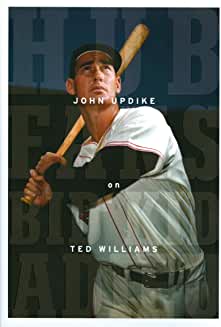
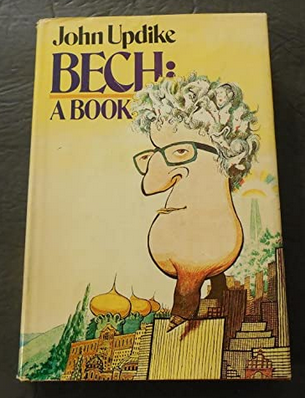
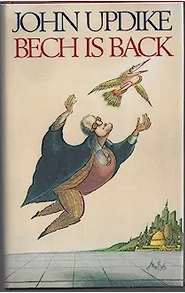
The plaque, which was mounted next to the Caldwell Building entrance that Updike took to reach his second-floor office, reads: “From 1960 to 1974, two-time Pulitzer Prize-winning author John Updike had an office in the Caldwell Building, where he wrote many acclaimed literary works, including ‘A&P,’ Bech: A Book, The Centaur, Couples, ‘Hub Fans Bid Kid Adieu,’ Midpoint, A Month of Sundays, Of the Farm and Rabbit Redux.”

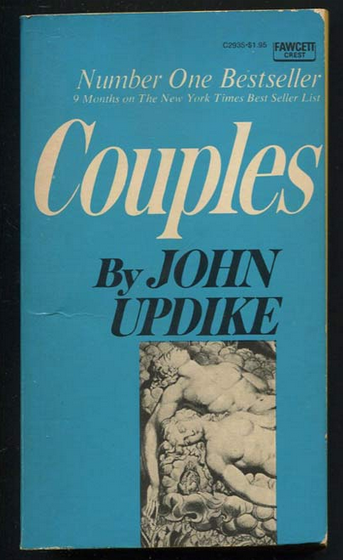
Couples, a 1968 novel, caused a stir in Ipswich because of its scandalous content: wife swapping. Some locals recognized themselves in the book, and the Updike family decided to spend the next year in London. Fittingly, there was just the slightest hint of scandalous behavior at the plaque unveiling, as grandchildren Trevor and Sawyer Updike proudly posed alongside the plaque to show matching tattoos of the self-portrait caricature their grandfather had drawn to accompany his Paris Review interview. The tattoos were on their thighs, which, of course, required that their trousers be dropped in order to show them off.

Trevor Meek covered the event for The Local News. Read the full story and see photos of the event.

Where everybody knows your name: Updike on Cheers?

John Updike never made a personal appearance on the long-running CBS-TV series Cheers, but the two-time Pulitzer Prizewinner was referenced several times in a Season One episode.

Cheers: The Complete Series Blu-ray was released on April 25, 2023, and as fans re-watched one of TV’s smartest sitcoms they heard Updike’s name mentioned several times in Episode 12: “The Spy Who Came in for a Cold One,” which aired Dec. 16, 1982. Earlier that year, in April, Updike had been announced as winner of the Pulitzer Prize for Fiction, honored for Rabbit Is Rich. In this episode, an eccentric (guest star Ellis Rabb, pictured below) visiting Cheers first pretends to be a spy, and then a writer. Thinking the man a literary prodigy, intellectual (read: snobbish) waitress Diane rushes to the phone to call someone in the publishing industry that she knows, and we get the following one-sided phone conversation:

“Yes. May I speak to him?

This is Diane Chambers.

He’s chatting with John Updike?

Well, interrupt.

No, I’m not kidding. I have something that makes Updike seem like small pommes de terre.”

Cheers was set in a bar near Boston Common that was run by former Red Sox pitcher Sam Malone (Ted Danson), whose baseball career had been derailed by alcoholism. With a great ensemble first-season cast that featured Shelley Long, Nicholas Colasanto, George Wendt, and John Ratzenberger, Cheers quickly grew on fans.

Cheers was created by James Burrows, Glen Charles, and Les Charles. Directed by Burrows, it was written mostly by the trio—though this particular episode was penned by David Lloyd.

Even with turnover in key roles, Cheers won 28 Primetime Emmys over its 11-year run and finished as a Top-10 TV show for eight of those years.

Fairway Philosophy blogger focuses on Updike the golfer

Fairway Philosophy blogger Matthew Chominski had Updike on the mind this past week. Two of his posts were devoted to Updike the golfer.

In an April 27, 2023 post, “Golf and the Shortness of Life,” Chominski wrote, “The great American author and golf devotee was once in the presence of a young woman who informed him that life was too short ‘for crossword puzzles and for golf.’ His responsory ruminations are worth quoting at length:

“‘The nature of humankind must be considered before we decide what life is too short for. Is it too short for sex, for instance, or is sex its business? Men and women need to play, and it is a misused life that has no play scheduled into it. Crossword puzzles, even, have a fit place in some psychological budgets. With them, as with golf, we set ourselves to solve a puzzle nature has not posed. Nothing in natural selection demands that we learn how to beat a small ball into a hole with a minimum number of strokes. . . . The great green spaces of a golf course remember the landscape in which the human animal found his soul. Certainly the sight of our favorite fairway wandering toward the horizon is a balm to the eyes and a boon to the spirit. Our mazy progress through the eighteen is a trek such as prehistoric man could understand, and the fact that the trek is fatiguingly long constitutes part of its primitive rightness.'” Read the whole post.

Then, on an April 29, 2023 post titled “Golf’s Peculiar Bliss,” Chominski reminded golfers and Updike fans of a video clip in which John Updike was filmed on his home course, Myopia Hunt Club, intercut with footage and a voiceover of Updike reading from his golf essays.

Ipswich announces details for April 28 Updike event

The Local News reported on April 12 that the Ipswich Historical Commission has finalized details for the John Updike plaque unveiling at the Caldwell Building, 15 S. Main St., in Ipswich, Mass. on April 28, 2023.

The plaque will be unveiled at the Caldwell Building next to the entrance leading up to the second floor, where Updike wrote in Suite #5 for many of the 17 years that the Updikes lived in this North Shore community. The ceremony is set for 6 p.m., rain or shine.

At 6:30 p.m., the Ipswich Public Library, 25 N. Main St., will host a reading of “A&P,” one of the most anthologized stories that Updike wrote in his Caldwell Building office above the Choate Bridge Pub. After that, local writers also will offer short readings on Ipswich, followed by an open mic.

From April 28-30 the Choate Bridge Pub will offer a special menu item in honor of Updike’s preferred lunch back when the the space was occupied by The Dolphin Restaurant: a pastrami sandwich with a side of pea soup. Just ask for the “P&P” special. That weekend the pub will also offer a special cocktail (“The Witches of Eastwick”) named for Updike’s popular novel. And who knows? Maybe the specials will catch on.

In Memoriam: Emerson Wicklein Gundy

Emerson Gundy, known to John Updike Society members as Updike’s second cousin and classmate who graduated from Shillington High School in 1950, passed away on April 4, 2023. He was 90.

According to his obituary, Emerson graduated from Temple University, served in the U.S. Army during the Korean War, worked for Conestoga Telephone Company, and was a U.S. Coast Guard Charter Captain who liked to fish on the Chesapeake Bay. A member of Robeson Evangelical Lutheran Church and Union Lodge No. 479 F&AM, Birdsboro, Emerson was also an avid hunter and private plane pilot.

From 1990-2014 Emerson and his wife, Marlene, owned the Updike family home in Plowville, and were enthusiastic and mindful caretakers of Updike’s legacy. They donated their papers (Emerson and Marlene Gundy Collection of John Updike Materials) to Alvernia University, and their collection of Updike books to The John Updike Childhood Home, where they are on display in the bedroom where Linda and Wesley Updike slept. Emerson specified that he wanted some of the books to be displayed so that Updike’s inscriptions could be seen, and the books will be rotated so that all of them can be viewed at some point.

When the society held their first conference in 2010, the Gundys graciously opened their home so that members could have a look inside the sandstone farmhouse where Linda Updike was raised and where she returned to live with the family when John was 13. Everyone who posed for a photo in front of the Gundys’ home will forever remember their generosity and geniality. Emerson’s passing leaves a hole in our hearts. On behalf of those and other members, we extend our heartfelt sympathies to Marlene and the family.

Inquirer spotlights John Updike Childhood Home

When John Updike was still alive, writer William Ecenbarger convinced the famed novelist to drive with him through Berks County to visit childhood haunts. That account first appeared in The Inquirer Sunday Magazine on June 12, 1983, and was reprinted in part in the first chapter of Adam Begley’s biography (Updike, HarperCollins 2014) and in full in John Updike’s Pennsylvania Interviews (Lehigh University Press, 2016).

Recently Ecenbarger returned to Shillington to write about Updike again—this time to see for himself how Updike’s beloved childhood home looks now that it has been turned into a museum.

In “Step inside Pulitzer Prize-winner John Updike’s childhood home in Shillington, Pa.,” which appeared in the Sunday, April 2 Inquirer, Ecenbarger wrote, “The house in Berks County, listed on the National Register of Historic Places, has been professionally restored to look as it did during Updike’s days here but the ‘John Updike Childhood Home’ museum is still a work-in-progress. They just received an Olivetti manual typewriter that was used by Updike.”

Ecenbarger added, “There are 10 rooms of exhibits, many with explanatory storyboards: Items owned by the Updikes and original to the house. His high school transcript shows nearly all A’s except physical education. Copies of The Chatterbox, the high school newspaper to which Updike contributed many articles. . . . Smiling down from the living room wall is a portrait of Updike done by Ernest Hemingway’s grandson, Edward.”

Ecenbarger wrote, “Updike was inconsolable when, at his mother’s insistence, the Updikes moved from 117 Philadelphia Avenue to a farm owned by her family. He wrote in a poem, ‘We have one home, the first.'” This home, once a source of pride for Updike, is now a source of pride for the community. Thanks to the efforts of director Maria Lester, close to 800 Berks County students toured the house last year to learn about one of Berks County’s most famous and accomplished residents. But Ecenbarger was right: the museum still is a work in progress. Seven new exhibit cases of unique items will be added within the next several months—reason enough to visit and revisit the place where Updike said his “artistic eggs were hatched.”

Writer recalls golfing with Updike, wants less AI, more Updike

In an opinion column (“Take That, ChatGPT!”) written for Boston Magazine, John D. Spooner voiced his reaction to a new artificial intelligence writing program and cited Updike as an example of “some things that only a human can do well. Writing is one of them.”

“John Updike was one of my gods,” Spooner wrote. “In my view, Updike was the greatest man of letters in America from the 1960s through the 1990s. He wrote novels and short stories. He wrote poems and essays. When he was president of the Harvard Lampoon, there were times when he wrote the entire issue. And illustrated it as well. He had gone to Oxford to study drawing. One of his classic pieces described Ted Williams’s last baseball game. ‘The Kid’ would never tip his hat to the crowd after a home run. He just ran the bases, with no expression and his classic, easy stride. Williams hit a home run that last day. He never acknowledged the fans. Updike wrote, ‘Gods do not answer letters.’ One of the greatest lines ever to describe an athlete.

“Amazingly, this most erudite of authors loved golf. A mutual friend arranged a game at Updike’s course, where they both belonged. I was excited about what I could ask him about his books, his life, and his insights on writing. But on the course, Updike was all business. It wasn’t ‘a good walk spoiled.’ It was his focus on the game, his game, and not about my favorite sport, ‘shootin’ the breeze.’ It was a drizzly day on the North Shore of Boston. Updike was polite, a gentleman on the course, long pants in the summertime. His swing was a manufactured one as if he had spent a lot of money on a lot of lessons, and it produced a routine with a lot of parts—a routine he completely focused on. We played for a few dollars, two players against two. The rain came down harder and harder, with no chance to ask my hero anything related to writing.

“We kept playing in the rain. Updike seemed, on every shot, to be replaying the lessons he had taken. The friend who had invited me to play said, ‘John is a focused dude. He goes through his routine like there’s no one else here. And he wants to win.’ My glasses were fogged up from the rain. Now I know that Updike was not going to give me any creative secrets, which, of course, I resented. So I did not want to fork over any money to my hero. My host, who was a really good player, said to me, ‘If we lose, it’s your fault.’

“We came to the 18th hole all even. Updike had a three-foot putt to win the match. It curled around the cup. And stayed out. I won two dollars, carried over from the front nine.

“We all shook hands and had a beer in the clubhouse. I figured that now was my chance to ask him about his writing life. But he tossed down his beer, got up, and said, ‘Nice playing with you, gentlemen.’ Updike walked out of the club bar. Gods do not answer letters.”

Updike’s favorite typewriter, a manual Olivetti Linea 88 made in Great Britain circa 1968-69. It will soon go on permanent display in The John Updike Childhood Home, 117 Philadelphia Ave., Shillington, Pa.