From blogger Thomas Swick:

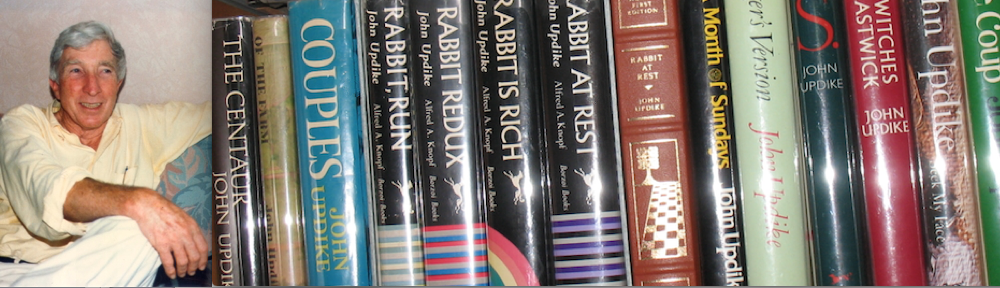
 Today’s Washington Post featured a Q&A, “Post critic Michael Dirda turns a page: Dirda discusses the life of a critic, and his decision for a change of pace after 30 years of weekly columns,” in which John Updike merited a brief mention.
Asked if he has a favorite instance of when one of his reviews led to correspondence with the book’s author, Dirda responded, “In general, I avoided getting to know authors I admired because then I’d have to recuse myself from reviewing their books. Still, I counted James Salter and Tom Disch as good friends, was something of a gossipy pen pal with A.S. Byatt, and enjoyed many long telephone conversations with Angela Carter. Among the best six or seven hours of my adult life were those I spent talking books and writers with Guy Davenport at his home in Lexington, Kentucky. I was also gobsmacked when John Updike sent me a two-page letter complimenting me about my memoir, An Open Book.
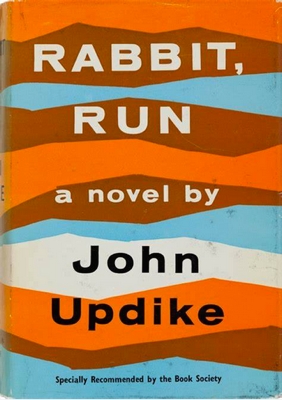
First U.K. Edition
The “about” tab says it all: “The concept of Colin’s Review is pretty self-explanatory. My name is Colin, and I review things. So, why should you care? Professional criticism is a dying industry. Ask any journalist or newspaper staff-writer and they’ll unfortunately tell you the same thing. However, there still exists a large contingency of readers who long for the golden era when criticism itself was just as artful as the topics the authors were reviewing. That’s what I strive to provide on this blog.”
So far he’s only reviewed four books (and Updike might be cringing somewhere to discover that Philip Roth’s Sabbath’s Theater merited an A while Rabbit, Run was awarded an A-), but Colin seems insightful, somewhat bold, and quite readable. In his review, after summarizing Updike’s first Rabbit novel in two sentences, Colin writes,
“It makes for a very funny premise, and when told through Updike’s extremely poetic and occasionally profound style, it makes for a very compelling read. After all, the masculine urge for escape is relatable to everyone. Or, rather, Updike’s such a talented writer that Rabbit’s masculine impulses are easy to empathize with. The further he self-destructs, the more human he becomes.
“Then again, Rabbit isn’t exactly the most likable protagonist . . . . Watching him constantly take advantage of those around him would be quite exhausting if it wasn’t for Updike’s wit and clarity. Not to mention the book’s present tense P.O.V., which keeps Rabbit’s cycle of assholery refreshing despite its repetition—an uncomfortable and entertaining read.
“Back in 1960, Rabbit, Run provided a fresh perspective: a window into the soul of American men disillusioned with the middle-class WASP lifestyle, searching for spirituality but lacking religion, obsessed with sex yet scared of commitment, desperate for meaning in a seemingly meaningless world. Admirable cowards, self-righteous fools.”
Colin notes that Updike had such an “immense” influence that “thousands of similar characters” have “taken up Rabbit’s running-away-from-family mantle. From American Pastoral to Cosmopolis to Five Easy Pieces, there’s no shortage of problematic white male protagonists. Then again, I can’t blame Updike for a half-century of imitators.”
The brisk review is made even brisker with sections on “Further Reading,” “Stray Observations (including Spoilers),” and “Quotes from Rabbit, Run.”
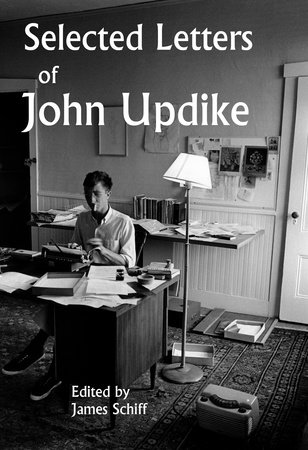 Knopf, now a division of Penguin-Random House, just released cover art for Selected Letters of John Updike, edited by Updike scholar and John Updike Society vice-president James Schiff. The hefty hardcover (900 pages) is roughly 6×9″ and slated for October 21, 2025 release. A book release event and signing will be scheduled as part of the joint Roth-Updike societies’ conference in New York City, Oct. 19-22. Those who plan on attending should count on getting a copy in NYC.
From the Penguin-Random House website, which offers purchase links to Amazon, Barnes & Noble, Books A Million, Bookshop.org, Hudson Booksellers, Powell’s, Target, and Walmart:
“The arc of literary giant John Updike’s life emerges in these luminous daily letters to family, friends, editors and lovers—a remarkable outpouring over six decades, from his earliest consciousness as a writer to his final days
“As James Schiff writes in the introduction to this volume, of the writer who would eventually express himself in written form as copiously and as elegantly as any American writer before him, ‘Updike needed to write the way the rest of us need to breathe or eat.’ With his stunning rhetorical gifts—allowing him to thrive in both fiction and nonfiction, in criticism as well as poetry—he was also a consummate letter writer. From his early writing attempts (he began submitting work to magazines as a teenager) to the 150 eye-opening letters home when he left the farm and family to go to Harvard, to the young adult correspondence with The New Yorker and other publications where his work began to appear, and on into the fullness of a long literary life, his correspondence, Schiff notes,’figures not as an adjunct to but rather an integral part of his astonishing literary output.’
Gertrude and Claudius, John Updike’s “prequel” to Shakespeare’s Hamlet, has sparked interest ever since it was published in 2000—which means it’s celebrating a silver anniversary this year . . . and still golden.
Grace Tiffany named it “Best Fictional Adaptation of Hamlet Which Excludes Hamlet” in her Literary Hub article “The Best of the Bard: Nine Literary Works That Radically Reimagine Shakespeare.”
 Of Updike’s novel she writes, “Mining, as did [Dorothy] Dunnett, some of Shakespeare’s own sources, Updike relied partly on Saxo Grammaticus’ twelth-century saga of Amlothi for details about the characters on which his Danish king and queen are based.
“We meet Hamlet Senior in the flesh (rather than as a ghost), and get to know some secrets that the play keeps hidden: like, exactly how long has Gertrude been fooling around with her late husband’s brother? Updike’s eloquence is consistent, and it’s fascinating to assess the character of Hamlet—who, when on stage, won’t stop talking to us—from the kind of partial, side view first presented (more comically than here) by Tom Stoppard’s play Rosencrantz and Guildenstern Are Dead.
“In Updike’s work as in Stoppard’s, Hamlet is mostly absent, a mournful and silent young man when he finally appears. The focus is on Claudius and Gertrude, and their mutual obsession. An unforgettable scene is one in which Claudius crawls through mud and worse into a barricaded garden, to perform the murderous deed to which Hamlet is aftermath. We already know what’s going to happen, but Updike’s writing compels us to turn the page.”
Read what Tiffany has to say about the other eight recommended literary turns on Shakespeare.
 Sixties’ icon Marianne Faithfull, a singer-songwriter who was considered a major figure in the so-called “British Invasion” of U.K. music to hit the U.S. during the turbulent decade, died Jan. 30, 2025. But before her death, Faithfull, who came from an intellectual family, shared her Top 10 list of books.
Updike’s Rabbit Angstrom ranked pretty high on her list:
 Updike Society member Lang Zimmerman was reading Salman Rushdie’s Knife: Meditations After an Attempted Murder (Random House, 2024) when he came upon a second-chapter account of the birth of the PEN America World Voices Festival:
Rushdie wrote, “I’ll just say that if Norman Mailer hadn’t been president of PEN back in 1986—if he hadn’t raised a ton of money and invited a glittering array of the world’s greatest writers to New York City for that legendary Congress at which Günter Grass and Saul Bellow got angry with each other about poverty in the Bronx, and John Updike used the little blue mailboxes of America as a metaphor of freedom and his coziness irritated a substantial segment of the audience, and Cynthia Ozick accused the American ex-chancellor Bruno Kreisky (a Jew himself) of anti-Semitism because he had met with Yasser Arafat, and Grace Paley got angry with Norman for putting too few women on the panels, and Nadine Gordimer and Susan Sontag disagreed with Grace because ‘literature is not an equal opportunity employer’ . . . .”
 Jeff Werner, of Patch, writes that the editors of Neshaminy: The Bucks County Historical and Literary Journal nominated two essays for The Pushcart Prizes, as literary magazines are allowed to do. One, by Lee Bigelow Davis and Melissa D. Sullivan, was on “Operation ’64: A Matter of Civic Pride.” The other was an essay by Don Swaim: “John Updike—One Walks by Faith, and One Writes by Faith.”
Swaim’s essay was published in the Fall/Winter 2024 issue of Neshamany: The Bucks County Historical and Literary Journal.
We are saddened to report that Victor Amos Kroninger, Jr. died at age 93 in his home in Blandon on Jan. 10, 2025. He was the son of Rev. Victor Kroninger, the pastor at Grace Lutheran Church when young John Updike attended services and went to Sunday School as a child.
Victor Jr. graduated from Shillington HIgh School a year before Updike, and later attended Muhlenberg College and The Lutheran Theological Seminary in Philadelphia. Like his father, he became a minister, serving in parishes in Bethlehem, Pottstown, Philadelphia, and Robesonia. In retirement, he assisted at Ziegels Lutheran Church in Breinigsville.
 As his Reading Eagle obituary noted, “In 1994, he received the MVP award from the American Motorcycling Association ‘In recognition of valuable contributions in the interest of motorcycling.’ His joy was to treat seniors to motorcycle mini-rides. His claim to fame was John Updike’s reference to him as ‘the preacher’s son, bombing around town on a motorcycle’ in John’s novel Rabbit, Run. He enjoyed youth ministry and took many teen groups on bicycle overnight ventures . . . notably Lancaster County, Philadelphia, and once with Ziegels youth in Manhattan. In later years, he led his family band, Psalm 150, in singing “A New Song” across two synods.”
Updike Society members who attended the very first conference in Reading may remember Victor Jr. for sharing his memories of his father and John Updike when conference attendees visited Grace Lutheran.
We extend our deepest sympathies to his wife, Jeanean; sons Mark, Matt, and John; three grandchildren; and sister Anne.
