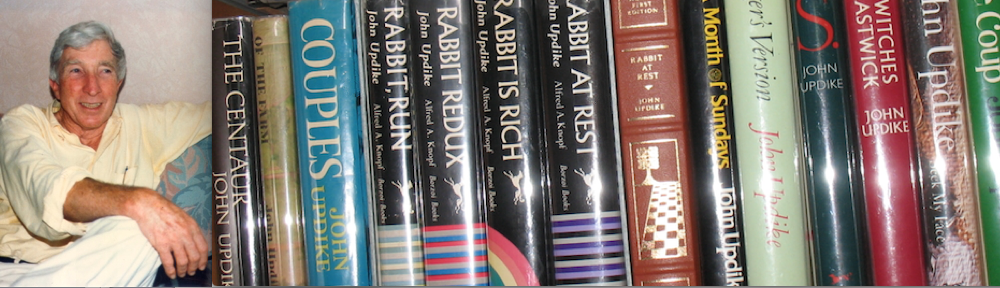
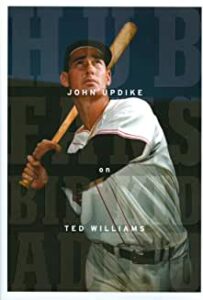
 As part of a grand centennial year celebration, an episode of The New Yorker Radio Hour featured “Louisa Thomas on a Ballplayer’s Epic Final Game,” a remembrance that “naturally gravitated to a story about baseball with a title only comprehensible to baseball aficionados: “Hub Fans Bid Kid Adieu.” The essay was by no less a writer than the author John Updike, and the “Kid” of the title was Ted Williams, the Hall of Fame hitter who spent nineteen years on the Boston Red Sox. By happenstance, Updike joined the crowd at Fenway Park for Williams’s last game before his retirement, in 1960. Thomas, looking at subtle word changes that Updike made as he was working on the piece, reflects on the writer’s craft and the ballplayer’s. ‘Marginal differences really matter,’ she says. ‘And it’s those marginal differences that are the difference between a pop-up, a long fly, and a home run. Updike really understood that, and so did Williams.’
Excerpts from ‘Hub Fans Bid Kid Adieu,’ by John Updike, were read by Brian Morabito.”
 “Welcome to a distinguished residence where historic charm meets modern comfort. Spanning 2 grand Back Bay townhouses, this home offers city living at its finest. Originally built for the Lowell family & later home to John Updike, 151 Beacon features 3 bedrooms, 2.5 baths, & over 2,000 sq. ft. of sophisticated living space. Enjoy direct elevator access, a formal living room w/ gas fireplace, custom built-ins, & oversized windows framing picturesque Beacon Street views. The open-concept kitchen, enhanced by bay windows w/ striking John Hancock Tower views, boasts a central island & a second gas fireplace. The primary suite offers a luxurious retreat w/ an oversized walk-in closet & spacious ensuite bath. 2 additional bedrooms, a powder room, in-unit laundry, & two separate AC/heat units complete the layout. Set in a professionally managed, boutique building of just 6 residences, this home includes 1 tandem parking space & is around the corner from some of Bostons Historic landmarks.”
 British writer Diana Evans has written four acclaimed novels and, more recently, a collection of essays titled
  “There are thus good arguments for the premise of John Updike’s Gertrude and Claudius that Hamlet’s father is the truly evil person in the play, and that his injunction to Hamlet is an obscenity. Updike’s novel is a prequel to Shakespeare’s play: Gertrude and Claudius are engaged in an adulterous affair (Shakespeare is ambiguous on this point), and this affair is presented as passionate true love. Gertrude is a sensual, somewhat neglected wife, Claudius a rather dashing fellow, and old Hamlet an unpleasant combination of brutal Viking raider and coldly ambitious politician. Claudius has to kill the old Hamlet because he learns that the old king plans to kill them both (and he does it without Gertrude’s knowledge or encouragement). Claudius turns out to be a good, generous king; he lives and reigns happily with Gertrude, and everything runs smoothly until Hamlet returns from Wittenberg and throws everything out of joint. Whatever we imagine as the (fictional) reality of Hamlet, Gertrude is the only kindhearted and basically honest person in the play.”
 For this entry we need to thank writer
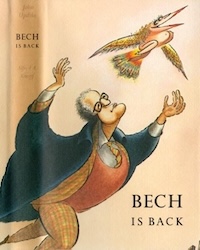 Coming in at #2 was Donald Sassoon’s Becoming Mona Lisa, which traces the path to superstardom of Leonardo da Vinci’s most famous subject/painting—a study that Brown said “suggests that, contrary to popular and scholarly belief, posterity is a peculiarly fickle thing.”
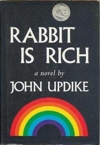 “The third installment of John Updike’s ‘Rabbit’ series finds Harry ‘Rabbit’ Angstrom finally comfortable—or at least financially secure—amid the tumultuous backdrop of 1979’s oil crisis and stagflation. ‘How can you respect the world when you see it’s being run by a bunch of kids turned old?’ the narrator observes, capturing the novel’s eerie contemporary resonance: interest rates and real-estate climbing skyward—and staying there—and a gnawing certainty that the next generation won’t have it quite so good. Updike’s prose transforms the mundane rhythms of middle-class life into something approaching poetry as he excavates middle-class anxiety and success. Rabbit’s car dealership is printing money thanks to the Japanese vehicles he sells, even as his own prejudices and racial anxieties bubble beneath the surface. His son Nelson is adrift, the world seems to be coming apart at the seams and Rabbit’s own biases reflect the tensions of a changing America. The novel won Updike both the Pulitzer Prize and the National Book Award for its devastating precision in capturing what it means to ‘make it’ while watching the ladder get pulled up behind you.”
 Thomas wrote, “On a dreary Wednesday in September, 1960, John Updike, ‘falling in love, away from marriage,’ took a taxi to see his paramour. But, he later wrote, she didn’t answer his knock, and so he went to a ballgame at Fenway Park for his last chance to see the Red Sox outfielder Ted Williams, who was about to retire. For a few dollars, he got a seat behind third base.