 Sometimes the most interesting takes on an author come from great thinkers outside the field of literature. Such is the case with an article by Kali DuBois that was published in Medium: “What If Gore Vidal and John Updike Had a Lovechild? Why Chop Dog-Eared These Pages Like a Hungry Man on a Cheeseburger Vagina.”
“Gore Vidal and John Updike reshaped what it meant to be a man in America—and they did it from opposite ends of the battlefield,” wrote DuBois, who holds a Master’s degree in human sexuality and certifications in biological psychology, biofeedback, kinesiology, neuro-semantics, tantra, yoga, mind codes, and martial arts.
“Gore Vidal taught men that the personal was political, and that sex was never just about pleasure but about power. He forced men to see hypocrisy in the mirror, questioning the structures they benefitted from while often feeling trapped within them. He mocked American masculinity — its obsession with conquest, its fear of vulnerability, its addiction to empire — and invited men to see themselves not as rulers of the world but as products of it,” DuBois wrote.
“Vidal’s men were sharp, politically aware, often bisexual or morally fluid, understanding that identity was both a performance and a prison. He planted in men’s minds the belief that if you weren’t willing to challenge the system, you were part of it — and if you wanted freedom, you had to face uncomfortable truths about who you were, what you desired, and what you were complicit in.
“John Updike, meanwhile, told men it was okay to feel.
“His men were confused, lustful, terrified of aging, perpetually restless in their marriages, and looking for transcendence in the bodies of women they often did not deserve. Updike gave men permission to see their boredom, their longing, their sexual frustrations, not as shameful failings, but as a fundamental part of being alive.
“But he also left men with the belief that their inner turmoil was something the world should revolve around, that their dissatisfaction was profound, and that the search for pleasure and meaning in the domestic was a noble, if doomed, quest.
“Between them, these two men planted conflicting beliefs into American men:
- That sex is power (Vidal) and sex is salvation (Updike).
- That politics is personal (Vidal) and personal suffering is political enough (Updike).
- That masculinity is a performance to be deconstructed (Vidal) and masculinity is a tragic inheritance to be endured (Updike).
Men who read Vidal learned to distrust the system. Men who read Updike learned to distrust themselves. Together, they created a generation of men who wanted to be both aware and desired, critical and romantic, cynical and yearning.
Read the whole article.
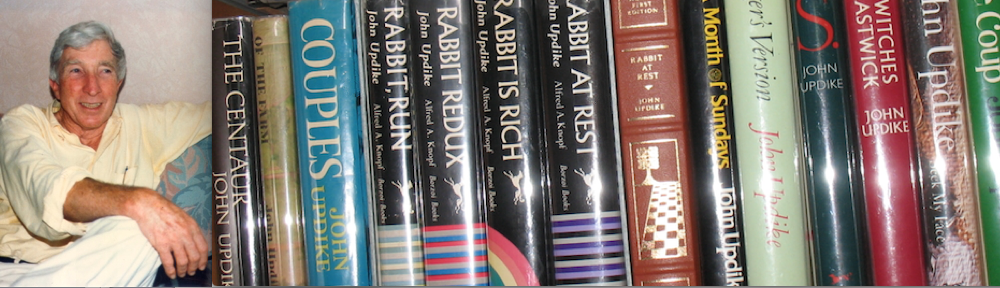
 John Updike Society president James Plath spent two weeks as a fall 2023 Quarry Farm Fellow working on an essay detailing how Twain modeled being a celebrity writer for both Hemingway and Updike. Plath conducted that research, but also felt compelled to write poems about the house and its inhabitants. Not surprisingly, Updike found his way into one of the poems:
 The remaining letters are directed to various editors, his parents (whom he addresses as “Plowvillians”), and others that collectively give some sense of his relationship with The New Yorker. The final letter, addressed to fiction editor Deborah Treisman, is a poignant one, given that it was written just 17 days before Updike passed away:
 Heer had written, “Not too long ago, the Fourth of July was a festive occasion: a day of national celebration, hot dogs and parades, flag-waving and fireworks. John Updike memorialized the traditional July 4 holiday in Rabbit at Rest (1990), the
  “John Updike’s 1960 novel introduced readers to Harry ‘Rabbit’ Angstrom, perhaps the most iconic character in suburban literature. Harry ‘Rabbit’ Angstrom is a middle-class man who feels there is something missing from his life. The novel follows Rabbit as he flees his suburban responsibilities—his pregnant wife, his job, his entire life—in a desperate attempt to recapture the vitality of his youth. Frank Wheeler, Piet Hanema, Frank Bascombe – these are a handful of the suburban men in the fiction of Richard Yates, John Updike, and Richard Ford. These writers all display certain characteristics of the suburban novel in the post-WWII era: the male experience placed at the forefront of narration, the importance of competition both socially and economically, contrasting feelings of desire and loathing for predictability, and the impact of an increasingly developed landscape upon the American psyche and the individual’s mind. Updike’s genius was in making Rabbit both sympathetic and infuriating—a man whose suburban malaise drives him to make increasingly destructive choices. The novel launched a series that would span four decades, chronicling the evolution of suburban America through one man’s journey.”
 The issue was negative versus positive reviews. Christopher Lehmann-Haupt’s New York Times review was cited as an example of the former, with Lehmann-Haupt arguing that “by repeatedly invoking Catch-22 Mr. O’Brien reminds us that Mr. Heller caught the madness of war better, if only because the logic of Catch-22 is consistently surrealistic and doesn’t try to mix in fantasies that depend on their believability to sustain. I can even imagine it being said that
 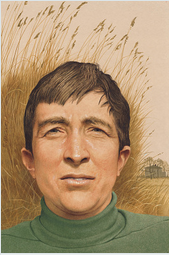 “American novelist John Updike claimed not to write for ego: ‘I think of it more as innocence. A writer must be in some way innocent.’ We might raise an eyebrow at this, from the highly successful and famously intrusive chronicler of human closeness. Even David Foster Wallace, the totem effigy of literary chauvinism, denounced Updike as a ‘phallocrat.’ But if we doubt such innocence of Updike, pronouncing as he was at the flushest height of fiction’s postwar heyday, we might believe it of these new novelists, writing as they are and when they are. Without a promise of glory, and facing general skepticism, they have written from pure motives. They are novelists as Updike defined them: ‘only a reader who was so excited that he tried to imitate and give back the bliss that he enjoyed’.