Updike book a perfect read for the Covid holidays?

As the pandemic rages on, many people are tending toward rage as well. Or at least a profound feeling of being “over it all.” Or disappointment that the usual holiday gatherings had to be abandoned. But the 746 Books blog reminds us that John Updike’s offbeat Christmas book might be just what the epidemiologist ordered.

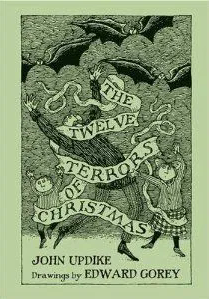
In “Alternative Christmas Reading!” 746 Books recommends Updike’s The Twelve Terrors of Christmas:

“John Updike’s wry observations paired with Edward Gorey’s off-kilter illustrations make for a decidedly different festive reading experience! From impractical miniature reindeer to alcoholic Santa’s Updike expores the more disappointing side of this most wonderful time of the year!”

New Updike monograph by Fromer now available for pre-order

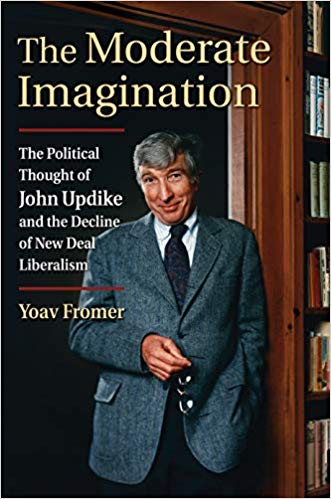
The Moderate Imagination: The Political Thought of John Updike and the Decline of New Deal Liberalism, a monograph by John Updike Society member Yoav Fromer, is now available for pre-orders at Amazon.com.

Scheduled for June 12, 2020 publication by the University Press of Kansas, the new critical work on Updike is 288 pages, hardcover, and priced at $39.95.  Here’s the description:

“In the aftermath of Donald Trump’s victory in 2016, Americans finally faced a perplexing political reality: Democrats, purported champions of working people since the New Deal, had lost the white, working-class voters of Middle America. For answers about how this could be, Yoav Fromer turns to an unlikely source: the fiction of John Updike. Though commonly viewed as an East Coast chronicler of suburban angst, the gifted writer (in fact a native of the quintessential rust-belt state, Pennsylvania) was also an ardent man of ideas, political ideas—whose fiction, Fromer tells us, should be read not merely as a reflection of the postwar era, but rather as a critical investigation into the liberal culture that helped define it.

“Several generations of Americans since the 1960s have increasingly felt ‘left behind.’ In Updike’s early work, Fromer finds a fictional map of the failures of liberalism that might explain these grievances. The Moderate Imagination also taps previously unknown archival materials and unread works from his college years at Harvard to offer a clearer view of the author’s acute political thought and ideas. Updike’s prescient literary imagination, Fromer shows, sensed the disappointments and alienation of rural white working- and middle-class Americans decades before conservatives sought to exploit them. In his writing, he traced liberalism’s historic decline to its own philosophical contradictions rather than to only commonly cited external circumstances like the Vietnam War, racial strife, economic recession, and conservative backlash.

“A subtle reinterpretation of John Updike’s legacy, Fromer’s work complicates and enriches our understanding of one of the twentieth century’s great American writers—even as the book deftly demonstrates what literature can teach us about politics and history.”

Updike’s Rabbit named one of The 100 Greatest Literary Characters

The characters aren’t ranked, but John Updike’s most famous fictional creation, Harry “Rabbit” Angstrom, made the cut to be included in The 100 Greatest Literary Characters, published July 2019 by Rowman & Littlefield.

The authors of the volume—James Plath, Gail Sinclair, and Kirk Curnutt—considered previous lists, plus recommendations from 100 writers, librarians, teachers, and book lovers they polled in order to come up with a list of “characters who have become larger than their lives on the page”—those that are “time-honored reader favorites, prototypes, and cultural influencers . . . who have somehow entered the collective public consciousness, ones who were influential models for others to follow, and ones who have been so popular with readers that they have become significant, memorable, or even cherished.”

Of Rabbit, Plath writes, “Literature is full of heroes and antiheroes, but Harry ‘Rabbit’ Angstrom is uniquely average—a flawed, irrepressible, and often unlikable human being who is still somehow so endearing to audiences worldwide that one novel couldn’t contain him.” He’s “unfaithful, impulse driven, prejudiced, and old-fashioned when it comes to women. But he is a seeker, a quester of truth. With a healthy libido and appetite for life, Rabbit, though in many ways a typical American male, nonetheless manages to see everyday objects and people in a more brilliant and illuminating light than the average person. He has never lost his childlike sense of wonder—a rare quality that draws people toward him.”

The author with the most characters in the book is Charles Dickens, whose Miss Havisham, Ebenezer Scrooge, and Oliver Twist were included. Among Updike’s contemporaries, Toni Morrison had two (Pilate Dead and Sethe), while Philip Roth and Saul Bellow had one each (Alexander Portnoy and Eugene Henderson, respectively).

The book is available from Amazon.


Updike cited in new Adam Gopnik book

In reviewing Adam Gopnik’s A Thousand Small Sanities: The Moral Adventure of Liberalism, Howard Schneider writes that Gopnik celebrates liberalism and argues that liberalism “has been the source of all that’s civically decent and humane in the world for at least the last two centuries.” Schneider also takes exception with Gopnik’s characterization of John Updike, who is referenced in the volume:

“Two perhaps nitpicking points, but I think the author is wrong about them. Was John Updike really ‘religiously obsessed’? Yes, some of his novels incisively assay religiosity, but he was too urbane to be besotted with religion. Gopnik also suggests that good science can’t thrive in a tyranny. Nazi Germany and North Korea, unfortunately, prove otherwise.”

“A Thousand Small Sanities: The Moral Adventure of Liberalism”

Updike essay on Gene Kelly included in new dance anthology

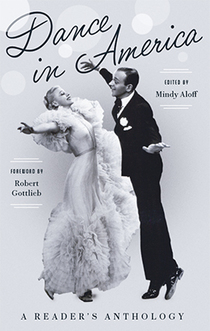
John Updike is no stranger to subscribers of the Library of America series, but this time he’s just one contributor out of many. For Dance in America: A Reader’s Anthology, dance critic Mindy Aloff has assembled a collection of essays and other forms written by “dancers and dance creators, impresarios and critics, and enthusiastic literary observers” to tell the story of dance in America “from tap and swing to ballet and modern dance, from Five Points to Radio City Music Hall, and from the Lindy Hop to Michael Jackson’s Moonwalk.”

Among the contributors are Edwin Denby, Joan Acocella, Lincoln Kirstein, Jill Johnston, Clive Barnes, George Balanchine, Merce Cunningham, Paul Taylor, Twyla Tharp, Allegra Kent, Mikhail Baryshnikov, Ralph Waldo Emerson, Emily Dickinson, Hart Crane, Edmund Wilson, Langston Hughes, Susan Sontag, Stuart Hodes, Alastair Macaulay, Zora Neale Hurston, Arlene Croce, Yehuda Hyman, and Updike. Updike’s essay is on “Genial, Kinetic Gene Kelly.”

Here’s the LOA link to purchase

Read Rabbit, Run when you’re 41?

That’s what The Washington Post Book World staff concluded. At age 41, “You may feel like fleeing sometimes, but remember: Selfishness is not a victimless crime.” So read John Updike’s best-known novel, Rabbit, Run at that age, they say.

“Books for the Ages” is a fun new addition to the recommended books lists that pop up with the frequency of yard dandelions. At age 1, the Book World staff suggests you try The Very Hungry Caterpillar by Eric Carle. At Sweet Sixteen, turn to Jane Eyre because “Nobody understands you and your terribly unfair life. Reader, you are not alone.” At 18, it’s Lorrie Moore’s A Gate at the Stairs that they recommend, because “There are many important lessons to learn in college, not all of them from books.” At 21? What else besides Hemingway’s The Sun Also Rises: “You’re old enough to drink and carouse with your friends. Isn’t it pretty to think so?”

Not all the recommended books are fiction. When you turn 65, the authors recommend reading 65 Things to Do When You Retire, edited by Mark Evan Chimsky. “If you need ideas, Jimmy Carter, Jane Fonda and Gloria Steinem have suggestions.” And if you make it to age 100? Sailor and Fiddler: Reflections of a 100-Year-Old Author by Herman Wouk. “Life is a wonderful adventure. Books make it even better.”

Member’s new book offers creative resources for churches

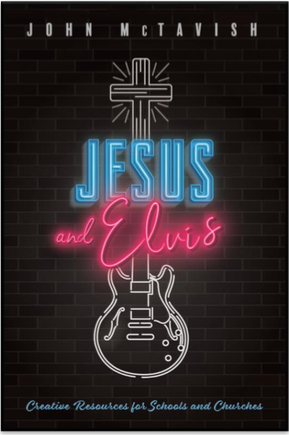
John McTavish, a United Church of Canada minister and longtime member of The John Updike Society, has included three Updike poems in his new book: Jesus and Elvis: Creative Resources for Schools and Churches. In addition to the title poem, “Jesus and Elvis,” there are reprints of “Perfection Wasted” and “Seven Stanzas at Easter,” along with McTavish’s commentary on all three.

The book is intended to offer “a host of creative resources for use in schools and churches. . . . Categories include poems, plays, hymns, prayers, pictures, a communion service, participatory readings, and essays.”

One of the blurb writers for the book, Catherine MacLean, the senior minister at St. Paul’s United Church, notes that “John Updike’s poem ‘Jesus and Elvis’ glitters among the gems” and describes McTavish’s book as a “wide range of reflective and performance material” that “brings together biblical traditions, ethics, and contemporary life—a shining collection.”

Here’s the Amazon link to the book.

New Updike publication in Portuguese

Member Carla Ferreira, who is an associate professor in the Literature and Language Department at Federal University of Sao Carlos, Brazil, reports that her dissertation has been published in book form.

The title is North and South Readings: Perception of Oneself and the Other in Updike’s Fiction. “The book is written in Portuguese,” Ferreira says, “and it is about The Coup and Brazil.

“The next book I am writing in English so JUS members can read it,” Ferreira writes. She is finishing up her postdoctoral research on Updike’s New Yorker essays at the University of South Carolina, under the direction of Donald J. Greiner.

Updike children’s book considered a classic

EatReadSleep blogger Cheryl Teal, a collection development librarian, yesterday posted an entry on A Child’s Calendar, by John Updike and Trina Schart Hyman,” in which she shares her rediscovery of the book and her affirmation that it’s worthy of being considered a classic.

“Our library system runs a report to find titles that are getting low on copies, and we selectors review it to find the gems that need to be re-ordered. Some titles and series are deservedly going out of print, but others are beloved classics that every library should keep forever. I was intrigued to find A Child’s Calendar—which I had never read—on that report, so not only did I order more copies, I also checked out a copy for myself.”

“Perhaps the best part of this discovery was that Updike chose one of my favorite illustrators for the updated edition. Trina Schart Hyman uses rich colors and black outlines to create busy, charming family scenes. Her diverse children and adults live in mostly rural and small-town settings, displaying both the labor and laughter of everyday life. . . . Surprisingly, Updike and Hyman were both born in Pennsylvania and later moved to New England.”

“Originally published in 1965, Updike made many changes and reprinted the volume in 1999. There is a poem for each month of the year, sweet and nostalgic, with traditional families and realistic humor. Here is the last stanza of the March poem:

“‘The mud smells happy
On our shoes.
We still wear mittens,
Which we lose.'”

The result? “This is a book to treasure for generations,” Teal concludes. “A lovely way to feed little souls.”


New Updike critical monograph slated for November release

Amazon is now accepting pre-orders for A Theology of Sense: John Updike, Embodiment, and Late Twentieth-Century American Literature, by Scott Dill. The hardcover volume runs 198 pages, with a suggested retail price of $64.95 from The Ohio State University Press. The monograph will be published on November 13, 2018.

Amazon link

From the press: 

“Scott Dill’s A Theology of Sense: John Updike, Embodiment, and Late Twentieth-Century American Literature brings together theology, aesthetics, and the body, arguing that Updike, a central figure in post-1945 American literature, deeply embeds in his work questions of the body and the senses with questions of theology. Dill offers new understandings not only of the work of Updike—which is importantly being revisited since the author’s death in 2009—but also new understandings of the relationship between aesthetics, religion, and physical experience.

“Dill explores Updike’s unique literary legacy in order to argue for a genuinely postsecular theory of aesthetic experience. Each chapter takes up one of the five senses and its relation to broader theoretical concerns: affect, subjectivity, ontology, ethics, and theology. While placing Updike’s work in relation to other late twentieth- century American writers, Dill explains their notions of embodiment and uses them to render a new account of postsecular aesthetics. No other novelist has portrayed mere sense experience as carefully, as extensively, or as theologically—repeatedly turning to the doctrine of creation as his stylistic justification. Across this examination of his many stories, novels, poems, and essays, Dill proves that Updike forces us to reconsider the power of literature to revitalize sense experience as a theological question.”

From Updike scholar James Schiff:

“One of the finest, most original monographs I’ve read on Updike. Dill covers new ground in approaching Updike’s work through sensory aesthetics, carving out a path that others may wish to follow. Further, he persuasively counters many of the criticisms that have over the years been leveled against Updike.”

From Mark Eaton, co-editor, The Gift of Story: Narrating Hope in a Postmodern World:

“This book will considerably deepen our understanding of how Updike developed a unique ‘theology of sense’ out of his lifelong reading of Christian theology and religious history, not to mention his longstanding devotion to practice.”

Dill, who teaches at Case Western Reserve University, is an active member of The John Updike Society. He recently took part in the closing panel of The Fifth Biennial John Updike Society Conference at the National Library of Serbia: “Updike & Politics: Does Rabbit Angstrom’s Political Evolution Help to Explain Trump Supporters?”