JUS Facebook Redux: Roth-Updike conference photos posted

John Updike Society members may recall that Facebook’s not terribly intelligent Meta AI shut down The John Updike Society and The John Updike Childhood Home pages for alleged  “impersonation.” Other single author societies, Roth included, were also shut down. The Updike Society lost more than 10 years of posts and photos as a result. To share photos from last week’s Roth-Updike Conference in Greenwich Village, NYC, James Plath decided to slip a fastball under the chin and open another Updike Society account. Call it a Pop-up.

Here’s the link to the new Updike Society Facebook page for you to bookmark:  https://www.facebook.com/profile.php?id=61582524401777

And here’s the link to the conference photo album (which you can find in the future by selecting the photos tab, then albums tab):  https://www.facebook.com/profile.php?id=61582524401777&sk=photos_albums

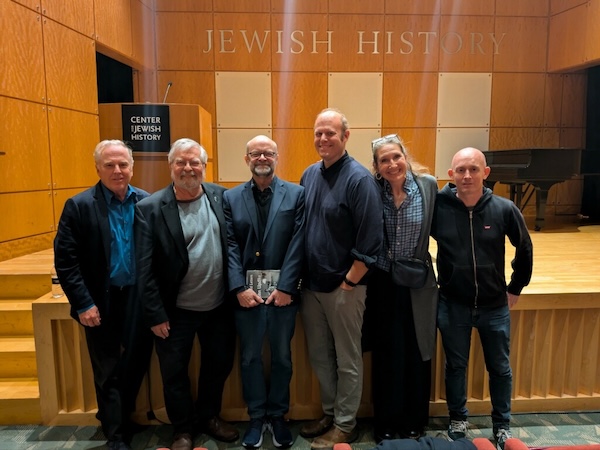
Below is the planning committee, posing at the very last scheduled event . . . when there was nothing more to plan: (L to r) JUS veep James Schiff, JUS prez James Plath, co-director Adam Sexton, RS past prez Matthew Shipe, co-director Aimee Pozorski, and RS prez Andy Connolly.

Program set for The Roth-Updike Conference in NYC

Roth-Updike, a joint conference of the Philip Roth and John Updike societies, will begin Sunday, Oct. 19 and end the morning of Oct. 22. Seventy people registered to participate, with attendees getting the chance to interact with members of both societies. Sessions were deliberately designed to encourage everyone to attend both Roth and Updike panels, as there will be no competing concurrent offerings.

Here is the Roth-Updike Conference Program.

Final call for Roth-Updike conference in NYC

Announcements have been sent to members of The John Updike Society and The Philip Roth Society, but for those who missed it, are on the fence, or are not a member of either society, this is your last chance to attend the ROTH-UPDIKE conference in New York City, Oct. 19-22. Cut-off to reserve a room at the conference hotel, The Walker Greenwich Village, is Sept. 1. After that, all unsold rooms in the conference block will be released to sell to the general public.

The jointly sponsored conference is a first for both societies, and conference directors Aimee Pozorski and Adam Sexton have done a marvelous job of putting together a program. The conference features keynotes by Adam Gopnik, who knew both men, and novelist Taffy Brodesser-Akner, and two receptions that are included with registration. See the program and registration materials below.

ROTH-UPDIKE program

Roth-Updike registration

Updike is referenced in a book of Mark Twain poems

John Updike Society president James Plath spent two weeks as a fall 2023 Quarry Farm Fellow working on an essay detailing how Twain modeled being a celebrity writer for both Hemingway and Updike. Plath conducted that research, but also felt compelled to write poems about the house and its inhabitants. Not surprisingly, Updike found his way into one of the poems:

Carved Stone Troughs

John Updike saw himself in a dogwood tree
his parents planted the year he turned one.
Parents do such things. Twain’s jeu d’esprit
led him to place four troughs in part-sun

along the Farm on East Hill road, so spaced
to revive tired horses, and with their carvings mark
the birth of four Clemens—who may have raced
later to see whose was used, while dogs would bark.

But when three of four children die before the father,
those troughs become hollowed-out markers that bear
the burden of emptiness, not crosses to inspire prayer
or reflection. It’s a wonder that Twain continued to care,

funneling stone-cold grief into sage
satire, instead of yielding to alcohol and rage.

At Quarry Farm was published in June 2025 by Kelsay Books and is available from the publisher and Amazon. Society members wanting a copy and who also plan on attending the Roth-Updike Conference in NYC in October can email Plath (jplath@iwu.edu) to bring a copy there to save postage.

Registration opens for Roth-Updike conference in NYC

The Philip Roth and John Updike societies announced that registration is now open to participate in a joint conference to be held in New York City, Oct. 19-22, 2025.

The conference celebrates a literary friendship-rivalry and publication anniversaries of Roth’s The Prague Orgy (40th), Sabbath’s Theater (30th), and The Human Stain (25th), and Updike’s first “Talk of the Town” column (70th), Of the Farm (60th), A Month of Sundays (50th), Rabbit Angstrom (30th), Gertrude and Claudius (25th), and Still Looking (20th).

Participation is limited to 100, and papers/moderators will be accepted on a rolling basis.  See Roth-Updike announcement for details on the call for papers and also newly added information about conference and hotel registration.

Release date announced for Selected Letters of John Updike

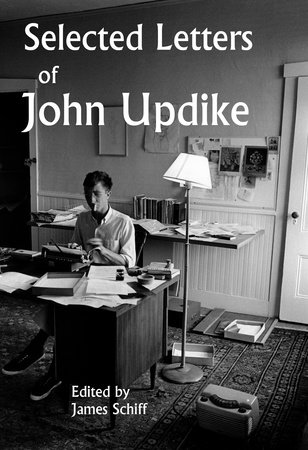
Knopf, now a division of Penguin-Random House, just released cover art for Selected Letters of John Updike, edited by Updike scholar and John Updike Society vice-president James Schiff. The hefty hardcover (900 pages) is roughly 6×9″ and slated for October 21, 2025 release. A book release event and signing will be scheduled as part of the joint Roth-Updike societies’ conference in New York City, Oct. 19-22. Those who plan on attending should count on getting a copy in NYC.

From the Penguin-Random House website, which offers purchase links to Amazon, Barnes & Noble, Books A Million, Bookshop.org, Hudson Booksellers, Powell’s, Target, and Walmart:

“The arc of literary giant John Updike’s life emerges in these luminous daily letters to family, friends, editors and lovers—a remarkable outpouring over six decades, from his earliest consciousness as a writer to his final days

“As James Schiff writes in the introduction to this volume, of the writer who would eventually express himself in written form as copiously and as elegantly as any American writer before him, ‘Updike needed to write the way the rest of us need to breathe or eat.’ With his stunning rhetorical gifts—allowing him to thrive in both fiction and nonfiction, in criticism as well as poetry—he was also a consummate letter writer. From his early writing attempts (he began submitting work to magazines as a teenager) to the 150 eye-opening letters home when he left the farm and family to go to Harvard, to the young adult correspondence with The New Yorker and other publications where his work began to appear, and on into the fullness of a long literary life, his correspondence, Schiff notes,’figures not as an adjunct to but rather an integral part of his astonishing literary output.’

Writer recalls lunch with Updike

Writer Clyde Haberman posted on social media yesterday that the death at age 92 of André Soltner, “the great chef who presided over Lutece in New York,” reminded him of a lunch he had there with John Updike.

“In 1996 I interviewed John Updike there, a restaurant he chose because it was near his publisher, Knopf. ‘There was sort of a symbiosis between the Knopf editorial board and Lutece,’ Updike said. Then he added, ‘I’ve never felt comfortable in here. I feel gourmet food is sort of wasted on me.'”

In “At Lunch With/John Updike; On Reading, Writing and Rabbit,” which appeared in The New York Times on March 6, 1996, Haberman wrote, “A sandwich and a glass of cranberry juice will do for lunch when [Updike] is at home, on 11 isolated acres in Beverly Farms, Mass., about 25 miles north of Boston. At this point, Mr. Updike said, he has to watch his waistline almost as much as his language.

“‘There’s no disguising the fact that a writer’s life is a sedentary one and prone to incessant snacking if you work at home,’ he said. ‘The little break of going down to get another oatmeal cookie is almost irresistible. So I try to make up for the cookies by not eating much at lunch.’

“Even when he was a boy in Shillington, Pa., outside the working-class town of Reading, literature and food converged. ‘I was a great peanut-butter lover from childhood on,’ he recalled. ‘The way I used to read was, we had an old sofa in the house, and I’m make a sandwich consisting of peanut butter and raisins. You’d eat one of those while you read John Dickson Carr or some other mystery writer, or James Thurber of Robert Benchley. In that way, many a happy afternoon went by.'”

Despite Updike’s talk of watching his caloric intake, Haberman wrote, “Let it be noted that he held up fine under the gustatory strain of Lutece, polishing off a serving of grouper after a cup of pumpkin soup and a puff pastry of sweetbreads and spinach. He did draw the line at dessert.”

In his 1-19-25 social media post, Haberman remarked, “That lunch with Updike . . . was one of those times when I enjoyed myself thoroughly and marveled that I actually got paid for such moments. I felt the same after interviewing Umberto Eco in Bologna a few years earlier.”

New York Public Library announces New Yorker centennial exhibition

“A Century of The New Yorker” exhibition will open at The New York Public Library on February 22, 2025, City Life Org reported. The exhibition “showcases the historic transformations” of one of America’s iconic and most distinguished magazines.

Displays will include founding documents, rare manuscripts, photos, cover and cartoon art, and artifacts on loan from other institutions–all intended to take visitors “behind the scenes of the making of one of the United States’s most important magazines,” according to City Life Org.

The New Yorker transferred its extensive archive and records to The New York Public Library in 1991. That archive—2,500 boxes (1058 linear feet)—is one of the Library’s largest collections.

Highlights from the exhibition include:

  • The prospectus for The New Yorker (1924)
  • Original artwork for the first issue of The New Yorker by Rea Irvin (1925)
  • W.H. Auden’s handwritten draft of “Refugee Blues” (1939)
  • John Updike’s handwritten assignments for Talk of the Town (1950s)
  • Original signed art by Helen Hokinson (1941)
  • The New Yorker type identification and style guide (1981)
  • Correspondence between William Shawn and John Hersey related to “Hiroshima” (1946)
  • The typescript draft of “In Cold Blood” by Truman Capote, with revisions and deletions by William Shawn (1965)
  • Hannah Arendt’s original typescript manuscript of “Eichmann in Jerusalem” (1963)
  • Cynthia Ozick, “The Fallibility Rag,” poem dedicated to New Yorker grammarian Eleanor Gould (1987)
  • A mock-up of the first New Yorker website and other 21st-century artifacts
  • Original film featuring current and recent writers, editors, and staff exploring the history, legacy, and future of The New Yorker.

Members of the John Updike and Philip Roth societies who attend the joint conference in New York City in October 19-22, 2025 will have time to head to Fifth Avenue and 42nd Street to explore the library and the exhibition.