Thirteen years ago, on Jan. 27, 2009, BBC-radio phoned John Updike Society president James Plath to get his reaction to Updike’s passing.
“What?”
It was shocking news to Plath, whose on-air response was less than composed.
Updike’s death from lung cancer was a surprise to many who loved and looked forward to reading a new book from him every year for the previous five decades.
Updike’s beloved dogwood tree, in bloom
The Telegraph (U.K.) called him “one of America’s greatest and most prolific literary icons, acclaimed for his precise, intimate style of writing,” while the BBC acknowledged that “John Updike’s novels, magisterial dissections of the soul of post-World War II middle America, placed him at the very pinnacle of his profession. . . . Whether writing novels, short stories, essays, or poems, John Updike’s work always seemed to find the pulse of modern America.” Closer to home, The New York Times praised Updike for being “kaleidoscopically gifted” and called him “the great chronicler of middle-class America . . . . America’s last true man of letters.”
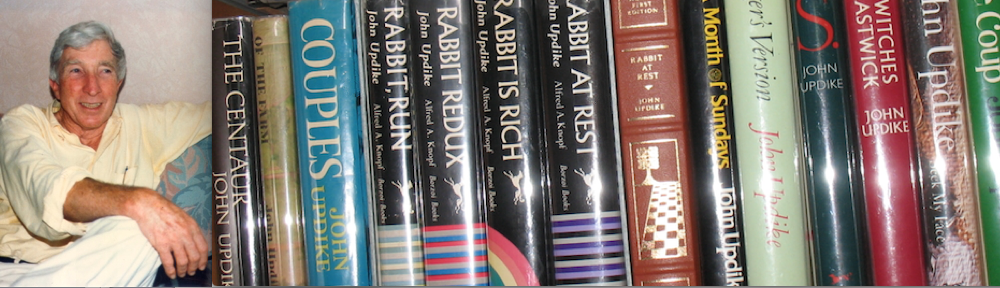
Today, on the anniversary of his death, it might be a good idea to pull a favorite Updike book off the shelf and reread a favorite passage or two.
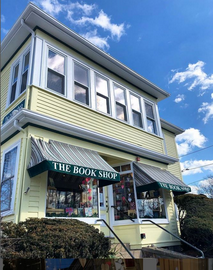
Shelf Awareness reports that owners of The Book Shop of Beverly Farms has started a biweekly podcast they’re calling “John Updike’s Ghost,” which “features casual discussions between the store owners–siblings Hannah Harlow and Sam Pfeifle–about what they’re reading, running the store, how they match books with readers and more. Harlow and Pfeifle bought the store two years ago.
“These are the kinds of conversations we have with people who come into the shop all the time,” Pfeifle told Shelf Awareness. “People think you have to read hard books, or that you have to finish everything you start, or that long books are too intimidating. We want them to hear that we read romances and mysteries, too, and that we think some books aren’t working for us at all and just put them down all the time. And reading books should be fun! It shouldn’t feel like work,” Pfeifle said.
The article noted that the podcast is named after Updike because “the store thinks of him as its ‘patron saint.’ The owners explained: “As a long-time resident of Beverly Farms, the Book Shop was his local source for books, and he frequented the spot, which first opened in 1968. As Harlow and Pfeifle learn more about his role in the community, his philosophy on reading and writing, and the way his catalog stands up to contemporary scrutiny, Updike’s presence really seems to resonate through the Shop.”
“Consider also this view of death by the atheist John Updike, from his novel, Pigeon Feathers:”
Wait. The atheist John Updike?
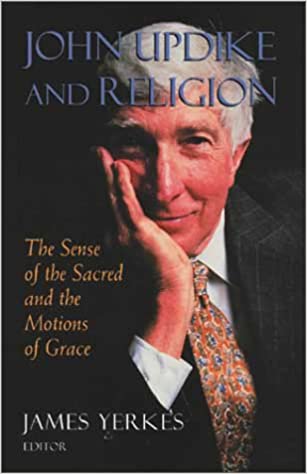
James Yerkes’ 1999 book delves into Updike’s complicated view of religion
It’s easy enough for non-literary folks to confuse a short story collection with a novel, but confusing a writer almost universally hailed as a Christian writer with an atheist? Let’s be clear here. Though dictionaries define “atheism” as simply “disbelief or lack of belief in the existence of God or gods,” it must necessarily involve something more extreme—a rejection of God or the existence of God, perhaps, or else all of Christendom are atheists. For who hasn’t had at least one moment of fearful doubt, the frightening kind of “What if there is no God?” thought that threw deep thinkers like the existentialists into the throes of despair? Didn’t Christ also experience a moment of despair and lack of faith while dying on the cross: “My God, my God, why hast thou forsaken me?”
Below is the passage that Dr. Cook was introducing:
“Without warning, David was visited by an exact vision of death: a long hole in the ground, no wider than your body, down which you were drawn while the white faces above recede. You try to reach them but your arms are pinned. Shovels pour dirt in your face. There you will be forever, in an upright position, blind and silent, and in time no one will remember you, and you will never be called by any angel. As strata of rock shift, your fingers elongate, and your teeth are distended sideways in a great underground grimace indistinguishable from a strip of chalk. And the earth tumbles on, and the sun expires, an unaltering darkness reigns where once there were stars.”
This was 14-year-old David Kern during his moment-on-the-cross despair. Later in the story, however, David experienced an epiphany and a return to faith . . . and to hope.
The John Updike Society has so many members who are ministers precisely because Updike—a Lutheran who married a minister’s daughter—is a Christian writer who writes honestly about what it really means to be a Christian and to wrestle with doubts. Even the admission of doubt is an act of faith, for doubt is uncertainty, not disbelief. As many Updike scholars have observed and even Wikipedia noted, “Updike’s novels often act as dialectical theological debates between the book itself and the reader….”
“Updike’s faith is Christian,” Bernard A. Schopen wrote some 16 years after Pigeon Feathers was published in book form, “but it is one to which many of the assumptions about the Christian perspective do not apply—especially those which link Christian faith with an absolute and divinely ordered morality.” In Updike’s fictional world, faith is not absolute, nor is it constant. It is perpetual, but broken (balanced?) by doubts that occupy his heroes as they hope for grace.
As Updike wrote in the November 29, 1999 New Yorker, “Faith is not so much a binary pole as a quantum state, which tends to indeterminacy when closely examined. At the end of the millennium, and of a century that has the Holocaust at its center, the reasons for doubt in God’s existence are so easily come by….” Wavering faith is the rule in Updike’s fictional world, not the exception. But wavering faith and atheism are not the same.
It will come as no surprise to fans of John Updike that Gertrude and Claudiusmade the list. Of Updike’s imaginative historical novel, Barker wrote, “Shakespeare’s play Hamlet kicks off with a powder-keg dynamic for its titular character—his father is dead and his mother has married his uncle. But how did things get so complicated? In Gertrude and Claudius, Updike explores the lives of Hamlet’s mother, father, and uncle before the Prince of Denmark vowed his revenge and took center stage. A prequel that ends just after the start of Shakespeare’s play, this ambitious novel gives insights into characters who—in the original text—were largely supporting.”
Other novels that made the list: I, Iago by Nicole Galland; Ophelia by Lisa Klein; Rosencrantz and Guildenstern Are Dead by Tom Stoppard; and I Am Juliet, by Jackie French.
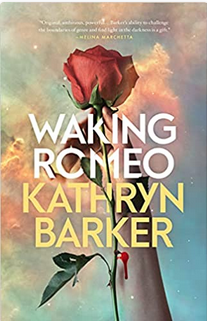
Barker might have included her own Waking Romeo, now available from Amazon, because it too is a retelling of a Shakespeare classic.