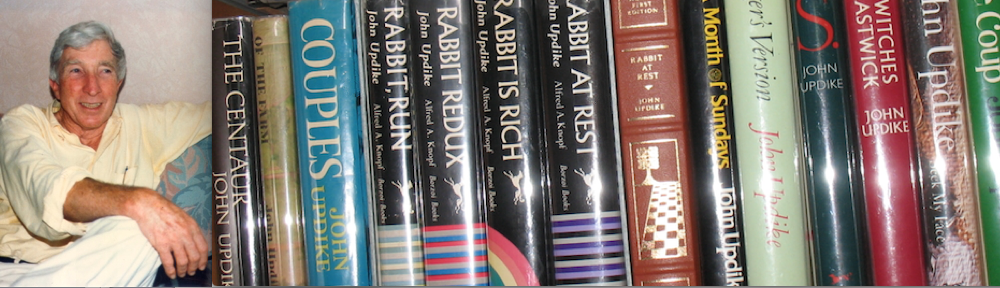

In Memoriam: Robert Weatherall

CN13227317_232018We learned belatedly and are saddened to report that John Updike Society member Robert Weatherall died on December 26 at his home in Ipswich, Mass.

Members will remember Bob from the very first conference at Alvernia University in 2010, when he and Mary Weatherall (Updike’s first wife) mingled with registrants and displayed a graciousness that was topped only by their opening their Ipswich house to us for our second conference—even mounting an impressive display of Updike materials, especially for us. Those who interacted with Bob were touched by how genuine and gentlemanly he was, and how giving.

His obituary in The Ipswich Chronicle recalls a full life that began in wartime Britain and had an impact on countless people: “He was a passionate advocate of education and was the first to work to ensure the the Foeffees of Little Neck honored William Payne’s 17th century gift to Ipswich students. He had an abiding interest in the public good, whether it be the welfare of the schoolchildren of Ipswich or access to and stewardship of open spaces.”

Members in the area can attend a memorial that be held at Ascension Memorial Church in Ipswich on January 31 at 2 p.m. In lieu of flowers, memorial contributions in his name may be made to Essex County Greenbelt Association, 82 Eastern Ave., Essex, MA 01929, or to the Ipswich Music, Arts & Drama Association, Inc., Box 449, Ipswich, MA  01938. Visit www.whittier-porter.com to send a message of condolence.

Our sympathies go out to Mary and the children. He will be missed.

The Paris Review writes about Updike and cartoons

Screen Shot 2015-01-14 at 4.56.52 PMUpdike fans know that he first aspired to be a cartoonist and was enamored with Disney, especially. And he was a fan of Big Little Books as a little fellow. But in a post today on The Paris Review website, Jeet Heer contemplates why John Updike loved comics and concludes, “While Updike might have ceased cartooning, the visual language of comics was never far from his mind.”

Heer writes, “A full inventory of the impact of cartooning on Updike’s writing would require a much longer essay. It would include a discussion of a poem that features Al Capp (creator of L’il Abner); Harry “Rabbit” Angstrom’s resentful affection for the girlie comic strip Apartment 3-G; the superhero references in the later Rabbit books; the story “Intermission,” about a young writer of comic strips; the novel Marry Me, which features a character who works in advertising animation; and the essays Updike devoted to cartoonists such as Ralph Barton, James Thurber, and Charles Schulz. Such a discussion would also look more deeply at the visual potency of Updike’s prose and also his habit of limning vividly grotesque secondary characters (think for example of the story “The Madman”), a fictional practice that owes as much to the tradition of caricature as to the model of Dickens.

Here’s the complete article: “Updike: Portrait of the Artist as a Young Fan”

English major talks about Getting Over Updike

First Person Singular focuses on a January 14 blog post by Jon Busch titled “Getting Over Updike,” which begins,

“John Updike was a living legend around Gordon College. He lived mere miles from our tiny campus, and swapping tales of ‘Updike sightings’ was a common pastime among English majors.”

Updike “encounters” were apparently just as common, and Busch shares several humorous anecdotes, along with his somewhat embarrassed reaction to A Month of Sundays.

He writes, “Regardless of the absurdity and vulgarity of A Month of Sundays, I do wish we Gordonites had not irrevocably offended Updike all those years ago. His ‘Seven Stanzas at Easter’ alone is adequate atonement for a lifetime of bad sex writing.”

Gordon College is a Christian school in Wenham, Massachusetts. “Legend has it (and I have no way to verify this) that an intrepid English professor in the late seventies or early eighties struck up a friendship with Updike and asked him to come speak on campus. Updike accepted the invitation, but had to be ‘disinvited’ when the president of the college famously declared, ‘I don’t want that pornographer anywhere near our campus.

“Decades later, an Updike convocation was still off the table. Apparently, the man knew how to hold a grudge. We English majors held a grudge as well, against that ignorant, foolish president who damned us to an Updike-less, and thus incomplete, education.”

It was only after reading A Month of Sundays many years later that Busch says he developed “sympathy for the old president’s position.”

Papers still needed for ALA panel

One session is now full, but The John Updike Society still needs a moderator and papers for a second session sponsored by The John Updike Society at the American Literature Association Conference, May 21-24, 2015, West Copley Place, Boston Mass.

Papers are welcome on any aspect of John Updike’s life and work, including (especially?) comparisons to other authors. Send abstracts to: Peter Quinones, Sessions Coordinator at peterquinones79@hotmail.com.

The deadline for submission is January 20. Peter will acknowledge receiving your abstract within a day or two of receiving it and notify those selected for participation by January 28. Thank you in advance for your willingness to share your insights on Updike with the greater literary community. Presenters must register for the conference, and more information will be provided later. Presenters should also be members of the Society, but dues are minimal: regular dues are $25/year and dues for grad students and retirees are $20/year. We welcome all who enjoy Updike’s work.

Infamous Updike detractor gets his own reader

wallaceThe late David Foster Wallace, who famously attacked Updike and other literary Johns, is featured in The David Foster Wallace Reader and the subject of a Newsweek cover story by Alexander Nazaryan.

For any fan of Updike who’s more familiar with Wallace’s sniping than with Wallace and his fiction, “The Turbulent Genius of David Foster Wallace” provides a good summary of the career of the author of Infinite Jest, who killed himself in 2008.

In it, Updike is mentioned . . . of course, pejoratively.

David Updike on Growing up Updike

GrowingupUpdikeDavid Updike, the current John Updike Scholar in Residence at Alvernia University, is featured in a new Alvernia Magazine article titled “Growing up Updike” (pp. 20-24).

In it, he talks about what it’s like being the son of one of America’s most celebrated authors and shares memories of one particular family trip to Pennsylvania, where his father “took us to see his old house in Shillington, but was too shy to knock and ask to go in,” so he “walked us back to the playing field [at the high school behind the house] and the shelter where he used to play roof ball,” David writes.

“Even at an early age I could sense his disappointment that we seemed to underappreciate these places which, for him, held such sweet emotional weight—the memory of childhood, of his being seven, or so, and sprinting out of the side door of his house [at 117 Philadelphia Ave.] to join his friends in the Pennsylvania twilight, to play a final game of roof ball.”

DavidUpdike“It must have been a surprise to my parents, as it was to me, when I started to write short stories, and then odder still, had them accepted by The New Yorker. Photography, not writing, had been my preferred medium, and I knew well that my father had toiled for a decade or so—sending off countless cartoons, and spots, and light verse—before his poems were accepted by The New Yorker.

“I knew that my own success was somehow unjustified—unearned. I need not have worried, for in my mid-twenties things got more difficult, and I was languishing in New York, where I had moved for no very good reason . . . .”

Commonweal: Updike made it look easy

In a Commonweal article inspired by Adam Begley’s recent biography, Rand Richards Cooper considers “The Charms of the Conqueror: How John Updike Made It Look Easy.”

“His writing flickers with the hope that the world was created, and thus merits the devotion of attention (by fictional characters) and description (by Updike himself),” he writes.

“The Rabbit novels are crammed with the trivia of American life down the decades, and their accumulating excess reminds us that far from being ‘untroubled,’ Updike wrote from a condition of spiritual urgency.”

“Having read Begley’s book, I shouldn’t be surprised that Updike wrote to the very end; still, I find myself awed by the courage it must have taken to sit in the fearful presence of death and write . . . a sonnet?”

Cooper concludes, “After someone we love dies, his or her voice stays with us, fresh and close, for years; we keep expecting the phone to ring with that voice on the other end; we experience frank disbelief, and renewed sorrow, at the idea that its owner truly is gone forever. It’s not much different with a writer one has loved. Keep company with a writer, in many books over decades of your life, and you grow accustomed to his presence; you hear his voice in much the same way you hear a friend’s or a sibling’s. Updike in his early years imitated other writers’ styles, channeling first Fitzgerald and Hemingway, and later Salinger and Nabokov—praising them by imitating their voices before eventually settling in to play his own exquisitely tuned instrument. Reading his prose in this life-and-art-affirming biography, I hear him vivid as ever, and miss him all over again.”

Begley bio makes more end of year lists

End-of-year accolades keep coming for Adam Begley and his biography of Updike:

Biographile: Discover the World Through Biography and Memoir
Updike by Adam Begley

“Like his sometimes-rival Cheever, Updike was a writer named John who liked to pick at the pretty exterior of American suburbia and see what he could find. The results of his excavations were some of the most vivid works of American literature to date, albeit ones marred somewhat by Updike’s obvious discomfort with the fairer sex. Journalist Begley is a compassionate biographer, but doesn’t avoid discussion of Updike’s stormy personal life.”

The Lone Reader
3. Updike – Adam Begley

There are few writers I admire more than Updike. His work was so prolific and of such quality, it’s hard to compare him to anyone. What Begley’s biography does is link the writer’s work to his life. Indeed, the best moments are when Begley spends time on what Updike wrote, especially the discussion of the short stories. It may be rather reverential, but the book does display Updike as a flawed man, one who deeply regretted some of his decisions. It shed light not only on the man but on his work and after reading it, I returned to the Olinger short stories and saw them in a new light. Begley has written a readable, fascinating biography.

 janetsomerville: Musings about books, film and theatre
Updike by Adam Begley

A masterful literary biography that has me pledging to read as much of Updike’s oeuvre as I can. Each time I finished a book, I penned a hand-written missive to Adam Begley. So far, I’ve enjoyed Seek My Face, Always Looking: Essays on Art, and Self-Consciousness the most.

Entertainment Monthly shares Top Five Anti-Holiday Reads

UpdiketerrorsThere haven’t been many Grinches or Scrooges or shouts of “Bah Humbug” this holiday season, but Entertainment Weekly has offered the next best thing:

“‘Tis (Not) The Season: Top Five Anti-Holiday Reads.”

Updike has been making a lot of “best” lists this season, and he makes this one as well, coming in at #2 right behind Dr. Seuss’s How the Grinch Stole Christmas! with a book that may be unfamiliar to many Updike fans: The Twelve Terrors of Christmas, featuring illustrations by fellow Harvard alum Edward Gorey. The hardcover book was published in 2006 by Pomegranate Communications and released in a revised edition a year later. You can find a copy, as with almost all out-of-print books, at Abebooks.com.

In making the selection, Entertainment Monthly‘s Madeline Poage writes, “An old one, but a good one, Updike’s wry voice and natural sense of humor flows organically through this compact work. A deconstruction of every facet of Christmas, the book unpacks every ritual and tradition down to the bare bones. Mercilessly witty and disturbingly accurate, every aspect of Christmas if put to the test against logic—what are Santa’s true motives? How do reindeer landing of roofs not destroy them by accident? Do the elves need a union? And of this wouldn’t be complete without Edward Gorey’s illustrations, haunting and stark on every page. For anyone tired of the Christmas hype, this is an absolute must.”