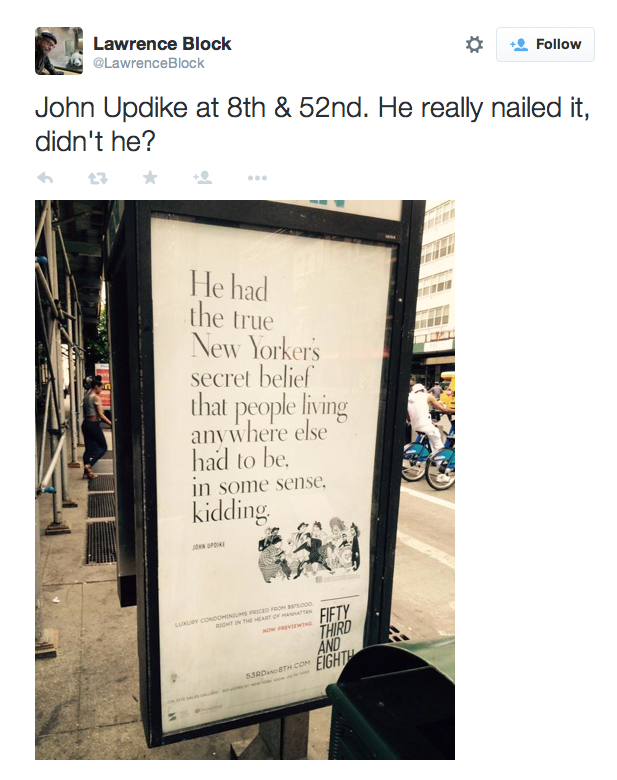
Lawrence Block tweets Updike quote
Reply
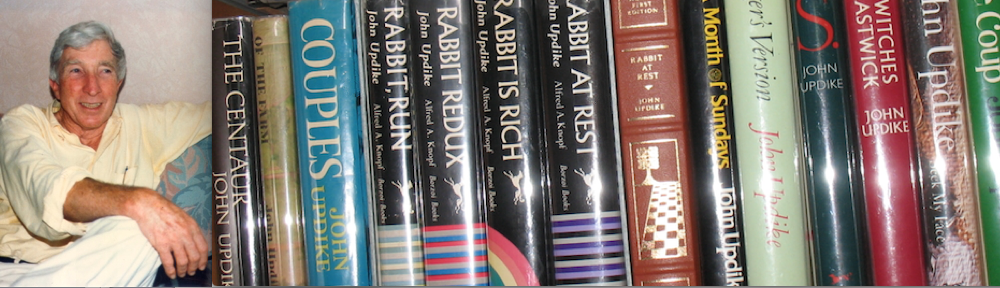
 WGBH-Boston has announced “Reading Hearts: The BPR Summer Book Club,” a three-month, no boundaries, interactive book club hosted by Alex Beam. In other words, you can read along, and listen in on the conversation with callers about each of the books, if you don’t feel like calling in yourself.
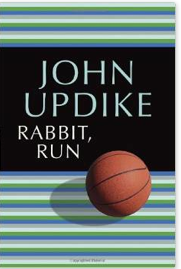
The June entry is Barefoot, by Elin Hilderbrand. For July, readers are asked to tackle Updike’s Rabbit, Run, and the communal read for August is Pack of Two: The Intricate Bond between People and Dogs, by Caroline Knapp.
The article quotes Amazon.com in summarizing Rabbit, Run as the July entry:
“Rabbit, Run is the book that established John Updike as one of the major American novelists of his—or any other—generation. Its hero is Harry ‘Rabbit’ Angstrom, a onetime high-school basketball star who on an impulse deserts his wife and son. He is twenty-six years old, a man-child caught in a struggle between instinct and thought, self and society, sexual gratification and family duty—even, in a sense, human hard-heartedness and divine Grace. Though his flight from home traces a zigzag of evasion, he holds to the faith that he is on the right path, an invisible line toward his own salvation as straight as a ruler’s edge.”
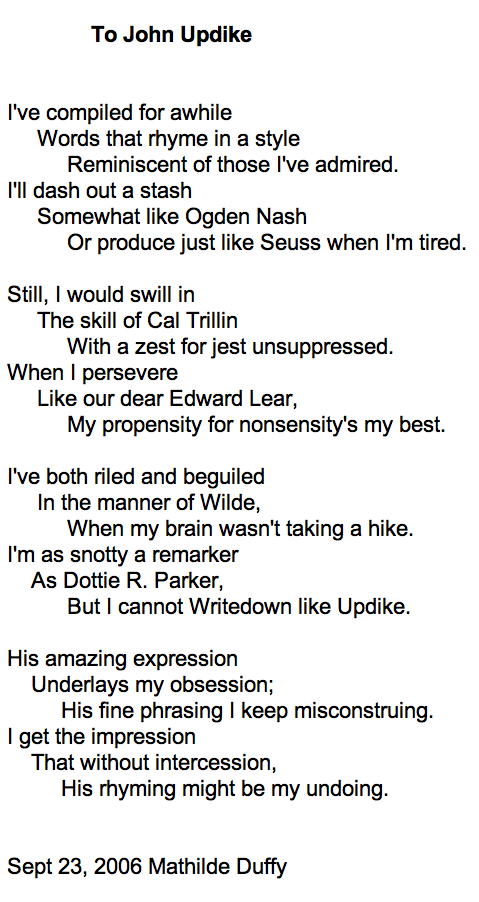
Michael Updike writes, “I received a cold call from an admirer of my father’s tonight. She had hoped to read this poem to my father but his demise put an end to that. So reading it to me was the bridesmaid’s option.” Mathilde Duffy is an artist who works and teaches art classes in the greater Boston area.
 June is soon upon us and it’s come to our attention that a year ago Rachel Grate of Arts.Mic shared “14 Brilliant Pieces of Literature You Can Read in the Time it Takes to Eat Lunch.”
Margaret Atwood’s “Happy Endings” comes in at #1, followed by John Updike’s “Pygmalion.”
“Inspired by the story of Pygmalion from Ovid’s Metamorphoses, the story follows a sculptor who falls in love with a statue he carves. Updike transforms the narrative’s message to reveal the narcissism we all bring to love.
“Updike makes every sentence of this brief piece count, nonchalantly surprising his readers with a new twist in every paragraph. Soon, we begin to wonder how much of a relationship is based on who the other person really is and how much is based on how we transform them.
“Read it for free here,” courtesy of The Atlantic online. The story appeared in the July 1981 issue.
Only one of the American Nobel laureates made the Arts.Mic list: Ernest Hemingway (“Hills Like White Elephants”).
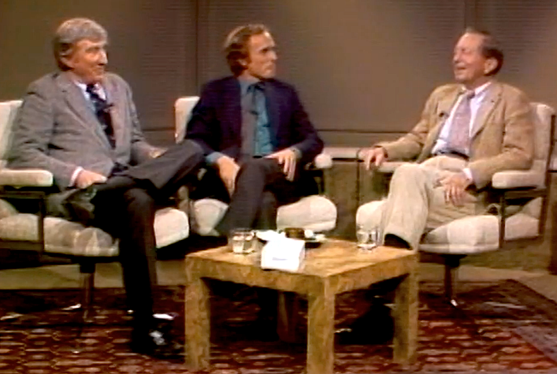
Today The Paris Review uploaded a blog post by Dan Piepenbring which featured the photo below of John Updike and John Cheever on The Dick Cavett Show and an entry from Cheever’s journal, circa 1974, 1978, that’s here titled, “False Alarm.”
It begins, “The telephone rings at four. This is CBS. John Updike has been in a fatal automobile accident. Do you care to comment. I am crying. I cannot sleep again. I think of joining Mary in bed but I am afraid she will send me away.”
Later, Cheever writes, “As for John he was a man I so esteemed as a colleague and so loved as a friend that his loss is indescribable. He was a prince. I think it not difficult to kiss him goodbye—I can think of no other way of parting from him although he would, in my case, have been embarrassed. As a writer of his generation I think him peerless; and his gifts of communicating, to millions of strangers, his most exalted and desperate emotions was, in his case, fortified by immense and uncommon intelligence and erudition.”
It would be Cheever, Updike’s senior by two decades, who would die first, in 1982. Here’s a link to the October 14, 1981 Dick Cavett Show featuring the two luminary Johns.
 A 1972 thesis “Submitted to the Faculty of the Graduate School at The University of North Carolina at Greensboro in Partial Fulfillment of the Requirements for the Degree Master of Science in Physical Education” is now available online.
Click here to access Kathryn Jane Upshaw’s “John Updike and Norman Mailer: Sport Inferences,” which was filed in September 1972. To navigate past the title page, click on the right center edge to move forward, and the left center edge to go backward. “Through the analysis of the lives and writings of modern contemporary American authors John Updike and Norman Mailer, the allusions to sport were studied with a view toward understanding the inferences of that phenomenon on the development of the novel’s elements of plot, character, and setting. Furthermore, sport inferences were studied in light of style.”
The author studied Updike’s The Poorhouse Fair, Rabbit, Run, The Centaur, Of the Farm, Couples, and Rabbit Redux, and Mailer’s The Naked and the Dead, Barbary Shore, The Deer Park, An American Dream, and Why Are We in Vietnam?
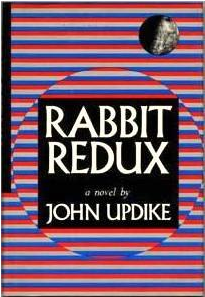 Rabbit, Run gets all the attention, and Rabbit Is Rich and Rabbit at Rest earned Pulitzer Prizes. But Guardian writer Robert McCrum says Rabbit Redux is his favorite—which is why he included it at #88 on his list of “The 100 Best Novels.”
“Harry ‘Rabbit’ Angstrom, the account of whose life and times adds up to more than half a million words, is often placed with honor, and a measure of irony, next to America’s great literary protagonists such as Huck Finn, Jay Gatsby and even Captain Ahab,” McCrum writes. “Rabbit Redux was published in the US by Alfred A Knopf, a great literary house and a natural home for a novel that, from the title down, nodded to the Anglo-American literary tradition. Anthony Trollope (see No 22 in this series) published Phineas Redux in 1873, and Updike, who was steeped in English literature, would have enjoyed the allusion. Other critics have noted its ‘Dickensian’ ambitions.
“The Angstrom series had many inspirations, including Sinclair Lewis’s Babbitt. Updike, who also venerated Lewis, always spoke warmly about his admiration for Marcel Proust, though ‘Rabbit’ has little to do, explicitly, with A la Recherche du Temps Perdu. Ian McEwan [who, summarising Updike’s achievement on his untimely death in 2009, compared him to Saul Bellow (see No 73 in this series) as ‘a master of effortless motion—between first and third person, from the metaphorical density of literary prose to the demotic, from specific detail to wide generalization, from the actual to the numinous, from the scary to the comic’] described Updike’s ‘Rabbit’ novels as his ‘masterpiece.’ Philip Roth, a sometime writer, declared Updike to be America’s ‘greatest man of letters, a national treasure,’ while, for Lorrie Moore, Updike is ‘our greatest writer,’ though she prefers his short stories.”
Physics Central, which links to American Physical Society Sites, yesterday posted “Physics in Verse: A John Updike Poem about Neutrinos.”
“There is a long history of poets taking Nature as their muse, from the call of the sea to the draw of the wild. But poems about physics phenomena are harder to find,” Tamela Maciel writes. “Updike was not a physicist, but he did a remarkable job describing the current view of the physics community, as this article from Symmetry magazine unravels.”
Cosmic Gall
by John Updike
Neutrinos, they are very small.
They have no charge and have no mass
And do not interact at all.
The earth is just a silly ball
To them, through which they simply pass,
Like dustmaids down a drafty hall
Or photons through a sheet of glass.
They snub the most exquisite gas,
Ignore the most substantial wall,
Cold-shoulder steel and sounding brass,
Insult the stallion in his stall,
And, scorning barriers of class,
Infiltrate you and me! Like tall
And painless guillotines, they fall
Down through our heads into the grass.
At night, they enter at Nepal
And pierce the lover and his lass
From underneath the bed—you call
It wonderful; I call it crass.
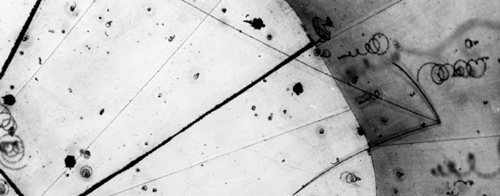
Pictured is “The first observation of a neutrino-induced reaction in a hydrogen bubble chamber. An invisible neutrino arrives from the right and strikes a proton where the three tracks join. The proton, a muon, and a pion then fly off in different directions.”
 In a post for the “Idle Chatter” department of The Smart Set, from Drexel University, Morgan Meis reports on “Updike Country; In the semi-rural suburbs of southeastern PA, finding—and living in—Rabbit Angstrom’s middle America.”
“John Updike always wrote beautifully about this part of the world. The middle class houses. The certain kind of red clay. The specific attitude of a person who grew up around here, in the vicinity of Reading.
“If John Updike were still alive and driving around Limerick he’d write something about the beautiful pseudo-cloud coming from the cooling tower of the Limerick plant. He’d say, the white powder of that cloud drifts over the farmland and the strip malls all the same. It dusts the heads of the locals on their way out of the bar on Township Line Road. It dusts everything. You can’t see or feel the dust. It does not harm. But it’s heavy nonetheless. It keeps you here even when you want to pass on through. . . .”
 On May 3, John Updike Society president James Plath was invested as the R. Forrest Colwell Chair of English at Illinois Wesleyan University, where he has taught for the past 27 years. The appointment is for six years, renewable for five-year terms thereafter. The committee cited his work on Hemingway and Updike, his work with student organizations, and his long-term service on both major committees and the Faculty-Staff Recognition Committee.
Here is the article.
