Updike credited for redux revival

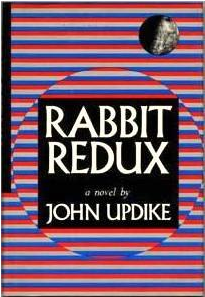
Redux. From the Latin, meaning, “to lead back.” And an article on “The Top 10 Words That Died and Were Reborn,” written by John Rentoul and published in The Independent, credits John Updike for the revival:

“Redux. Excellent nomination from Steve, who pointed out that it was popularised by John Updike. Rabbit Redux, 1971, was the second of his Rabbit series. Mostly used in fairly upmarket US commentary, it means brought back, revived, and dates from the late 19th century, from Latin, reducere “bring back.'”

The article is interactive, with terms suggested by various people, and in that spirit we suggest you try using all 10 words in a sentence. You know Updike could do it.

Updike’s half-moon, small cloud poem and others

How can April be the cruelest month when it’s National Poetry Month? And The Atlantic teases readers with a reminder that John Updike wasn’t just a Pulitzer Prize-winning novelist. He was a pretty good poet as well.

Exhibit A is this excerpt from Updike’s “Half Moon, Small Cloud”:

For what is the moon, that it haunts us,
this impudent companion immigrated.f
from the system’s less fortunate margins,
the realm of dust collected in orbs?

The full poem was published in their October 2006 issue, and you can read it here. Additional poems of Updike’s that The Atlantic published are also linked:

“Madurai” (July/August 2007)

“Rainbow” (November 2000)

“Doo-Wop” (November 2007)


Article rounds up writers throwing shade at one another

In an April 24, 2017 article published on Signature: Making Well-Read Sense of the World, Tom Blunt speaks, well, bluntly about how common it is “for authors to end up creatively sharpening their claws on each other,” with writerly rivalries spawning “some of history’s most savage put-downs, capitalizing on the fragile egos and insecurities that haunt anyone who pushes together words for a living.”

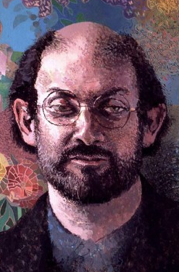
Keats “throws shade” at Byron, and Byron throws it back . . . after Keats’s death. H.G. Wells criticizes Henry James, Mark Twain and Virginia Woolf rip Jane Austen, Dickens has something unkind to say about houseguest H.C. Andersen, Mary McCarthy minces no words in a put-down of Lillian Hellman, Dorothy Parker zings Norman Mailer, Ayn Rand responds to C.S. Lewis’s criticism, Vladimir Nabokov gets snarky with Edmund Wilson, Hemingway badmouths Fitzgerald, Gertrude Stein badmouths Hemingway, and Salman Rushdie tosses John Updike under a (Las Vegas) bus.

The latter is attributed to a 2006 interview Rushdie gave: “Somewhere in Las Vegas there’s probably a male prostitute called ‘John Updike.'”

Read the full article:  “The Library Is Open: 13 Instances of Writers Throwing Shade at One Another.”


Art-matters story cites Updike

In a story posted in the travel section of The Australian on 29 April 2017, author and former manager of Art Gallery of NSW bookshop Brian Turner observes, “Art museums are a favorite mise-en-scene for novelists’ storylines and denouements.” He cites Dan Brown’s popular Da Vinci Code novels as an obvious example, but includes others as well and concludes by offering a reading list for traveling “museum obsessives”:

“In-flight reading while returning home? Museum obsessives should relish the last chapter of The Museum of Innocence for [Orhan] Pamuk’s exotic small museums listing—Proust’s house in Illiers-Combray in central France; Paris’s Musee Edith Piaf; New York’s Glove Museum and Baltimore’s Edgar Allan Poe House. Also read John Updike’s short story, ‘Museums and Women.’ Updike met his future wife in a museum and assures readers they offer the opposite to what we seek in churches, but you must decide for yourself.”

Read the full article:  “Galleries and museums set the scene in fiction and real life.”


Novelist’s best kiss: John Updike

Rosanna Greenstreet of The Guardian recently played 23 questions with novelist Ann Patchett, whose novels The Magician’s Assistant, Bel Canto, and State of Wonder were shortlisted for the Orange Prize for Fiction (now the Women’s Prize for Fiction), and this interesting exchange popped up:

What was the best kiss of your life?
I kissed John Updike as he presented me with an award. It wasn’t the best kiss as far as kisses go, but I hold the fact that I kissed John Updike, that he kissed me, very close to my heart.

Well, there’s a new spin on the old phrase kiss-and-tell. . . .

The rest of her responses are below:

“Ann Patchett: My best kiss? I kissed John Updike as he presented me with an award.” 

New De Bellis book on Updike slated for summer release

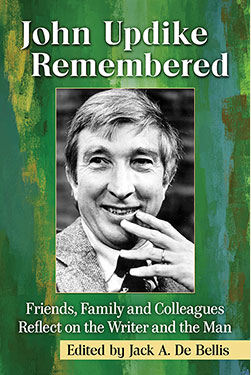
John Updike Remembered:  Friends, Family and Colleagues Reflect on the Writer and the Man, edited by Jack De Bellis, will be published this summer by McFarland Books and is now available to pre-order. The softcover volume features 53 remembrances that “present a prismatic view of the two-time Pulitzer Prize winner and his work through anecdote and insight” as “interviews and essays from family, friends and associates reveal sides of the novelist perhaps unfamiliar to the public—Updike the high school prankster, the golfer, the creator of bedtime stories, the charming ironist, the faithful correspondent with scholars, the devoted friend and the dedicated practitioner of his craft,” as described on the McFarland website. List price is $29.95.

“Contributors include: his first wife, Mary Pennington, and three of their children; high school and college friends; authors John Barth, Joyce Carol Oates and Nicholson Baker; journalists Terri Gross and Ann Goldstein; and scholars Jay Parini, William Pritchard, James Plath, and Adam Begley, Updike’s biographer.”

De Bellis, who is Professor Emeritus of English at Lehigh University, was a founder of The John Updike Society and served on the board of directors from 2009-14. A member of the editorial board of The John Updike Review, he is best known among scholars for the books he has edited or written on Updike:

John Updike, 1967-1993: A Bibliography of Primary and Secondary Sources (Greenwood Publishing Group, 1994)
The John Updike Encyclopedia (Greenwood Publishing Group, 2000)
John Updike: The Critical Responses to the “Rabbit” Saga (Oak Knoll Press, 2003)
John Updike: A Bibliography of Primary and Secondary Materials, 1948-2007, co-authored by Michael Broomfield (Oak Knoll Press, 2008)
John Updike’s Early Years (Lehigh University Press, 2013)

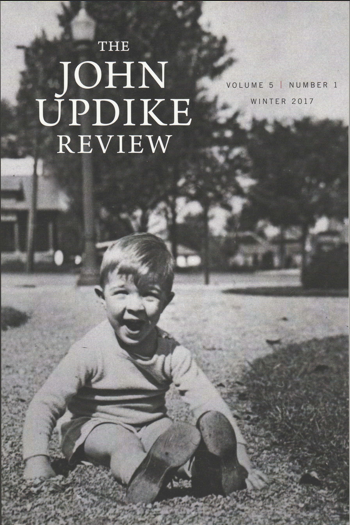
Have you seen this child . . . John Updike?

If not and you’re a member of The John Updike Society, it ought to be arriving soon. Volume 5: Number 1 (Winter 2017) of The John Updike Review is out now, featuring:

“A Word from the Editor”—James Schiff
“Summer 1974, in Fiction and Memory”—David Updike
“A Conversation with John Updike in Moscow”—Ward Briggs & J. Alexander Ogden
“Updike in Venice”—John Philip Drury
“John Updike’s Broadsides: The Blackness of Death and Bath after Sailing“—Donald J. Greiner

plus “Three Writers on Villages“:
“Programmed Delirium: Villages and the God of Multilevel Selection”—Marshall Boswell
“Dreams, Conflated Wives, Lingering Guilt, and Coitus Recalled in Updike’s Villages”—James Schiff
“Seduction in John Updike’s Villages“—Aristi Trendel

and reviews by Sue Norton (The Violet Hour: Great Writers at the End, by Katie Roiphe) and Laurence W. Mazzeno (Myth and Gospel in the Fiction of John Updike, by John McTavish).

The refereed journal, which publishes the very best of current Updike criticism and articles, is free with membership in The John Updike Society. It’s published twice annually by the University of Cincinnati and The John Updike Society and based at the University of Cincinnati Department of English and Comparative Literature. For institutional subscriptions contact James Schiff, james.schiff@uc.edu.

Shurbanov added as keynote for JUS Conference in Serbia

Distinguished poet, writer, translator, and Shakespearian scholar Alexander Shurbanov, who translated John Updike’s novel Gertrude and Claudius into Bulgarian, will be featured as a keynote speaker at the Fifth Biennial John Updike Society Conference in Serbia. The conference, 1-4 June 2018, will be sponsored and hosted by the Faculty of Philology at the University of Belgrade.

Not only did Shurbanov, now Professor Emeritus at the University of Sofia in Bulgaria, correspond with Updike while translating Gertrude and Claudius, but he was also a longtime friend of Blaga Dimitrova, the prototype of Vera Glavanakova from Updike’s O. Henry Award-winning story “The Bulgarian Poetess.”

Shurbanov, who has also taught at the University of London, UCLA, and SUNY-Albany, has translated 14 texts ranging from Chaucer, Shakespeare, and the Magna Carta to Tales by Beatrix Potter and poetry by Milton, Coleridge, Dylan Thomas, Ted Hughes, and Rabindranath Tagore. As a poet and essayist he is also the author of 18 collections, including three bilingual Bulgarian-English titles:  Frost-Flowers (Princeton, 2001), Beware: Cats (Sofia, 2001), and most recently Foresun: Selected Poems in Bulgarian and English (Sofia, 2016).

From 1972-2009, Shurbanov taught at the University of Sofia, where he received The Honorary Medal of Sofia University in 2001. He is also the recipient of numerous other awards, including The Danov National Award for Overall Contribution to Culture (2007), The Geo Miley National Literary Award (2015), and The Portal Kultura Special Prize for Notable Achievements in Poetry and Translation (2016).
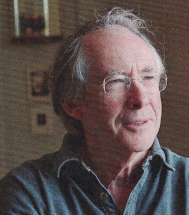
Along with celebrated writer Ian McEwan, who was announced earlier as a keynote speaker, the addition of Professor Shurbanov gives the conference two top-flight presenters that should appeal to both society members and devotees of literature. Like Updike, whom he knew, McEwan worked in multiple genres, the author of 14 novels, three short story collections, two plays, two children’s books, five screenplays—even a libretto. Among his numerous awards are the Booker Prize for his eighth novel, Amsterdam (1998); the Jerusalem Prize for the Freedom of the Individual in Society (2011); and the 50th Anniversary Gold Medal from the University of Sussex. Long an advocate for Updike’s legacy and an admitted beneficiary of Updike’s influence, McEwan is a Fellow of the Royal Society of Literature, the Royal Society of Arts, and the American Academy of Arts and Sciences. His most recent novel is Nutshell (2016)—which retells the story of Shakespeare’s Hamlet from the point of view of an unborn child.

Though membership in the society is required to attend the conference, The John Updike Society is an inclusive organization whose members are teachers, professors, writers, theologians, independent scholars, Updike family and friends, collectors, and the kind of just-plain-readers that Updike always appreciated. The society previously held conferences in Columbia, S.C., Boston, and Reading, Pa. (twice). This will be the first time members will meet outside the U.S.

Call for papers
 

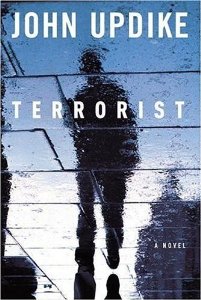
Terrorist and Jihadi fiction: a scholarly paper

Jago Morrison’s paper, “Jihadi fiction: radicalisation narratives in the contemporary novel” is available online, published 6 March 2017 by the Taylor & Francis Group. Here’s the abstract (link to full text also available):

“As Ulrich Beck suggests in World at Risk, fear of Islamist extremism has become a dominant strand in contemporary perceptions of risk. In the media, a set of ‘stock’ radicalisation narratives have emerged in which, typically, a misguided loner is brainwashed into embracing a violent perversion of Islam. In the background, the wider Muslim community is accused of a dangerous complicity and complacency. This essay explores some notable attempts in fiction to unpick such popular radicalisation narratives. In novels by John Updike and Sunjeev Sahota, the psychological and faith dimensions of suicide bombing are a key focus, attempting to explore from the inside, how an educated young Muslim might be impelled along the path to martyrdom. In texts by Mohsin Hamid and J.M. Coetzee, the ideological staging of ‘radicalisation’ and ‘fundamentalism’ themselves is brought into question. Current counterterrorist measures include indefinite detention of US citizens without trial, while in the UK, over two million public sector workers have been recruited to the largest surveillance exercise ever codified in British law. In this context, the essay shows how recent fiction has attempted to trouble the frames of representation through which a perpetual state-of-emergency is passed off as our ‘new normal.'”

“In John Updike’s Terrorist,” Morrison writes, “both radicalisation and its contexts are portrayed rather differently. Again, the focus of the novel is to explore the risk of a devastating suicide attack, but to do so through an individual, human story. This, however, is very much an American tale, in which the impulse towards extremism is seen as rising, at least in part, out of the bleakness and inanity of contemporary suburban life. Like Sahota, Updike begins by drawing a protagonist who is damaged and ripe for influence. No visit to Afghanistan is required for Ahmad: between the machinations of a local imam and those of a CIA agent, the manipulations all happen close to home, in an ordinary city modelled on Paterson, New Jersey. In Updike’s portrayal, Ahmad is an impressionable and (somewhat cartoonishly) zealous American teenager, product of a broken home and in search of self-esteem. Raised non-religious after his Egyptian father abandoned him as a young child, he is described by his mother as ‘trusting’ and ‘easily led.’”

Continue reading