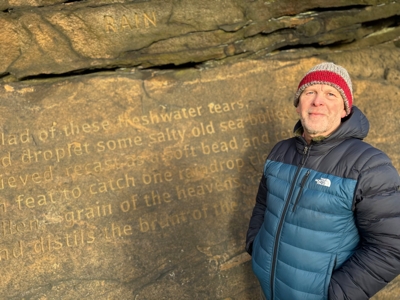
 With heavy hearts we report the death of longtime John Updike Society member Andrew J. Moorhouse, whom many members first met when he attended the society’s second biennial conference in Boston in 2012.
According to a post his family created on his Facebook page, Andrew “died peacefully on Tuesday, September 24, after a year of ill health and a short-lived battle with a secondary CNS lymphoma which took root in his brain.
“Andrew would have used his unique talent with words to craft this message full of beautiful allegories, imagery and metaphors but sadly we have neither his brains nor his brilliance.
“Many will know Andrew through his Facebook and social media, which he used to connect with like-minded people across the world. Andrew was a generous and loving husband, father, brother and friend. As well as a loyal Dale fan. He will be greatly missed.”
Updike Society members will certainly miss him. Andrew was a gentle and quiet force of nature who, members may recall, was fresh off of a kidney transplant when he talked about becoming a fine letterpress edition publisher of poetry. As he told Body online literary magazine in 2021,
“I have always been a keen reader. My favorite authors generally are American novelists but also British poets. A collector too. I like beautifully printed and bound signed, limited editions. I collected John Updike’s books—it was Updike who said: ‘a book is beautiful in its relation to the human hand, its relation to the human eye, to the human brain, and to the human spirit.’ I felt the same way.”
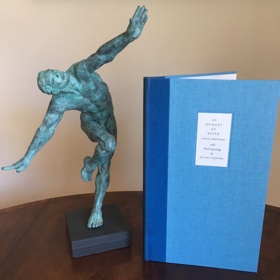 Inspired by Updike and Updike small-press limited edition publisher William Ewert, Andrew contacted UK Poet Laureate Simon Armitage, whose work he collected, asking if he’d be interested in working with him to produce fine press editions of his works. Armitage was interested, and in October 2013, Andrew started Fine Press Poetry and officially became a small press publisher with his first book, In Memory of Water, poems by Armitage. Many more books followed.
Andrew was indeed an insightful reader of Updike who could talk about Updike’s books on the same level as any Ph.D. or much-published scholar. He was interesting and intelligent and a delight to be around. The John Updike Society is poorer without him, and we offer our condolences to his family: Rosie, Rebecca, and James. He made the world a better place.

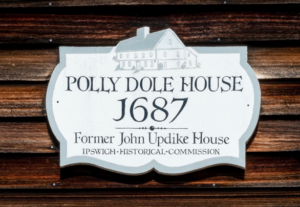
 Chase Replogle, pastor of Bent Oak Church in Springfield, Mo., posted a chapter excerpt that didn’t make the final cut of his book, A Sharp Compassion. “I think it still matters, he wrote. “It is taken from the chapter on affirmation and examines how the church has been tempted to avoid what offends.”
 In
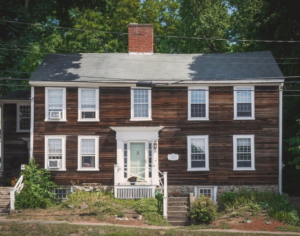
In 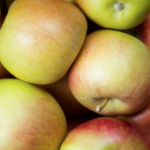 Phoenixville (Chester County) Pa.’s Excursion Ciders “uses local apples that are presssed and made in-house, also utilizing other locally-grown ingredients to make their drinks. Currently, the star of the show is Of the Farm: Core. This cider has an ABV of 7.5 percent and is made with apples from Plowville Orchard. Author John Updike spent time there and they named this cider after his novel, Of the Farm.” Here’s the
  “In the small town of Eastwick, Rhode Island, three women — Alexandra, Jane, and Sukie — discover they have magical powers after their marriages end.
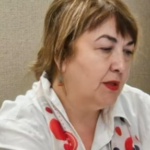 RTS, the Serbian public broadcast service, took note of two Serbian scholars of John Updike appearing on a panel at the recent American Literature Association conference in Chicago.
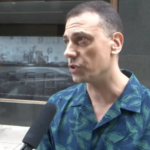 Dojčinović talked about what was covered in the panel on “Revisiting Olinger Stories (1964) at 60 and The Afterlife (1994) at 30: A Roundtable,” while Glintić talked about what it meant for his thesis-in-progress.
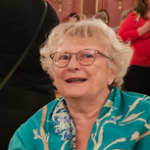 John Updike Society board member Sylvie Mathé was profiled in the series “Persistence of Character — Major interview: Archaeology of a journey” in e-Rea, electronic journal of studies on the English-speaking world. The series, published in French, tracks the breadth of an entire career of distinguished intellectuals, including early influences. An English translation exists in PDF form, but in a file to big to upload and no link to share. Here is the link to a French version online:
 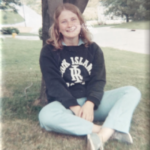 Mathé talks about the full trajectory of her career, including the experience of spending her senior year in high school in Rock Island, Ill. “Compared to my final year in French, the amount of work was nothing like it was, nor the demands of the homework,” she told the interviewer. She shared that her host family was “extremely puritanical,” with the mother “surprised, even horrified, that I had read texts by Hemingway, or Sanctuary by Faulkner…It must be said that 1968 in a small town in Illinois was still the 50s. It had nothing to do with what was happening on campuses at the same time, with women’s lib, demonstrations against the Vietnam War, for civil rights, etc.” In summary, “Let’s say that compared to my final year in French, or my life in France, which was essentially focused on high school, work and success, it was a much more varied life, more entertaining…I was doing things I had never done before: I was caught up in the rhythm, I went to matches according to the football, basketball, baseball seasons,” and she dated, went to parties where there was drinking and marijuana brownies, and was generally inducted into American culture.
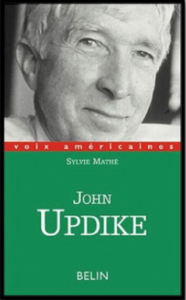 Mathé’s introduction to John Updike came when she went to Oxford and studied “Puritanism in John Updike’s Fiction” with Jeanne-Marie Santraud, “who was the only Americanist at Paris IV.” She would go on to write her master’s thesis on Updike and compose a monograph for the American Voices series edited by Marc Chénetier titled John Updike: Nostalgia for America.
 On the American Literature public Facebook group, Milan Milan Stankovic posted a consideration/comparison of two “Great American Writers” whose works offer “profound insights into American society, culture, and individual psychological and individual psychological complexities”: John Updike and Philip Roth.