Panels set for ALA

The John Updike Society will sponsor two panels and hold a business meeting at the 21st American Literature Association Conference, May 27-30, 2010, which will be held at the Hyatt Regency San Francisco in Embarcadero Center.

Here are the sessions the Society is sponsoring, and the members who are participating:

John Updike and American Pop Culture

Chair: Sally L. LeVan, Gannon University

“‘The Bright Island of Make Believe’: Updike on the Movies,” Peter Bailey, St. Lawrence University

“Returning to the Catacombs: Revisiting John Updike’s ‘Adulterous Society,'” Matthew Shipe, Washington University

“The Music of Your Life: Updike’s Visiono of Travel, Tourism, and Foreign Contact as Manifestations of American Pop Culture’s Ubiquity,” Edward Allen, The University of South Dakota

Updike Abroad

Chair: James Schiff, University of Cincinnati

“Updike’s Many Worlds, Local and Global, in Towards the End of Time,” Judie Newman, University of Nottingham

“The Cynic Tyrannies of Honest Kings: John Updike and the Use of Melville’s Verse in The Coup,” Kevin Frazier, independent scholar, Finland

“Updike’s Ambivalent Reception in France,” Sylvie Mathé, Université de Provence

All sessions will be on Thursday, May 27, with John Updike and American Pop Culture scheduled for 10:30-11:50 a.m., Updike Abroad for 1:30-2:50 p.m., and the business meeting of The John Updike Society from 3-4:20 p.m.

We hope to see many of our members there, especially those on the West Coast. But if you can only afford to travel to one conference this year, the First Biennial Updike Society Conference in Reading, Pa., is the one to go to this coming October! Those of you who can attend ALA should click on the link on the left menu for information about registration and hotels.

The next Updike volumes to be published?

Andrew Wylie, whom Martha Updike hired to act as literary agent for the Updike Estate, told The New York Observer that a collection of Updike’s essays would be given to Knopf this fall. Observer reporter Leon Neyfakh also wrote in his January 5 article that Max Rudin, publisher of the Library of America series, has been in discussions with Wylie about Library of America editions of Updike’s work, “something the author was very eager to do while he was alive but couldn’t because such editions would compete directly with Knopf’s Everyman’s Library series.” As for the essays, we asked Andrew Wylie if he could tell us whether the volume would be a compilation of previously published material, ala More Matter and Due Considerations, or if they were previously unpublished essays that came closer to Self-Consciousness. “It’s premature to say more now,” Wylie responded. “Sometime in the fall there may be more news.”

For another story about Wylie’s acquisition of the Updike account, see the January 6 Daily Finance article by Sarah Weinman.

Talk with other members on the JUS Facebook page

The John Updike Society now has a Facebook page, and there are two photo galleries so far and a discussion board where members can start topics and engage each other and Updike fans in discussions ranging from teaching Updike and interpreting texts to collecting Updike. The link is on the left column menu. Let us know what we can do to improve the Facebook page and this one. The photo here is from one of the galleries. It’s John at age 7, taken by his mother, Linda. Courtesy of Jack De Bellis.

So visit the John Updike Society Facebook page and become a “fan.” And don’t forget to send me your news to post on the Society’s website!

It’s official: Alvernia to host Society’s first conference

Today, Alvernia University and The John Updike Society announced that Alvernia will host the Society’s very first conference October 1-3, 2010. The conference will celebrate the 50th anniversary of the publication of Rabbit, Run, and it’s appropriate that Alvernia is hosting. The University was founded in 1958, the very same year that Updike saw publication of his first book, The Carpentered Hen and Other Tame Creatures. A Call for Papers will be issued soon, and information on the program, hotels, tours, etc., will be posted on the Conference Information page on the Society website left menu as details become available. They will also be posted on the Official Conference Web Page. The full press release is on the Conference Information page.

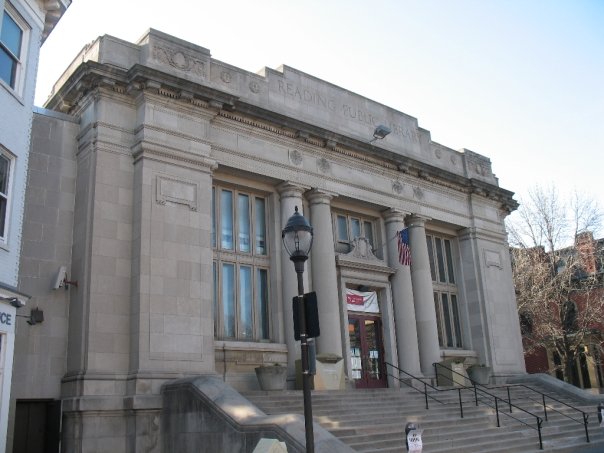
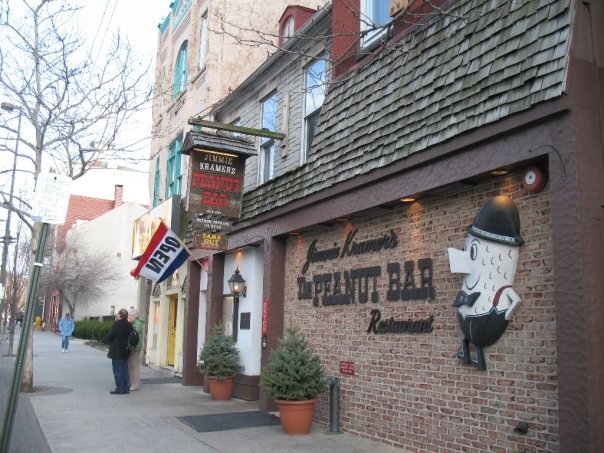
The conference will include the usual offering of panels featuring papers presented by Updike scholars and aficionados, along with panels with Updike’s Shillington High School classmates. It’s expected that at least some Updike family members will attend, and that the keynote speaker will be a writer who knew Updike. But for members of The John Updike Society, the real treat will be seeing Updike’s childhood home in Shillington, as well as remnants of the old poorhouse wall, sites mentioned in Rabbit, Run, and the farmhouse in Plowville. The owners of Updike’s childhood home and the Plowville farm are members of the Society, and they’ve graciously offered to open their doors to members for a tour. Visitors can also see the Reading Eagle where Updike worked summers as a copy boy, and eat at the Peanut Bar across the street where Updike and journalists hung out. And of course there’s the famed Pagoda rising above Reading, which Updike renamed the Pinnacle in Rabbit, Run, and the Reading Public Library, whose balconies Updike deemed “cosmically mysterious.”

The directors for the First Biennial John Updike Society Conference are Society co-founders Jack De Bellis, who will assemble the program, and Updike’s Shillington contact, Dave Silcox, who will serve as site director. So members, put October 1-3 2010 on your calendars and start saving for a trip to Pennsylvania for this doubly historic conference: the first for the Society, and a 50th anniversary celebration of Rabbit, Run.

Pictured: The Quad at Alvernia University; a young John Updike reading on the front porch of his home in Shillington; and the house as it looked in May 2009, when the Reading Public Library hosted a tribute to the author.

John Updike Society turns 100 . . . members, that is

Though The John Updike Society was formed fewer than seven months ago and launched with only 35 members, we’ve hit the 100 mark with the addition of Liliana Naydan, a doctoral candidate at SUNY-Stony Brook.

“I became interested in Updike a few years ago,” Naydan writes, “after studying his work with my now dissertation director, Prof. Stacey Olster (editor of The Cambridge Companion to John Updike). My dissertation, titled Fictions of Faith: American Literature, Religion, and the Millenium, includes a chapter on Updike (as well as Philip Roth and Don DeLillo).”

Her chapter on Updike considers “how Updike’s understanding of faith transforms on the eve of the second millennium. I argue that in In the Beauty of the Lillies Updike attempts to bridge apparent divide that fanatical believers, especially early fundamentalists, created between believing in God and embracing the developments of the 20th century as fruitful, not mere signs that an increasingly immoral American nation is rapidly devolving in the face of a fast-approaching, apocalyptic end.  I consider Updike’s earlier works, especially the Rabbit tetralogy, proposing that Updike’s focus in it is on the distinction between faith and good works as means by which to attain salvation.  In the Rabbit novels, only true faith appears to have the power to redeem man.  But in In the Beauty of the Lilies, Updike comes to distinguish between different kinds of faith, and he critiques religious fanaticism, specifically as it has emerged in the latter part of the 20th century.  Even though a fanatic’s faith is true, the intensity of that true belief creates the potential to transcend the bounds of what Updike views as characteristically good. Ultimately, I suggest that Updike comes to advocate for justification through temperance by way of his allusions to biblical and cinematic narratives.  He makes reference to the biblical Book of Esther, which suggests that God exists in the world even in the absence of clear evidence of His existence.  More to the point, he turns to Frank Capra’s Lost Horizon (1937) for his key message of temperance in all things.”

Minnesota Public Radio to feature Updike poems

Classical Minnesota Public Radio will broadcast Giving Thanks: A Celebration of Fall, Food and Gratitude on Thursday, Thanksgiving Day, Nov. 26 at 9 a.m. Minnesota Public Radio’s John Birge will host two hours of reflections on the meaning of gratitude and the blessings of Thanksgiving through words and music. The program includes John Updike reading two November poems and “To a Skylark.”

In the Twin Cities, tune in to 99.5; Minnesotans elsewhere can access the Minnesota Public Radio website to find the station closest to them.

Proposed ALA panels announced; papers sought

The board of The John Updike Society has decided to propose two panels for the 21st American Literature Association Conference in San Francisco, May 27-30 2010. “Updike Abroad” was suggested by two members separately, and the board also approved their paper proposals. But one more Updike scholar is still needed to present on this panel, and another to moderate. A second panel on “John Updike and American Pop Culture” is completely open, with three panel spots and a moderator to be filled. And of course the second business meeting of The John Updike Society will be held at ALA. There will be much to talk about, as the board has been moving forward on a proposal to hold the Society’s first conference in October 2010. And Jim Schiff is moving forward with The John Updike Review, so there will be plenty of opportunities for members and other Updike scholars to share their work. The conference will beheld at the Hyatt Regency in Embarcadero Center, San Francisco, which is near waterfront walking/jogging paths, the ferry to Alcatraz, and a cable car stop. It’s also a short walk through Chinatown to Fisherman’s Wharf from the hotel.

Those wishing to propose a paper should send a brief abstract to James Plath (jplath@iwu.edu), who will disseminate it to the board for review. Those wishing to moderate should also contact Plath.

UPDATE: The “Updike Abroad” panel has been filled, and we look forward to presentations by members Kevin Frazier (Finland), Judie Newman (England), and Sylvie Mathé (France). We still have three panelist seats open for the “John Updike and American Pop Culture” session, which will be moderated by Sally L. LeVan of Gannon University.

Houghton collection includes two unpublished novels

The Harvard Crimson reported on Wednesday that the newly acquired Updike archive includes “two unpublished Updike novels, slated to come out in twenty years,” that have “already been guaranteed to the Library for study.” According to curator Leslie A. Morris, “There will be a lot of surprises, I’m sure.”Crimson writer Michelle B. Timmerman reported that the current archive takes up 308 linear feet and that it “will take an estimated two years to sort through.”

The Houghton just requested an institutional membership in The John Updike Society (Welcome!), and Leslie Morris clarified a few things for us:

“There are two early, unpublished pieces in the Updike archive: Home and Go Away. These have been on deposit with us for many years, with access restricted by John Updike to those who had his written permission. The Literary Estate has requested that the two novels be restricted for 20 years, until 1 October 2029. Additionally, the newly acquired materials will not be available for research until catalogued, a process estimated to take about two years (some materials, such as his own publications and annotated books from his library, will be available more quickly). The material that was given to the Library during John Updike’s lifetime, listed here, will continue to be available for research until we reach the point where we are ready to ‘fold it in’ to the rest.”

Indian scholarly journal to publish Updike issue

The Criterion: An International Online Journal of Literatures in English and Language Studies, has put out a call for Indian scholars to submit papers for a special issue on John Updike, to be titled “Indian Perspectives on John Updike.”

In announcing the special issue, editor Vishwanath Bite writes, “One of the most critically respected and popular contemporary American authors, John Updike died in January 2009. We propose to bring this volume in his memory and expose Indian thoughts over his literary works. Updike has amassed a large and ever-growing body of best-selling novels, acclaimed volumes of short stories, essays, and poetry since his arrival on the literary scene in the late 1950s. An incessant chronicler of post-war American customs and morals, Updike alternately finds humor, tragedy, and pathos in the small crises and quandries of middle-class existence, particularly its sexual and religious hang-ups. His trademark fiction, largely informed by Christian theology, classical mythology, and popular culture, is distinguished for its broad erudition, wit, and descriptive opulence.”

The Call for Papers from Prof. Bite suggests possible topics on “Updike’s distinct prose style, the realist tradition in a literary mode of Updike, description of the real world over imaginative or idealized representations in Updike’s novels, the portrayal of the physical world and everyday life in Updike, the problem of faith and morality in the modern post-Christian world, autobiographical elements in Updike’s novels, spiritual quest for self-fulfillment and meaning, post-war American social history in Updike’s novels, the domestic reality of suburban middle-class American life, marital tensions, sexual behavior, relationships between men and women, religious beliefs in contemporary society, magic realism, American and Third-World ideology, a reinterpretation of the medieval Tristan and Isole legend, religious doubt, mediocrity, fame, and fanaticism, humor, clever linguistic turns and sophisticated witticisms, and Updike’s poetry.”

Needless to say, it will be fascinating to hear what Indian scholars have to say about Updike, and we thank member Pradipta Sengupta for alerting us to the journal, which she says is projected to be published online in January 2010.