LOA version of Hub Fans Bid Kid Adieu now available

Hub Fans Bid Kid Adieu: John Updike on Ted Williams is now available exclusively from The Library of America Web store, ten days ahead of its release to bookstores—including online booksellers such as Amazon and Barnes and Noble.

The list price is $15.00, but the book is available directly from the LOA for $13.50 (10 percent off) and shipping is free within the U.S. Here’s the link. You can also purchase the book by phoning LOA at 1-800-964-5778 and requesting product #410027. Jim Yerkes reports that the price is cheaper if you phone and request the product number than if you order online.

Collectible John Updike lapel pin available

There’s only one way to get this collectible John Updike lapel pin, which is faithful to the self-portrait Updike did for his Paris Review interview, and that’s to pay your membership dues for 2010. And for those who aren’t already members, it’s not too late to join. Those who do so between now and our business meeting at the American Literature Association conference the end of May will still be considered Charter Members. The lapel pin features the Society logo, sans lettering, and the Society is grateful to Martha Updike for giving us permission to use the drawing. These pins will be a great way for us to instantly recognize fellow Society members at conferences like ALA!

The Dogwood Tree: March 18, 1932

In perhaps his most famous autobiographical essay, “The Dogwood Tree: A Boyhood” (Assorted Prose, 1965), John Updike, who would have been 78 today, wrote:

“When I was born, my parents and my mother’s parents planted a dogwood tree in the side yard of the large white house in which we lived throughout my boyhood. This tree . . . was, in a sense, me.” According to Updike’s Shillington contact, Dave Silcox, John’s mother later corrected him, telling him it was planted on the one-year anniversary of his birth.

In “The Dogwood Tree,” Updike continued with a line that has more resonance today than when he wrote it:  “My dogwood tree still stands in the side yard, taller than ever . . . .”

Happy birthday.

(Photo courtesy of Jack De Bellis, taken in spring 2009)

New member treasures his encounter with J.U.

Professor Joseph McDade, of Houston Community College, is the most recent person to join the Society—our 153rd member—and like so many he’s planning on attending the Society’s first conference in October. Also like so many, he has a fond memory of meeting John Updike. His moment came on Monday, Feb. 28, 2008, when Updike spoke at Houston’s famed Alley Theater as part of the Inprint Brown Reading Series. But his relationship to John Updike began before that. He writes,

“I am guessing my own life regarding the man is fairly common.  All through college and grad school my mother would, every Christmas, treat me to each new handsome Knopf hardback, wrapped and under the tree.  Lately my wife has continued the tradition, and this past December treated me to a copy each of Rabbit at Rest and Roger’s Version (I had mentioned these were my two favorite of his novels) from the Signed First Edition series.

“I count as one of the great moments of my life the 20 or so seconds I spent with him after his Houston reading two years ago, when I stood in a line that snaked up the stairs of the Alley Theatre to a desk on a second-floor landing.  As he signed my evening’s purchase (the Everyman’s Library edition of Rabbit Angstrom: The Four Novels), I told him how happy I was that he had chosen, as part of the evening’s program, to read ‘The Family Meadow,’ a story I had often heard him read on audiotape and very nearly committed to memory.  ‘It’s one of my two favorite of your stories,’ I said.  Then, wanting to note it for the record, I continued,  ‘The other is ‘The Witnesses.”

“‘The WITnesses’?” he asked, seeming slightly startled.  I could only say, ‘Oh, sure,’ and move on.”

(Photo: The Alley Theater)

Joseph McDade

Rabbit, Run: Turning 50 and still hard to catch

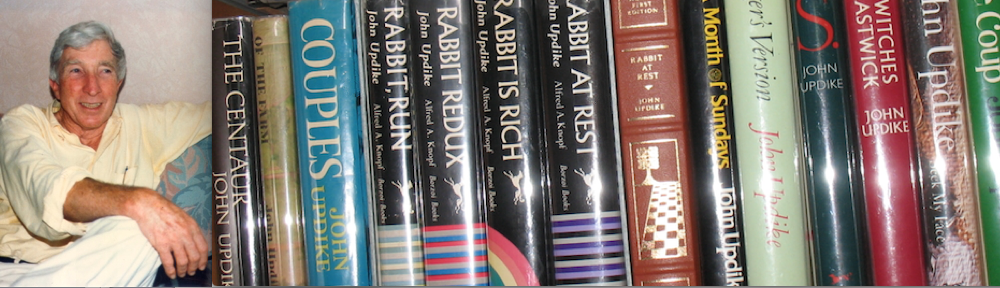
In a 1992 interview on The Dick Cavett Show, John Updike told his host that he keeps all of his books from Knopf “in a row, without their jackets, and it’s in this set that I note the typos and gaucheries, so in a sense I have a master set, ready for the new editions and to be further refined.” When Cavett said that book collectors  “would be horrified to know that the dust jackets aren’t on,” Updike responded, “Only this one set. Elsewhere in the same small room, there is a full set of them in their jackets and in their several editions and in their translations. It really is a room to enter. You’ve got to be pretty fond of me. Maybe only I can enter it.”

A collector himself, John would always take note of an edition he was asked to sign. When I finally saved up enough money to buy a First Edition of Rabbit, Run many years ago, I sent it to him to sign. It came back with another gracious inscription, but with a Post-It note attached:  “Jim—the book is a first edition, but the jacket is not [and he underlined “not”]. It quotes a review—the first had flap copy by me. Best, John.” I contacted the book dealer, who was one of the nation’s most reputable, and it was the first he’d known of this point, which wasn’t detailed in any catalog. But John noticed things like this. He was a stickler for detail and accuracy, as his readers well know. Unlike some authors who dated books if they were signed after publication year, John only dated a book if asked, or if it was a gift. He didn’t want to begrudge any collector his/her treasures.

According to Lawrence Grobel, who recently had an article on collecting Updike in Autograph Magazine, “pristine copies of his early signed books go for as much as $4500 (Rabbit, Run). Even 50 years after it was published, Rabbit, Run remains the most sought-after of Updike titles, but it’s awfully hard if not impossible to find a copy in pristine condition. Rare book dealer Ken Lopez has one for sale that’s fine in a near-fine, price-clipped dust jacket “with some slight rubbing and a tear at the lower rear spine fold,” signed, for $2000. There’s another copy on eBay now for $450 minimum bid, but it’s a little rough-looking and also has a signed bookplate—so Updike never held the book in his hands. But that’s all that seems to be out there right now, which would all but validate what Grobel is saying.

By comparison, Grobel says that signed copies of The Centaur are fetching $1800, while The Poorhouse Fair is commanding $875 and Pigeon Feathers $350. But the good news for new collectors just discovering Updike’s works is that the author so graciously signed so many books that there are a lot of the newer volumes out there for $100 or less. Hemingway and Fitzgerald Society members should be so lucky.

Will Kindle light a fire under Updike novel sales?

The Associated Press and Best Ebook Reviews reported that Random House is adding 7000 additional ebooks to its e-catalog over the next few months. Though ebooks count for fewer than a 1 percent market share of total book sales, Random House ebook sales have experienced a triple-digit percent increase since the Amazon.com Kindle reader was introduced. Typical Kindle editions sell for $9.00, and Random House specifically said that John Updike’s novels will be among those digitalized in this new wave of ebooks. For more information, see “Kindle Reader Impact–Random House ebook sales increase over 100%,” and thanks to Jack De Bellis for drawing it to our attention.

Museum & Woman: A reminiscence

Mary Houck Yuhasz was a Reading native who attended Reading High School and grew up with memories of John Updike that “skip thru our childhood and touch at various times through the years,” because Updike was a longtime friend of her family’s. Her parents and John’s were classmates at Ursinus and remained friends all their lives. In recent years, Yuhasz says she began a correspondence with Updike over the old days and she sent pictures, especially if they included images of his parents. And to the Society she sent a more recent recollection of a visit Updike made to Denver. Here it is:

John Updike Researched at Denver Museum of Nature and Science

In February 1986, John Updike was invited by the Friends of the Denver Public Library to read from some of his works. In preparation for the reading, he asked me (a lifelong friend) to take him to the then Denver Museum of Natural History. He headed for the old Dinosaur Hall and ambled around, studying the names on the exhibits. After a while I learned that what he had hoped to find was a pronunciation guide with each specimen. Since this was not included in the display, I suggested that we head back to the main information booth and ask to speak to a curator.

The person I spoke to was notably disinterested in responding to my request. John stood by, in his usual modest manner. Finally, in frustration I pointed to John and said: “Do you know who this is? John Updike, the author.” That produced a quick retreat behind the scenes and a curator arrived to discuss John’s pronunciation questions.

One of the short stories he read that evening was “The Man Who Loved Extinct Mammals,” (previously published in The New Yorker). He quoted from Harvey C. Markman’s book, Fossil Mammals. Markman had been the Curator of Geology and Paleontology from 1936 to 1954 and the Museum had published his book. John was hoping to find an answer by going to the source. In a recent interview for an article in National Geographic Updike mentioned that he had a basic knowledge in “dinosaurisms,” having written a few other such stories. Apparently such familiarity had come to him later than his 1986 reading here in Denver.

There was a bit of a dust-up over John’s visit that evening. A newspaper reporter took him to task for checking his watch too often. In his own defense, John wrote to the newspaper that he was simply trying to fall within the time period that “my sponsor and I had agreed upon.” He continued that he resented the implication that he was giving “short rations” when he had spent considerable time visiting with people after the reading. Local readers, differing with the reporter, came to John’s defense in letters to the paper afterwards. In his thanks to me he wrote of “how nicely I pronounced all those difficult terms.”

by Mary Houck Yuhasz

Member requests help with research

Member Maria L. Mogford, an Instructor of English at Albright College who’s a doctoral student at Alvernia University, would like to use the first Society conference in October to launch her research. The conference will celebrate the 50th anniversary of the publication of Rabbit, Run, and Maria is going to write her dissertation on the moral and spiritual leadership aspects present in Rabbit, Run.

“I was thrilled to find out that Alvernia will be hosting the first John Updike Society Conference this October,” Maria writes. She would like to set up and run a volunteer-only focus group consisting of Updike scholars to discuss the nature of leadership in Rabbit, Run. “The opportunity to work with experienced academics in John Updike’s hometown is very exciting. I would greatly appreciate the chance to use this focus group to explore my own ideas and perhaps crystallize and build upon those of others at the same time.”

Updike scholars who are planning on attending the Society’s first conference in October and who would like to help Maria can contact her directly to express a willingness to be a part of her focus group. Here’s her email: mmogford@alb.edu.

On the first anniversary of John Updike’s passing

In his poem, “Late January,” which was published in Tossing and Turning, John Updike ended with the line, “Time’s sharp edge is slitting another envelope.” How eerily prescient that poem feels now, a year after his passing on January 27, 2009.

Family, friends, and readers all over the world are still feeling his loss. Sure, we received our annual gift from him—three books, in fact: Endpoint and Other Poems, My Father’s Tears and Other Stories, and The Maples Stories. But it wasn’t the same, knowing that there will come a year for the first time in more than half a century when we won’t have a new book by John Updike.

We all have our favorites, but for me, one book of his remains special: Marry Me: A Romance. That’s because in April of 1995 I used that book to propose to my wife . . . with John’s help.

I still remember how he laughed when I phoned to tell him my plan and ask, “Would you help me propose to my wife?”

“You mean . . . like Cyrano?” he said, with that unmistakable bit of mischief that you heard in his voice when something amused him.

“Not quite that bad,” I said, explaining that I wanted to propose to Zarina atop the Empire State Building but hesitated to give her the ring there, afraid that it might get dropped in the nervousness of the moment and be lost in the dusk. “If I send it to you, would you be willing to inscribe my copy of Marry Me so I could use it to propose?”

“Oh, why not,” he said. “To my knowledge the book has never been used that way—though it’s a little ironic, isn’t it, since they don’t exactly live happily ever after in the book? I wouldn’t want it to jinx you.”

“It won’t,” I said. And he got the book to me just in time for a trip that Zarina and I were taking to New York City, where we were going to double date with my best friend from college—Gerry Hoey, who’s the Inspector General of New York City. The first stop was the Empire State Building, where we lingered at the top to allow some of the people to leave. Then I pulled out a small cassette player and set it on the railing. While “Arthur’s Theme” played and Gerry took pictures, I began slow-dancing with Zarina, then said, “I have something to give you.” She was expecting a ring, of course, but instead I reached behind my back and pulled out a plastic bag. I took out Marry Me and handed it to her.

Inside, John had written, “Dear Zarina, If you say ‘yes,’ you might get a ring in the Rainbow Room. Hope it all works out. Felicitations, John Updike.” And he dated it the day that I told him I was going to propose, 4/28/95. Four months later, for a wedding gift he sent us a copy of the limited edition of The Afterlife short story, in which he wrote, “For Zarina Mullan and Jim Plath, May you live happily ever after.”

Today, I’m wishing the same for him.

(Photo and text by James Plath)

The John Updike Review calls for submissions

Society board member James Schiff has been working hard to get The John Updike Review up and running, and he announced today that as editor he is ready to begin accepting submissions. This scholarly journal, published by The John Updike Society and the University of Cincinnati, will specialize in scholarship on the writings, life, and literary and cultural significance of John Updike.

The Review welcomes all critical approaches and publishes full-length articles as well as shorter notes, book reviews, bibliographical updates, professional postings about conferences, calls for papers, scholarships, and other items of interest pertaining to Updike.

Submissions will be reviewed by an editorial board comprised of Updike scholars and others knowledgeable on Updike and his writings. Work considered for publication is subjected to blind peer review by at least two outside readers and the editor.

Subscription information and submission guidelines are available at the quick-click left menu on the Society website.