The John Updike Society is now a LinkedIn group, thanks to member Brian Steffen, who started the page.
Members might find it useful for discussions, Brian said.
Here’s the link and an article about LinkedIn from Forbes Magazine.
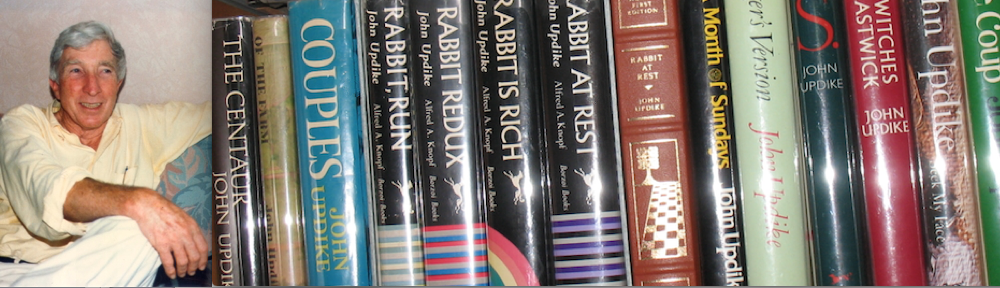
The John Updike Society is now a LinkedIn group, thanks to member Brian Steffen, who started the page.
Members might find it useful for discussions, Brian said.
Here’s the link and an article about LinkedIn from Forbes Magazine.
 Member Andrew Moorhouse sent us this item about England’s new football manager, Roy Hodgson, being an Updike lover.
It appeared online in the Guardian on Friday, May 18 and in the print version the following day.
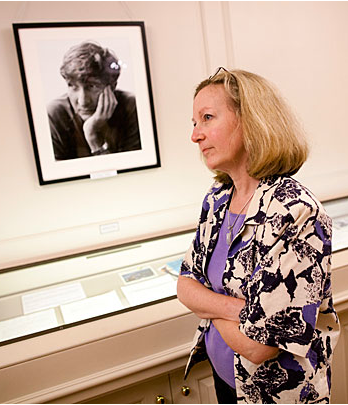 Houghton Library curator of modern books and manuscripts Leslie Morris put together a three-case exhibit for the visit by Society members during the 2nd Biennial conference, but those who missed it can still have a look. The exhibit comes down on June 30.
Here’s a Harvard Gazette article describing the exhibit and items found on Updike’s desk.
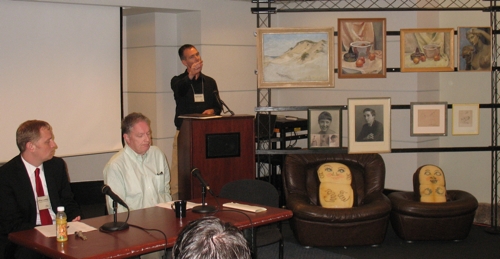 Suffolk University was a perfect host and Boston a perfect location for the Second Biennial John Updike Society Conference. Many attendees commented on the quality of papers, the exhibit that Michael Updike set up in the large meeting room, the enjoyable pacing of the conference, and the many receptions and tours. Quentin Miller and Bernard F. Rodgers, Jr. did a fantastic job, and by all accounts it was a successful conference. Members are already looking forward to 2014, when the society will return to Alvernia University in Reading, Pa., with the goal of providing tours and activities that are “must sees” for people who missed the first conference, but also some nice surprises for those who were at Alvernia in 2009. A date has not been set yet.
Here is a 2nd Conference report on the activities in Boston. Pictured above are plenary speakers Jeffrey Ludwig, Brian Keener, and Miller. For more photos, see the photo gallery on The John Updike Society Facebook page.
In just two days, the Second Biennial John Updike Society Conference kicks off in Boston with a reception at Suffolk University and a keynote talk by writer Joyce Carol Oates.
Site director Quentin Miller sent this letter to conference registrants, informing them of important details: Dear Colleagues
Here are Updike conference directions and a Restaurant Guide.
See you in Boston!
Several days ago the partners who currently own the John Updike Childhood Home at 117 Philadelphia Ave. in Shillington signed an agreement of sale that the Society signed last week. So we now have a deal in place to purchase the home with funds generously provided by a foundation to be named once the deal is closed. The sale is contingent upon the Society being able to obtain a variance to operate the house as a historic property.
Here is the article that appeared in this morning’s Reading Eagle:
“Deal reached on Updike home sale”
Another that more recently was published in The New York Times:
“John Updike Society Buys Author’s Boyhood Home for $200,000”
And a view from “across the pond” in The Guardian:
“Have we fallen out of love with John Updike?”
Short answer? No.
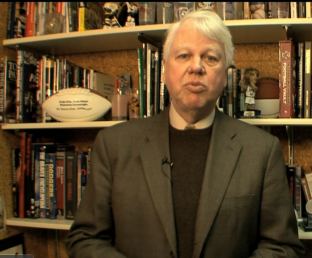 If he’s able, senior Boston Globe sportswriter and columnist Bob Ryan, who knew Updike, will address Society members after their tour of Fenway. The Red Sox have made special arrangements for the Society tour to end in the Royal Rooters club, so that we can hear Ryan’s remarks. He’s told us he would like to address the group, but much depends on how deep the Celtics go in the playoffs and when and where games are scheduled.
Updike attended Red Sox games with his college roommate and continued to take in games at Fenway, which turns 100 this year, throughout his life. He made sportswriting history with “Hub Fans Bid Kid Adieu” in describing Ted Williams’ last at-bat in an essay that many have called the best piece of sportswriting ever.
Ryan has covered all of Boston’s sports teams since 1968 and is a regular panelist on ESPN’s Sunday morning roundtable, The Sports Reporter.
It’s not too late to register for the conference, though registration will have to close soon because of the need to confirm a final count for buses and food.
The Second Biennial John Updike Society Conference will be co-sponsored and hosted by Suffolk University from June 12-16. Joyce Carol Oates is the keynote speaker, and in addition to the Fenway excursion, conference attendees will visit Salem, Updike sites in Ipswich, and Updike sites in Cambridge—including a look inside Updike’s freshman dorm room and a tour of Lowell House, where Updike lived his sophomore and junior years. And if you attended the first conference and heard from Updike’s children how he used to take them to Woodman’s of Essex for clams, you’ll know why our concluding dinner is a clambake at Woodman’s (with ribs on the menu as well).
If you still plan on registering, contact James Plath (jplath@iwu.edu) as soon as possible.
It’s past when we requested registrations to be turned in, but there’s still time to register for the Second Biennial John Updike Society Conference, June 12-16. The conference is co-sponsored and hosted by Suffolk University, on Beacon Hill near the start of the Freedom Trail, and it promises to be something special. For this conference we even have two housing options to accommodate different budgets and needs: the dorms at Suffolk, and Holiday Inn of Boston at Beacon Hill. Be advised that if you’re driving, parking at the Holiday Inn is an additional $40 or so for each night.
UPDIKE IN BOSTON (Registration and Holiday Inn information)
Suffolk dorm housing reservations
If you’re planning on attending, now’s the time to let us know, so we can begin to finalize things like bus and Woodman’s banquet reservations and our tour of Fenway Park. We had an incredibly congenial group at the First Biennial John Updike Society Conference, and people have said they’re looking forward to seeing colleagues and friends once more.
Certainly, everyone is eager to hear Joyce Carol Oates’ keynote remarks. Board member Jack De Bellis passed along this recent article about Ms. Oates.
If you have any questions, please email jplath@iwu.edu.
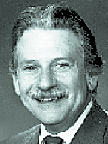 We report with sadness that John Updike Society member Brent G. Worley, 64, died on April 16, 2012 after a long battle with cancer. A resident of Berks County, Pennsylvania, and a longtime member of the Governor Mifflin School Board, Brent was an avid reader and collector of John Updike’s works who had amassed a near-complete set of autographed first trade editions of Updike’s works. He will be missed.
Here is his obituary, as it appeared in the Reading Eagle. It contains details about the memorial service on Saturday, April 28, 2012.
Our sympathies go out to his wife, Professor Rebecca Baker Worley.
 For the past several months, and with the authorization of the Board, the Society has been in discussions with a Shillington realtor, a benefactor, and current owners regarding the possible purchase of the John Updike childhood home at 117 Philadelphia Ave. We were trying to work quietly behind-the-scenes and not announce anything until we actually had something concrete to report, like a signed agreement. But one of the owners of the house went public with the story because he felt things weren’t moving quickly enough.
Here’s the Reading Eagle story about the “Author’s childhood home in limbo.”
We have foundation support lined up to enable us to purchase the home and to cover a significant portion of the maintenance into the future. We believe that Updike is an important American author and that his home should be not only preserved as a historic site, but made available to the public in some small way. We think that the Society purchasing and maintaining the home will be a good thing for Shillington and the Greater Reading area. I’ve been in touch with three author homes that operate as museums or literary centers in heavily residential areas in three different states, and have learned that the amount of traffic will actually be minimal—with less coming and going than if a family lived there, or renters, or a business. As a result, we believe that Society ownership of the house will be a good thing for the neighborhood and for Shillington; however, if the people of Shillington aren’t of the same mind, then we’re comfortable walking away from this, because when all is said and done, it’s the works themselves that speak to Updike’s legacy.
So where are things at? Well, you’ve all seen that the house was first listed on eBay and never sold, and the article indicates that the owners previously offered it to Alvernia University and the Burough of Shillington—again, with no interest. We are very interested in acquiring the property and are moving forward, but we wish to respect the process and go through proper channels, letting local residents know of our intentions, then applying for a variance . . . if we can do so without great risk or expense. Likewise, if our desire to pursue this through proper channels puts the owners in an untenable position, we’ve told the owners that they can put the property on the market again.
When we have something to report, we’ll report it here. We apologize that our members weren’t the first to read about this, but we were as surprised as anybody when one of the owners went public with this. He seems to think that public opinion will help us get the variance; we’re of the mind that proper channels are the way to go.