On word processing and writing habits

The Atlantic‘s Robinson Meyer contributed a piece on “How to Write a History of Writing Software,” subtitled “Isaac Asimov, John Updike, and John Hersey changed their writing habits to adapt to word processors, according to the first literary historian of the technology.” Meyer interviewed University of Maryland English professor Matthew Kirschenbaum, who has just published the first book-length history of word processing, Track Changes.

“It is more than a history of high art. Kirschenbaum follows how writers of popular and genre fiction adopted the technology long before vaunted novelists did. He determines how their writing habits and financial powers changed once they moved from typewriter to computing. And he details the unsettled ways that the computer first entered the home. (When he first bought a computer, for example, the science-fiction legend Isaac Asimov wasn’t sure whether it should go in the living room or the study.)

381b75cb92d30e801cc36925695d80ef“His new history joins a much larger body of scholarship about other modern writing technologies—specifically, typewriters. For instance, scholars confidently believe that the first book ever written with a typewriter was Life on the Mississippi, by Mark Twain. They have conducted typographical forensics to identify precisely how T.S. Elioit’s The Wasteland was composed—which typewriters were used, and when. And they have collected certain important machines for their archives.”

Kirschenbaum says that while he can’t say for certain which writer was first to compose using a word processor or computer, notable candidates are science-fiction author Jerry Pournelle and author John Hersey, who edited Hiroshima on a keyboard and used to computer to generate camera-ready copy.

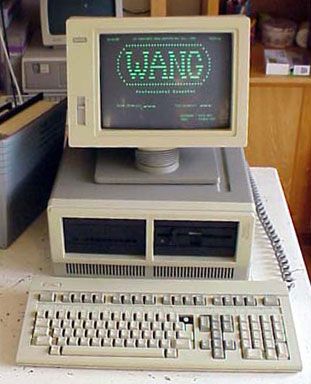
“Another interesting story that’s in the book is about John Updike, who gets a Wang word processor at about the time Stephen King does, in the early 1980s. I was able to inspect the last typewriter ribbon that he used in the last typewriter he owned. A collector who had the original typewriter was kind enough to lend it to me. And you can read the text back off that typewriter ribbon—and you can’t make this stuff up, this is why it’s so wonderful to be able to write history—the last thing that Updike writes with the typewriter is a note to his secretary telling her that he won’t need her typing services because he now has a word processor.”

Pictured: Stock photo of typical Wang word processor from the 1980s.


John Updike, Accidental Conservative?

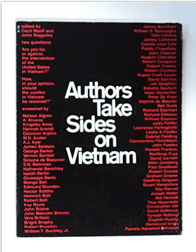
Screen Shot 2016-04-17 at 9.00.17 PMEchoing a critical essay that Society member Yoav Fromer wrote, Con Chapman explores the circumstances surrounding Updike’s hawkish Vietnam War stance in “John Updike, Accidental Conservative,” posted April 12, 2016 on Easy Street: a magazine of books and culture. He also provides additional context.

The Times, in a particularly dishonest bit of sleight-of-hand, said that Updike was the lone American writer in the collection [Authors Take Sides on Vietnam] who was ‘unequivocally for’ the United States intervention in Vietnam. This was untrue; novelist James Michener, who had spent much time in Asia, was more forthright in his defense of the American presence there than Updike….”

Ironically, as Chapman notes of Updike, “Had he not been summering on Martha’s Vineyard he would have been busy, he recalled later, and probably wouldn’t have answered the query, which was designed to elicit responses that could be assembled into a book of the sort that had been put together three decades earlier from writers’ reactions to the Spanish Civil War.

“Instead, he composed a thoughtful response that considered both sides of the question; he was, he wrote, uncomfortable about what he called America’s ‘military adventure’ in South Vietnam, but he doubted that the Viet Cong, who used force to rule the peasants of the country, had a ‘moral edge’ over the United States. He said the country needed free elections, and if they chose Communism the U.S. should leave, but until that time he did ‘not see that we can abdicate our burdensome position.'”

Chapman concludes, “In the long run, the controversy didn’t hurt Updike, who was unceasingly productive to the end of his life, but in the short run it cost him. Within a few months his tenure as a writer of unsigned ‘Talk of the Town’ pieces for The New Yorker ended when his editor objected to the tone of a piece that suggested, when Johnson announced that he would not run for re-election in 1968, that the President ‘might have been right after all.’ Updike acquiesced in a suggested revision, then decided to leave the column ‘to other, more leftish hands.’

“History has, of course, proven Updike right…,” Chapman concludes.

Author: Dying writers left things messy, unresolved

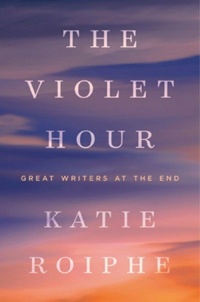
VioletHourIn a New York Times article to promote her new book The Violent Hour: Great Writers at the End, Katie Roiphe talks about the false notion that “when someone is dying, a new, honest, generous space opens up; that in the harrowing awfulness of dying there is a directness, an expansiveness, a loosening of inhibitions, the potential for things to be said that could not be said before. But if one does actually manage to pull off a last conversation, what can it be but a few words in a lifetime of talk?”

Roiphe featured John Updike in her book and includes remarks about Updike here as well:

“I talked about John Updike’s death with his ex-wife, Mary. She told me that there were questions she wanted to ask him that only he could answer. I heard this over and over. There were questions the bereaved wanted to ask. There were mysteries or confusions that could be cleared up if only they could have engineered that last conversation.

“Updike actually wrote about this. In Rabbit at Rest, as Rabbit Angstrom lies dying, he sees on his son’s face, ‘some unaskable question.’ Rabbit feels sorry for everything he has put the kid through, his various ebullient and destructive flights from the family, for instance, but he can’t quite muster that thought into words. His son looks at him expectantly. The last conversation is perhaps just the feeling that there is something more to say.”

Here’s the full article.

Roiphe was also featured on NPR, and quoted in a story titled “With Fear, Determination And Poetry: How Great Writers Face Death,” which features an audio link as well.

On John Updike, who wrote poems in the hospital after being diagnosed with lung cancer

It was amazing. He had very little time — just weeks before he was dead. I actually went up and looked at the manuscripts and you can see in his handwriting how arduous it was. At that last moment, when most people would just be watching television or railing against the universe, that was what he did and I found it very moving. …

The poems have a sort of quality of reporting — that he’s bringing news. And he talks about writing as turning pain into honey, which I find a really beautiful way to think about what writers do: taking this incredibly awful — maybe the most awful thing that can happen to you — and turning it into honey just with words.”

Cancer Today spotlights Updike

Cancer Today, the publication of the American Association for Cancer Research, featured “A Storied Life” by writer Sue Rochman in the Winter 2015-16 issue, which is also available online. In it, Rochman details how “literary realist John Updike used the scaffold of his own life, including his lung cancer diagnosis, to explore the shared experiences of our time.”

Screen Shot 2016-03-02 at 9.43.10 PMShe writes, “Not only did he write in many forms, Updike wrote all the time, producing on average a book a year. That didn’t change after he was diagnosed with lung cancer in 2008. He spent the months before he died writing poems on facing mortality, many of which were published in his collection Endpoint and Other Poems.

Lung cancer, Rochman reports, “is divided into two main types: small cell, which makes up about 15 percent of all diagnoses and non-small cell, which accounts for about 85 percent.

“It’s not widely known what type of lung cancer Updike had. It is known that he began to have some breathing problems in the summer of 2008. The initial diagnosis was bronchitis. When the cough didn’t clear, he was told it was pneumonia, a diagnosis he described as ‘oblong ghosts, one paler than the other on the doctor’s viewing screen’ in a poem dated Nov. 6. Two weeks later, as Thanksgiving approached, Updike spent five days at Massachusetts General Hospital in Boston, undergoing the tests that led to his lung cancer diagnosis.

“A misdiagnosis of pneumonia is ‘unfortunately, a common scenario,’ says medical oncologist Joan Schiller, deputy director of the Harold C. Simmons Comprehensive Cancer Center at the University of Texas Southwestern Medical Center in Dallas. ‘Pneumonia is a heck of a lot more common than lung cancer, so it’s understandable that someone with a cough would be treated for pneumonia and then later find out it is lung cancer.’

“When people die so quickly from cancer, it is often assumed the disease spread quickly. That can and does happen, but another common reason for a late lung cancer diagnosis is that it can be hard to know it’s there. ‘One reason is that the lungs don’t have a lot of nerves, so it doesn’t cause pain—and you can’t see it,’ says Schiller. Still, she says, even for lung cancer, Updike’s two-month span from diagnosis to death was unusually quick.

“Updike’s cancer was treated with chemotherapy. Were he diagnosed today, says Gregory A. Masters, a medical oncologist specializing in lung cancer at Christiana Care’s Helen F. Graham Cancer Center in Newark, Delaware, he might have had more options.

“‘Instead of having everyone with stage IV lung cancer get the same chemotherapy,’ says Masters, ‘we now see if the patient has one or more of the specific gene alterations that allow us to use a targeted therapy. If they do, we can give them a treatment that is more effective, less toxic and that will control the tumor for more time.'”

Here’s the complete article, which also offers a career summary of Updike and his literary importance.

Franzen on The Birth of The New Yorker Story

in an essay “drawn from The ’50s: The Story of a Decade, an anthology of New Yorker articles, stories, and poems” published the last week in October, Jonathan Franzen considers the writers and stories that came to characterize the magazine’s fiction.

“Along with John Updike and Ann Beattie, Cheever was the paradigmatic ‘New Yorker story’ writer, Franzen says, adding, “While Cheever and Updike were creating the main template for the New Yorker story, regional variants were flourishing.”

“The Birth of ‘The New Yorker Story'”

Fluff piece cites Rushdie-Updike feud

In “‘As usual, words fail him’—6 great literary feuds,” a glorified “list” story meant to entertain, The Telegraph’s Morwenna Ferrier and Rupert Hawksley offer a fluff piece that doesn’t go into much detail and didn’t involve much research. But it’s worth noting that Updike gets a mention:

Salman Rushdie vs John Updike

“Rushdie, as we know, is no stranger to controversy, but his battle with John Updike tops all his feuds.

“In 2006, Updike denounced Rushdie’s novel, Shalimar the Clown, writing ‘Why, oh why did Salman Rushdie, in his new novel call one of his major characters Maximilian Ophuls?.’ Rushdie responded to Updike’s query in The Guardian: ‘Why, oh why… ? Well, why not? Somewhere in Las Vegas there’s probably a male prostitute called “John Updike”.’ He went on to describe Updike’s latest, Terrorist, as ‘beyond awful,’ and suggested Updike should ‘stay in his parochial neighbourhood and write about wife-swapping, because it’s what he can do.’ Because what’s a little quibbling between literary giants…”

David Updike on Growing up Updike

Alvernia University just posted an online version of an earlier published memoir by David Updike, “Growing up Updike.” Here’s an excerpt:

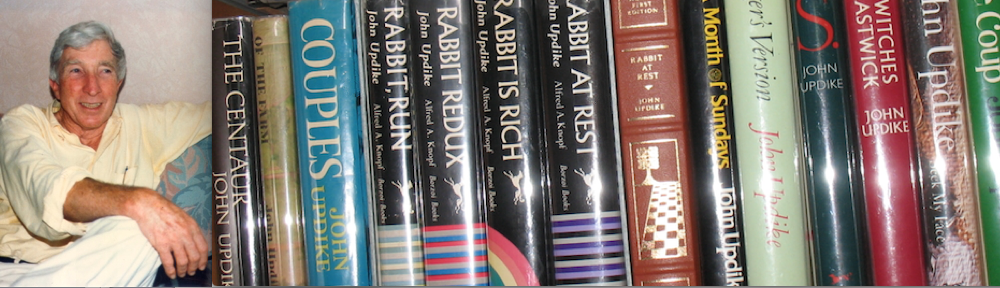
Screen Shot 2015-04-12 at 6.03.56 PM“As children, we grew up with the click-and-clackety sound of his typewriter — a battleship gray, Olympia manual — in our ears, and a gathering sense of his success, then growing fame. By the time I was seven he had published Rabbit, Run, then won the national book award from The Centaur, and moved his office from our house to a larger space in a modest, somewhat run-down office building downtown that he shared with a dentist, accountants and other such small businesses,” David writes.

“There, on a side table, lay The Centaur, with a picture of a half horse, half man. At night, he sat in a chair, reading proofs — long, scroll-like pieces of paper, on which he made small adjustments with a pencil. One fall, my grandparents arrived from Pennsylvania, with a basketful of fruit and a skittish dog, to look after us while my parents went to Russia for a month on a state department tour. His picture began to appear in magazines, and he was even sometimes on TV. A year or two later, Russians visited us, bearing gifts, and we took them for a lively walk on the beach, dogs and children included. Perhaps only with the publication of Couples in 1968, and the news from my friends that my father wrote a ‘dirty book,’ did I feel a twinge of unease, tempered by the knowledge he would be paid $400,000 for the movie rights! For soon we were on a boat, crossing the ocean in my new gray flannel pants, to spend the year in England attending a fancy American school and making side trips to Amsterdam, Austria for skiing, and then Morocco in April, to get some warmth and sun. Then by June, we flew back to America.

“My parents were still very young, in their thirties, and by my estimation the best-looking couple in their groups of friends — my father certainly the cleverest and most famous, my mother surely the most beautiful. But as a child my father had psoriasis, and asthma, and so shied away from organized sports, and even, I believe, felt inferior to the sports stars at Shillington High — the Harry Angstroms of his class.

“My mother had played field hockey in high school, and was an excellent ice skater, and they took us for long skating expeditions up the Ipswich River, back when it still froze solid. They played volleyball on Sunday afternoons, and then all migrated to someone else’s house, for ‘cocktails.’ They learned to play tennis, and ski, and we all went on Pleasant Mountain in February, where they had renamed the beginners slope Rabbit, Run, after his best-known novel.

“In tennis and skiing, they both became what I might call elegant intermediates. My father played kickball with us in the backyard, wheeling around the bases on long, loose legs while we frantically tried to retrieve the ball in some distant bushes. In the fall, there was touch football with the men, and in spring, before volleyball, half-court basketball, where he played shirtless and had a reliable, baby sky hook.”
Ipswich blogger commemorates an Updike milestone

Gordon Harris has posted another Updike-related story on his blog, Stories From Ipswich and the North Shore, subtitled “An antiquarian almanac from historic Ipswich, Massachusetts–In the news since 1633.”

In “John Updike is elected to National Institute of Arts and Letters, April 1, 1964” Harris embraces Updike’s honor as the community’s in a brief commemoration.

Ipswich blog tells the history of a former Updike residence

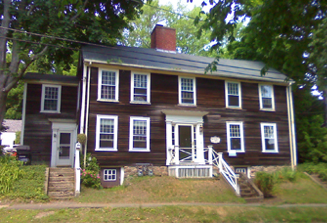
Screen Shot 2015-03-21 at 7.19.49 PMAn Ipswich blog recently posted a Gordon Harris story about the Polly Dole House at 26 East St. in Ipswich, Mass., where Updike once lived. The post quotes an article that Updike had written about the house for Architectural Digest that was reprinted in Picked-Up Pieces.

“The house I and my wife and four children lived in was called, on a plaque beside the front door, the Polly Dole House and given a date of 1686, though one expert sneeringly opined that dating it prior to 1725 would compromise his integrity.

“A seventeenth-century house can be recognized by its steep roof, massive central chimney and utter porchlessness. Some of those houses have a second-story overhang, emphasizing their medieval look. The gables are on the sides. The windows were originally small, with fixed casements and leaded diamond panes. The basic plan called for two rooms over two, the fireplace opening into each room; a later plan added half-rooms behind, creating the traditional saltbox shape. Inside the front door—at least our front door—a shallow front hall gave onto an exiguous staircase squeezed into the space left by the great brick core at the heart of the house. The fireplace, with its cast-iron spits and bake ovens, had been the kitchen. The virgin forests of the New World had contributed massive timbers, adzed into shape and mortise-and-tenoned together, and floorboards up to a foot wide.

“The Polly Dole House had a living room so large that people supposed the house had originally been an inn, on the winding old road to Newburyport, which ran close by. Polly Dole was a shadowy lady who may have waited on tables; we never found out much about her, though local eyebrows still lifted at her name. The big room, with its gorgeous floorboards, was one you sailed through, and the furniture never stayed in any one place. The walk-in fireplace, when the three-foot logs in it got going, singed your eyebrows and dried out the joints of any chair drawn up too cozily close. In the middle of the summer beam, a huge nut and washer terminated a long steel rod that went up to a triangular arrangement of timbers in the attic; at one point the house had been lifted by its own bootstraps. I used to tell my children that if we turned the nut the whole house would fall down. We never tried it.

“The decade was the sixties, my wife and I were youngish, and the house suited us just fine. It was Puritan; it was back-to-nature; it was less is more.”

Harris clears up the date:  “This salt box house was built in 1720 and has elements from a previous house built in 1687. It has a large front living room with a low ceiling, wide board floors and a ‘walk-in’ fireplace.

“The long ‘summer beam’ in the middle of this room is suspended by a cable to the peak of the roof. The left side is smaller than the right, suggesting that it may have been originally built as a ‘half house’ with the right side and the left addition added later.

“The house was built for Deacon John Staniford (1648-1730) and his wife Margaret, the daughter of Thomas and Martha (Lake) Harris. John Staniford bears the title of Mr. in his young life, and Deacon in his old age. He was said to be a man of intellectual qualities and ‘much occupied with duties which require legal knowledge.’

“Thomas Franklin Waters writes in Ipswich in the Massachusetts Bay Colony, ‘Capt. Jeremiah Staniford inherited the homestead of his father, Capt. John Staniford. Daniel Staniford received the homestead and sold to Nathaniel Lord 3d, March 5, 1811. Nathaniel Lord sold to two women, whose names are well remembered, Lucy Fuller and Polly Dole, April 29, 1837. The administrator of Lucy Fuller’s estate sold to Daniel S. Burnham, Aug. 23, 1865.’”

Stories From Ipswich and the North Shore

Continue reading

Russian lit expert shares Updike’s response to this and that

photoU.R. Bowie, who taught Russian literature for 30 years at Miami University and now writes a blog, recently shared a response from Updike to his questions about Charles D’Ambrosio (Up North), Natalie Portman and Julia Roberts (Closer), Woody Allen (Match Point), literary fiction, fluency in Russian, Philip Roth, Zuckerman, Zuckerman’s prostate gland, “etc.”

Here is Updike’s response to his 2006 letter:

classical-russian-literature.blogspot.com