
Updike poem read on Serbian state TV

BiljanaJohn Updike Society board member Biljana Dojčinović was featured on RTS (Radio Television of Serbia) in a program of culture titled “Metropolis,” about Sylvia Plath.

In it, around the 28-minute mark, she reads (in her Serbian translation) the beginning and end of Updike’s poem, “Upon Looking into Sylvia Plath’s Letters Home.”

Here are the YouTube link and some screen grabs.

Plath

Updike inspired fine press publisher

10801923_575518042584588_3734138739554104525_nJohn Updike Society members may know Andrew Moorhouse from the last two conferences he attended, at which he modestly suggested he was not an academic but “only” an Updike fan, a reader, and a lover of books.

But it turns out that his love of books has made him one of the most respected fine press publishers in the United Kingdom. And John Updike inspired him.

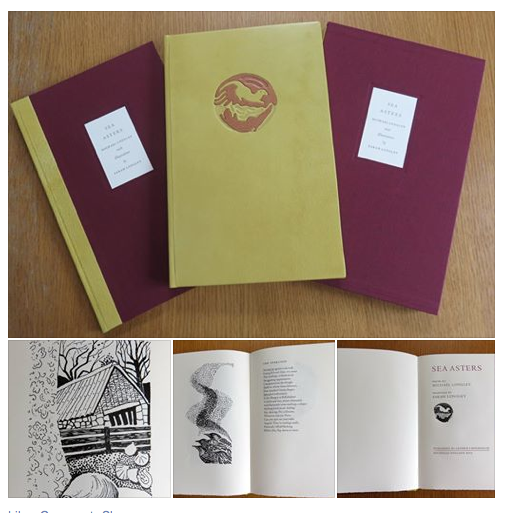
“The American author John Updike said: ‘A book is beautiful in its relation to the human eye, to the human hand, to the human brain and to the human spirit,’ and it is this quote which encouraged me to get involved in Fine Press publishing,” Moorhouse wrote in an article that appeared yesterday in The Irish Times: “Michael Longley’s Sea Asters: publishing as a work of art.”

In the article, Moorhouse talks about how he started Fine Press Poetry in 2013 and how his first three books—two featuring British poet Simon Armitage and this third release, Michael Longley’s Sea Asters, illustrated by the author’s artist daughter—came to be. The article also contains several poems by Longley, who was recently announced as winner of the Griffin International Poetry Prize.

Moorhouse’s forthcoming publication is Andrew Motion’s Ted Hughes Award-winning Coming Home poems. Fine Press Poetry, which specializes in creating letterpress editions of poems accompanied by illustrations by wood engravers and artists, is based in Rochdale, England.

Screen Shot 2015-06-06 at 8.12.53 AM

The New Republic on why we need physical books

Screen Shot 2015-04-20 at 7.55.17 AMIn “Object Lesson,” a consideration of “Why we need physical books published in the New Republic, William Giraldi inevitably turns to Updike:

“There was little that escaped the Updikian caress, and he wrote more than once about the pleasures and peculiarities of book collecting. In an essay called “The Unread Book Route,” about A History of Japan to 1334, Updike wrote: ‘The physical presence of this book, so substantial, so fresh, the edges so trim, the type so tasty, reawakens in me, like a Proustian talisman, the emotions I experienced when, in my youth, I ordered it.’ Leave it to the unerringly sensual and curious Updike to a) refer to book type as ‘tasty,’ and b) think as a youth that he needed to know something about Japan prior to 1334.

“Updike’s point about the Proustian talisman is a crucial one for bibliophiles: Their collections are not only proof of their evolution but monuments to their past, fragrant and visual stimulators of recall.”

Sex-on-the-page article includes Updike (of course)

In a story written for The Sacramento Bee books section, writer Sam McManis considers “Sex on the page: Often cringe-worthy, occasionally uplifting.” The pun was most certainly intended, considering some of the examples McManis cites as less than effective—among them this passage from Updike’s Brazil: “…he felt his cashew become a banana, and then a rippled yam.”

Updike’s contemporary and rival Philip Roth also gets “ribbed” for a passage from “The Humbling,” in which he attempts to describe a threesome: “It was as if she were wearing a mask on her genitals, a weird totem mask, that made her into what she was not and was not supposed to be. She could as well have been a crow or a coyote…”

“‘Good sex is impossible to write about,’ [Martin] Amis once told the Washington Post. ‘[D.H.] Lawrence and Updike have given it their all, and the result is still uneasy and unsure. It may be that good sex is something fiction just can’t do—like dreams. Most of the sex in my novels is absolutely disastrous. Sex can be funny, but not very sexy.”

“Yet the late Updike, twice a Pulitzer Prize winner, once told NPR’s Fresh Air that writing about ‘sexual transactions’ is realism at its core and a window into the human condition.

“‘For many people it’s the height of, what they see, of ecstasy and poetry is in their sexual encounters, who, for the record, had the Bad Sex ‘Lifetime Achievement Award’ bestowed upon him in 2008, a year before his death. ‘And furthermore … human personality does not end in the bedroom, but persists. Not all lovemaking is alike. Anyway, it seemed a writer should clearly be free to describe it.'”

Katie Roiphe is more complimentary of Updike’s attempts in a 2010 New York Times Book Review essay, especially the passages from the Rabbit novels. A “top-form” passage is cited: “…a little gauge inside his ribs doubles and redoubles his need for pressure…there is no love in it, love that glances and glides along the skin, he is unconscious of their skins, it is her heart he wants to grind into his own, to comfort her completely.’

“Roiphe credits Updike’s ‘unnerving gift: to be frank and anesthetizing all at once, to do poetry and whorehouse,” and gently scolds a newer generation of great American writers…for being passive and sexually ambivalent.”

Ipswich blogger commemorates an Updike milestone

Gordon Harris has posted another Updike-related story on his blog, Stories From Ipswich and the North Shore, subtitled “An antiquarian almanac from historic Ipswich, Massachusetts–In the news since 1633.”

In “John Updike is elected to National Institute of Arts and Letters, April 1, 1964” Harris embraces Updike’s honor as the community’s in a brief commemoration.

Ipswich blog tells the history of a former Updike residence

Screen Shot 2015-03-21 at 7.19.49 PMAn Ipswich blog recently posted a Gordon Harris story about the Polly Dole House at 26 East St. in Ipswich, Mass., where Updike once lived. The post quotes an article that Updike had written about the house for Architectural Digest that was reprinted in Picked-Up Pieces.

“The house I and my wife and four children lived in was called, on a plaque beside the front door, the Polly Dole House and given a date of 1686, though one expert sneeringly opined that dating it prior to 1725 would compromise his integrity.

“A seventeenth-century house can be recognized by its steep roof, massive central chimney and utter porchlessness. Some of those houses have a second-story overhang, emphasizing their medieval look. The gables are on the sides. The windows were originally small, with fixed casements and leaded diamond panes. The basic plan called for two rooms over two, the fireplace opening into each room; a later plan added half-rooms behind, creating the traditional saltbox shape. Inside the front door—at least our front door—a shallow front hall gave onto an exiguous staircase squeezed into the space left by the great brick core at the heart of the house. The fireplace, with its cast-iron spits and bake ovens, had been the kitchen. The virgin forests of the New World had contributed massive timbers, adzed into shape and mortise-and-tenoned together, and floorboards up to a foot wide.

“The Polly Dole House had a living room so large that people supposed the house had originally been an inn, on the winding old road to Newburyport, which ran close by. Polly Dole was a shadowy lady who may have waited on tables; we never found out much about her, though local eyebrows still lifted at her name. The big room, with its gorgeous floorboards, was one you sailed through, and the furniture never stayed in any one place. The walk-in fireplace, when the three-foot logs in it got going, singed your eyebrows and dried out the joints of any chair drawn up too cozily close. In the middle of the summer beam, a huge nut and washer terminated a long steel rod that went up to a triangular arrangement of timbers in the attic; at one point the house had been lifted by its own bootstraps. I used to tell my children that if we turned the nut the whole house would fall down. We never tried it.

“The decade was the sixties, my wife and I were youngish, and the house suited us just fine. It was Puritan; it was back-to-nature; it was less is more.”

Harris clears up the date:  “This salt box house was built in 1720 and has elements from a previous house built in 1687. It has a large front living room with a low ceiling, wide board floors and a ‘walk-in’ fireplace.

“The long ‘summer beam’ in the middle of this room is suspended by a cable to the peak of the roof. The left side is smaller than the right, suggesting that it may have been originally built as a ‘half house’ with the right side and the left addition added later.

“The house was built for Deacon John Staniford (1648-1730) and his wife Margaret, the daughter of Thomas and Martha (Lake) Harris. John Staniford bears the title of Mr. in his young life, and Deacon in his old age. He was said to be a man of intellectual qualities and ‘much occupied with duties which require legal knowledge.’

“Thomas Franklin Waters writes in Ipswich in the Massachusetts Bay Colony, ‘Capt. Jeremiah Staniford inherited the homestead of his father, Capt. John Staniford. Daniel Staniford received the homestead and sold to Nathaniel Lord 3d, March 5, 1811. Nathaniel Lord sold to two women, whose names are well remembered, Lucy Fuller and Polly Dole, April 29, 1837. The administrator of Lucy Fuller’s estate sold to Daniel S. Burnham, Aug. 23, 1865.’”

Stories From Ipswich and the North Shore

Continue reading

Russian lit expert shares Updike’s response to this and that

photoU.R. Bowie, who taught Russian literature for 30 years at Miami University and now writes a blog, recently shared a response from Updike to his questions about Charles D’Ambrosio (Up North), Natalie Portman and Julia Roberts (Closer), Woody Allen (Match Point), literary fiction, fluency in Russian, Philip Roth, Zuckerman, Zuckerman’s prostate gland, “etc.”

Here is Updike’s response to his 2006 letter:

classical-russian-literature.blogspot.com

Updike mentioned in L.E. Sissman reconsideration

Danny Heitman wrote a piece for The Magazine of The Weekly Standard about “Darkness Visible: L.E. Sissman, poet in a gray flannel suit” in which Updike is mentioned. The news “peg” is the final season of Mad Men, and Sissman is evoked as an example of “a real-life advertising executive in the 1960s, who appeared to survive the experience with his soul intact—even deepened.

Screen Shot 2015-03-20 at 7.06.49 AM“Along with his advertising career in Boston, where, over the years, he worked as a creative vice president at two leading firms, Sissman built a national reputation as a man of letters, penning book reviews for The New Yorker, a regular first-person column for The Atlantic, and several books of poetry. John Updike was a big fan, admiring Sissman’s literary work as an expression of ‘amiable, attentive intelligence.’ Other contemporary admirers included fellow poets Anthony Hecht, Richard Howard, and Howard Moss. The writer behind Sissman’s poems and essays seemed centered, charming, humane. ‘A sensible, decent man: that is the voice,’ Updike said of his friend.”

“Sissman reflexively avoided the bland generality in favor of the telling particular, which is why Updike, another master of precise observation, liked him so much. ‘When he evokes a city, it is Detroit or New York or Boston; there is no confusing the tint of the pavements,’ Updike wrote. ‘When he recalls a day from his life, though it comes from as far away as November 1944, it arrives not only with all its solid furniture but with its own weather—in this case, ‘thin, slate-colored clouds sometimes letting through flat blades of sun.’ '”