Updike one of three to comment on Pamuk novel

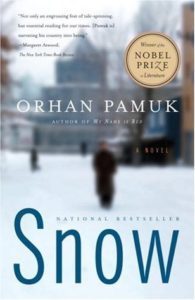
“Back in 2004,” Literary Hub writes, “three literary heavyweights reviewed Orhan Pamuk’s novel of Modern Turkey,” and in the article “Atwood, Updike and Hitchens on Snow the site compiles remarks from three individual book reviews.

In a review published in the August 30, 2004 New Yorker, Updike concluded, “If at times Snow seems attenuated and opaque, we should not forget that in Turkey, insofar as it partakes of the Islamic world’s present murderous war of censorious fanaticism versus free speech and truth-seeking, to write with honest complexity about such matters as head scarves and religious belief takes courage. Pamuk, relatively young as he is, at the age of fifty-two, qualifies as that country’s most likely candidate for the Nobel Prize, and the near-assassination of Islam’s last winner must cross his mind. To produce a major work so frankly troubled and provocatively bemused and, against the grain of the author’s usual antiquarian bent, entirely contemporary in its setting and subjects, took the courage that art sometimes visits upon even its most detached practitioners.”

Read the entire article.

Book on famous stutterers includes chapter on Updike

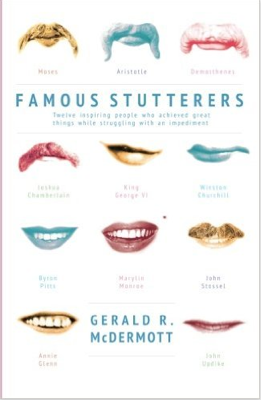
In Chapter 12 of Famous Stutterers, author Gerald R. McDermott begins,

“Until John Updike (1932-2009), no one had ever described stuttering with such dead-on precision. Once he compared it to a traffic jam. ‘I have lots of words inside me: but at moments, like rush-hour traffic at the mouth of a tunnel, they jam.’

“He painted a picture of facial tics that will make any relative of a stutterer groan with recognition.
Viewing myself on taped television, I see the repulsive symptoms
of an approaching stammer take possession of my face—an
electronically rapid flutter of the eyelids, a distortion of the mouth
as of a leather purse being cinched, a terrifying hardening of the
upper lip, a fatal tensing and a lifting of the voice

“All stutterers will nod knowingly when they hear him refer to that ‘untrustworthy’ part of himself that ‘can collapse at awkward or anxious moments into a stutter.’ They might smile at his philosophical conclusion that stuttering is a sign of the ‘duality of our existence, the ability of the body and soul to say no to one another.’ Or his reflection that a stammer is the acknowledgement of unacknowledged complexities surrounding even the simplest of verbal exchanges.”

Other famous stutterers included in the book are Moses, Aristotle, Demosthenes, Joshua Chamberlain, King George VI, Winston Churchill, Byron Pitts, Marilyn Monroe, John Stossel, and Annie Glenn.

Amazon link

Are cigarettes and golf transcendent for writers?

A book review of Gregor Hens’s Nicotine written for The Atlantic begins,

“Writers have long found rich fodder for their work in their leisure pursuits. John Updike, writing about golf in The New York Times in 1973, described the pastime as ‘a non-chemical hallucinogen’ that ‘breaks the human body into components so strangely elongated and so tenuously linked, yet with anxious little bunches of hyper-consciousness and undue effort bulging here and there, along with rotating blind patches and a sort of cartilaginous euphoria.’ Sketching out a particularly lucid paragraph about the act of preparing for a stroke, he confessed, ‘got me so excited I had to rush out into the yard and hit a few shots, even though it was pitch dark, and only the daffodils showed.’

“Updike’s experience of transcendence while playing golf—his sense of tapping in to a kind of acute concentration that alters perception—is echoed vividly in the German writer Gregor Hens’s new memoir of sorts, Nicotine,” reviewer Sophie Gilbert writes.

Nicotine, she says, “enters a kind of sub-genre of literary memoirs focused around a single practice or obsession, in which the object or activity enables the writer to achieve sharper focus, heightened consciousness, and creative fire. Like Haruki Murakami’s What I Talk About When I Talk About Running and Updike’s writing on golf, it illuminates the writerly quest for the elusive state the Hungarian psychologist Mihály Csíkszentmihályi named, simply, ‘flow.’ Smoking, Hens seems to believe, transformed him into a writer by expanding his sense of what was real and what was perceivable. It physically and irreparably altered the pathways in his brain. And it punctuated and constructed the order of his professional life.”

Read the full review.

Blogger considers Updike, Rabbit and Tolstoy

screen-shot-2016-12-26-at-9-22-47-am‘Twas the night before Christmas, and blogger Richard Smith (Richard Smith’s non-medical blogs) spent the evening pondering the connection between John Updike and his alter ego, Harry “Rabbit” Angstrom—specifically, by reading, considering, and including quotes from the novella Rabbit Remembered, with a comparison to Tolstoy thrown in for good measure:

“One of the characters in Rabbit Remembered says of the detective novels she is always reading, ‘How do they make all this up? They must have a screw loose.’ John Updike I feel is mocking himself. I’m sure that he thinks he has a screw loose, and he’s glad about it. He wouldn’t have wanted to have all his screws tight; who does?

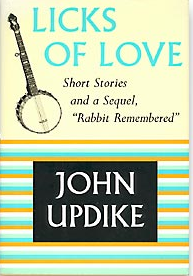
“I came to read Rabbit Remembered by mistake. I’ve been slowly—here and there, for a shot of humor, color, and inventiveness, like a glass of Cognac—been reading my way through Updike’s Licks of Love. When I started reading Rabbit Remembered I thought I was reading another short story, but it’s a full novel, or at least a novella. I read more than half of it in one go on the plane yesterday from Bengaluru to London. That’s the way I read. (I seem to have given up watching films on planes: they almost always disappoint. My novels, never—I’m too choosy.)

“Every sentence of Updike carries poetry and sharp observation—and often a joke as well. I’ve been reading Rabbit Remembered at the same time as reading Anna Karenina, and most sentences of Tolstoy contain insights—but they don’t have the fizz, the joy of words, the poetry of Updike (they probably have more poetry in Russian). The beauty of Tolstoy is in the vast range and the deep and timeless psychological understanding. In Anna Karenina marriage (“that bloody business”) is examined from every angle. Updike too exams relationships acutely, but in a lighter, funnier way. Perhaps some would find Updike overwritten, but his sentences sing and seem effortless, which, of course, they can’t be.”

The full post can be found here:  “Rabbit and Updike remembered.”

Those intrigued by Smith’s insights may want to also read his Dec. 25, 2016 post, “John Updike on the demented as a ‘dead weight’ on society,” also sparked by his reading of Rabbit Remembered.

On editors (and Updike’s take on them)

Rosemary Goring, literary editor for The Herald (Scotland), considered the writer-editor relationship in an essay, “Is writing on the wall for editors?”

“Great editors helped make the name of their writers,” she wrote. “Perhaps the most famous, Max Perkins, was Hemingway’s literary right hand, and that of F. Scott Fitzgerald too. Raymond Carver might never have reached the limelight but for the unsentimental and vigorous reshaping his editor Gordon Lish demanded. And those who wrote for the New Yorker will never forget the firm but courteous intervention of an editor such as William Maxwell, himself a fine novelist, who saved many authors from embarrassing themselves with a glitch or a cliche or a tired sentence. One of the New Yorker‘s regular contributors, John Updike, was rare in admitting he was always delighted to be edited. If someone wanted to suggest improvements, he was more than happy to consider them.”

Essay on Kierkegaard quotes Updike

kierkegaardWriting on “Cruel Intentions” for TLS (Times Literary Supplement), Will Rees discusses the life of Danish philosopher and theologian Soren Kierkegaard at some length and draws upon Updike at one point:

“John Updike famously argued that Kierkegaard’s works owe much to the art of novel-writing. After all, they are written by and about fictional characters whose world views they attempt to occupy from within. In a way that would please the contemporary teacher of creative writing, Kierkegaard does not tell – he shows. But we mustn’t get carried away; we do Kierkegaard a disservice if we simply appreciate his books. By departing from the normal philosophical form, they arguably tighten rather than slacken the demand on our attention, because arguments are present, but one must search for them, and often they reside in what Kierkegaard’s characters do not or cannot say – in the implicit gaps in their imperfect world views.”


Updike cited in New Yorker piece on presidents in the novel

screen-shot-2016-12-11-at-2-59-23-pmIn a pre-election piece written for The New Yorker’s Life and Letters section (October 31, 2016), Thomas Mallon considers “2016: The Novel” and mentions Updike in the process.

“In my novel Finale, set during the last years of Ronald Reagan’s Presidency, I never, except for a few pages in the epilogue, entered Reagan’s consciousness, not because I felt there was nothing there but because what was there looked so smoky and unseizable. In John Updike’s Rabbit at Rest, Harry Angstrom muses upon the fortieth President: ‘You never knew how much he knew, nothing or everything, he was like God that way, you had to do a lot of it yourself.’ I decided that Reagan, who had eluded capture by his authorized-access biographer, Edmund Morris, was best approached from the outside, through puzzled observers, both admiring and detracting, from Nancy Reagan to Christopher Hitchens—rather the way Gore Vidal gave us his novelized version of Abraham Lincoln, in 1984.”

Great writers on writing list includes Updike

Screen Shot 2016-08-09 at 9.10.11 AMUpdike was as prolific as he was critically acclaimed and popularly successful. He also gave a lot of interviews, so it’s no surprise that his name turns up on a compilation of “Famous Advice on Writing: The Collected Wisdom of Great Writers,” posted on the brainpickings blog by Maria Popova.

Updike pops up twice:

63. John Updike: Writing and Death
“Each day, we wake slightly altered, and the person we were yesterday is dead. So why, one could say, be afraid of death, when death comes all the time?”

70. John Updike: Making Money, How to Have a Productive Daily Routine, and the Most Important Things for Aspiring Writers to Know
“In a country this large and a language even larger . . . there ought to be a living for somebody who cares and wants to entertain and instruct a reader.”

Blogger electrified by Updike’s comments on race

James Howden, Sports, Culture & Other Obsessions posted an entry this past week on “John Updike: On Race and Being American” that quotes large sections from an essay in Self-Consciousness and reacts to Updike’s remarks about race in America.

Updike.GrandpaOne line that particularly stands out in a letter to his half-Ghanian grandchildren: “When Anoff was born . . . my instinctive thought was that he would do better if his parents settled in Ghana; that is, I trusted an African country to treat a half-white person better than my own country would treat a half-black. Now I wonder. Ours is a changing, merging, exogamous world, and while racial prejudice operates in the United States against blacks in many ways overt and oblique . . . at least our laws now formally insist upon equal rights. . . .”

“An ideal colorblind society flickers at the forward edge of a sluggishly evolving one . . . America is slowly becoming yours, I want to think,” Updike wrote many years before the current state of racism in America, fueled by politics.

Borges, Updike and infinite libraries

Adrienne LaFrance contemplates “The Human Fear of Total Knowledge; Why infinite libraries are treated skeptically in the annals of science fiction and fantasy” and quotes John Updike in the process.

“Libraries tend to occupy a sacred space in modern culture,” she writes in her June 3, 2016 Atlantic article. “People adore them. (Perhaps even more than that, people love the idea of them….)”

Screen Shot 2016-06-12 at 6.48.43 AM“In The Book of Sand, Jorge Luis Borges tells the story of an unexpected visit from a Bible salesman, who has in his collection a most unusual object. ‘It can’t be, but it is,’ the salesman says. ‘The number of pages is no more or less than infinite. None is the first page, none is the last.’ The strange book is so engrossing as to be sinister,” LaFrance writes, adding that in Borges’ The Library of Babel “‘each bookshelf holds thirty-two books identical in format; each book contains four hundred ten pages; each page, forty lines; each line, approximately eighty black letters.’ The appearance of order is an illusion….”

“I feel in Borges a curious implication: the unrealities of physical science and the senseless repetitions of history have made the world outside the library an uninhabitable vacuum,’ John Updike wrote in an essay about Borges in 1965. ‘Just as physical man, in his cities, has manufactured an environment whose scope and challenge and hostility eclipse that of the natural world, so literate man has heaped up a counterfeit universe capable of supporting life.’

“Borges was not just interested in literary artifice, as Updike points out, but fundamentally concerned with the nature of reality, a preoccupation that often led him to interrogate the scope and organization of human knowledge.”