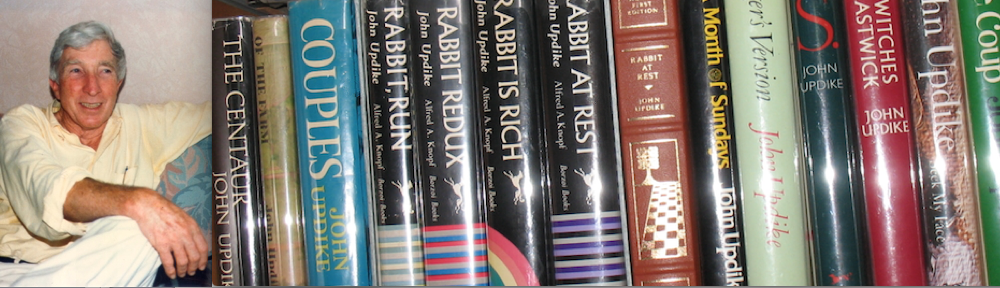
BBC’s ‘Front Row’ interviews James Schiff about the Updike letters

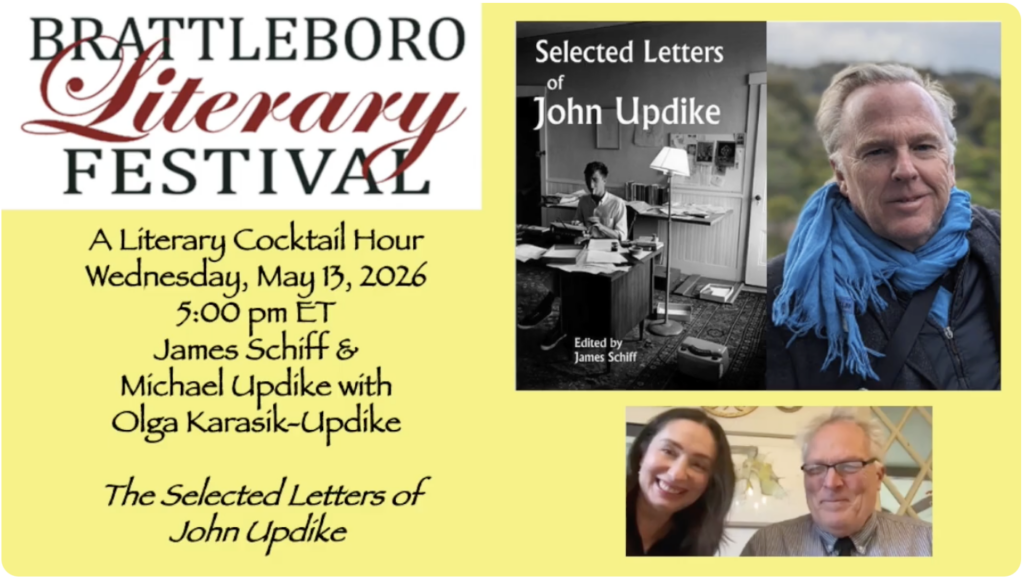
The Nov. 11 episode of BBC’s Front Row spotlighted art historian Andrew Graham-Dixon on Vermeer and radical Christianity, James Schiff on Selected Letters of John Updike, and director Edgar Wright on the new dystopian film The Running Man.

The Updike material begins around the 13:30 mark when the interviewer talks with writer Gish Jen, one of many who received letters from Updike.

Listen to the episode

Updike’s early unpublished novel may soon lose the ‘un’

Trevor Meek, of The Local News (Ipswich, Mass.), published a Jan. 31, 2026 piece on the Selected Letters of John Updike that began,

“Living in Ipswich in the 1960s and ’70s with John Updike as a neighbor meant playing a high-stakes game of literary roulette. “On any given day, you might crack open his newest novel or short story to discover you’d been immortalized — or perhaps skewered — on a page destined to be read by millions around the world. “That uneasy thrill returned for some folks late last year with the release of Selected Letters of John Updike.

“’Even with this book, various people are looking through it to see if they’re mentioned,’ said Updike’s son, Michael, a sculptor. “’And then when they realize they are mentioned, they’re insulted,’ he added with a laugh.”

Michael Updike, heavily quoted in the article, defended his father against one of the most common charges. “He seems to be an author who is judged as a misogynist because some of his characters are selfish. . . . We don’t say Nabokov is a pedophile because his character Humbert Humbert is one in Lolita.”

Michael Updike told The Local News that he’s working on the release of his father’s unpublished novel, Home. “We’re still figuring out how to get that rolling,” he said.

We asked Michael (pictured) for more details, and here’s what he had to say:

“Chris Carduff [who edited several of Updike’s Library of America volumes] gave us the idea, saying it was a completed novel albeit rejected by a publishing house. Jim Schiff [editor of the Selected Letters] has read it and says it’s not a perfect novel but does have a lot of new material about my grandmother in it. Andrew Wylie has been sent a copy and he thinks it should be published. So much of it is hand written, and our first step is to find a good typist who will type it up in Word. Then an editor to comb out any redundant or rough spots, and Wiley will shop it around. No timeline, but hopefully soon, by publishing terms—two or three years.”

Updike didn’t talk much about Home with interviewers, but he did tell Eric Rhode in 1969, ” I had written, prior to [The Poorhouse Fair], while living in New York City, a 600-page novel, called, I think, Home, and more or less about myself and my family up to the age of 16 or so. It had been a good exercise to write it and I later used some of the material in short stories, but it really felt like a very heavy bundle of yellow paper, and I realized that this was not going to be my first novel—it had too many traits of a first novel. I did not publish it, but I thought it was time for me to write a novel.”

If Home is as heavily autobiographical as Updike suggests, perhaps it will be read and appreciated as a companion to his Self-Consciousness: Memoirs (1989).

Raritan, now deceased, wasn’t a fan of John Updike

In Sheena Meng’s “A requiem for Raritan,” published on The Point, one thing rings pointedly clear:  “The editors were not particularly fond of Updike. Richard Poirier and Thomas R. Edwards, both literary critics and professors of literature at Rutgers, leveled coolly disdainful gazes at him in their 1978 proposal for the magazine:

The publication of a new book by John Updike, let us say, is probably not an event of the same magnitude as the publication of a new book by Bellow or Pynchon, by Elizabeth Bishop or Doris Lessing … He seems at the moment to be a writer of comparatively, and predictably, lesser weight, and for whatever reasons he does not call into play the cultural forces and special interests that are at work on behalf (or against) these other writers.

“It was their mutual confusion regarding Updike’s popularity that also solidified matters between Poirier and his successor, Rutgers historian Jackson Lears. One of the questions he had hoped to address when he founded the magazine, Poirier told Lears, was: How does a writer like John Updike get lionized and celebrated as if he’s some genius man of letters? Raritan, in other words, was interested in “cultural power,” as Poirier declared in his prefatory editor’s note: “those intricate movements by which ideas or events, canons or hierarchies of preference, minorities or cultural strata come into existence.” Updike, not considered ‘a sufficiently rewarding clue to something more important than the texts he writes,’ was given no notice in its pages.”

Sounds like Raritan‘s editors may have socialized with famous Updike detractors John Aldridge or David Foster Wallace, since all of the writers they cite as being superior have occasioned relatively the same level of interest from readers, and graduate students working on their theses or dissertations, as Updike.

Read the whole article

Selected Letters editor offers insights on Updike and Pennsylvania

James Schiff, vice president of The John Updike Society and editor of The John Updike Review, gave a great interview to Charles McElwee on The Real Clear Pennsylvania Podcast.  Schiff, a professor of English at the University of Cincinnati, talked about the Selected Letters of John Updike, which Schiff also edited and the debut of which the Updike Society celebrated in New York City in October 2025.

Here’s the link

Book reviewer references Updike and Roth

Andrew Gelman, in reviewing The Ten Year Affair by Erin Somers for The Future of Statistical Modeling (Substack), relies on John Updike and Philip Roth for a core comparison:

“Going back a bit in literary time, The Ten Year Affair is a lot like the novels of John Updike: various suburban married couples having affairs. The writing style is different–Updike is famously lyrical, whereas Somers uses a Millennial flat writing style: This happens, then This happens, then That happens, etc. Kind of like Ernest Hemingway or Raymond Carver if they had a sense of humor.

“I think Somers does a much better job than Updike in conveying what it feels like to be a parent. To me, Updike, like Philip Roth, was to the end of his life always a son, never a father. Updike did have four kids, but I guess his wife did most of the parenting. Updike’s characters often have children but always seem to be thinking only about themselves. Not so much that his adult characters are self-centered–I mean, yeah, they are, but that’s kind of the point–but more that their children don’t seem to exist at all, except to the extent that they sometimes have to be dealt with as obstacles when they get in the way of the parents. In contrast, the adults in The Ten Year Affair are very aware of their kids. In some ways this is similar to Little Children by Tom Perotta, a book whose entire theme is that these adults are thinking only of themselves and are not shouldering the responsibilities of parenthood.”

Read the whole article

Is reading Updike, even ‘Golf Dreams,’ an ‘act of rebellion’?

From The Falling Knife by Harvey Sawikin (Substack):

“The critic Ted Gioia recently posted a Substack called Is Mid-20th Century American Culture Getting Erased? He noted that among those being forgotten are literary giants like John Cheever and Saul Bellow; musicians like Duke Ellington and Charlie Parker; and movies like Citizen Kane. John Updike not long ago was one of America’s most prominent living writers, yet reading him today would be, in Gioia’s words, ‘an act of rebellion.’

“Call me a wild-eyed revolutionary, because I’ve just finished a book of Updike’s essays, Golf Dreams. I’ve been reading his novels since I was a teenager, starting with The Centaur, moving on to Rabbit, Run (which I was too young to understand), and over the decades getting to most of the others (Rabbit Is Rich is my favorite). Updike could write anything — novels, stories, poetry, essays — and bring to it his gift for the exquisite image and the revealing metaphor, as well as his insight into human psychology.”

Read the entire article

Updike cited as a Guardian of Language

If your pet peeves include people who speak the language with little regard for or knowledge of correctness, you might be interested in a Jan. 10 Quillette article by Bruce Gilley on “Guarding the Gates of Our Language; One hundred years after the publication of Fowler’s ‘Dictionary of Modern English Usage,’ it is more important than ever to uphold standards of correct English.”

Of course, “America’s Man of Letters,” as William Pritchard dubbed him, was cited. John Updike, the master stylist and a precise practitioner of the language, was apparently involved in a kerfuffle involving his beloved New Yorker:

“Most surprising, perhaps, is the enduring allegiance to Fowler at The New Yorker, citadel of oppressed writers, and writers on oppression, in modern American letters. In a curtain-raiser in September 2025 for the Fowler centenary, the University of Delaware academic Ben Yagoda traced the inextricable links between the magazine, launched in 1925, and Fowler, almost as if the magazine was founded as a sort of Society for the Propagation of the Fowler in the United States. In one telling anecdote culled from the magazine’s archives, Yagoda found that the young John Updike, while studying at Oxford in 1954, had submitted a poem to the magazine that was caught up in a minor storm of editorial debate on punctuation according to Fowler. Updike bowed before the strictures, and his corrected poem was published later that year. Thereafter, he seems to have become Keeper of the Fowler at The New Yorker. His scathing review of Burchfield’s 1996 desecration is a monument to fine English sensibilities in the New World. ‘It has the charm, in this age of cultural diversity and politically correct sensitivity, of assuring all users of English that no intelligible usage is absolutely wrong,’ Updike writes. ‘But it proposes no ideal of clarity in language or, beyond that, of grace, which might serve as an instrument of discrimination.’ That word again.

“As Updike foresaw, the globalisation of English and the radicalisation of the academy mean that the need for Fowler has become greater not less. ‘The language is a mess, except as scoured and rinsed and hung out to dry by Fowler.’”

Read the whole article

Blogger shares favorite Updike story

OnJan. 3, 2026, Patrick Kurp posted comments on his favorite Updike story on Anecdotal Evidence: A blog about the intersection of books and life: “The Happiest I’ve Been.”

“Of all Updike’s stories, this is my favorite, the most emotionally powerful, mingling memory, comedy, sadness and his peerless eye for American detail. It’s the best rendering I know of the retrospective character of happiness, our dawning awareness of it after it passes. For most of us, happiness is a momentary state, not perpetual.”

Kurp added, “Of “The Happiest I’ve Been,” Nabokov writes:

“‘The important thing, rather than the subject, was the conversation itself, the quick agreements, the slow nods, the weave of different memories; it was like one of these Panama baskets shaped underwater around a worthless stone.’ I like so many of Updike’s stories that it was difficult to choose one for demonstration and even more difficult to settle upon its most inspired bit.”

Read the whole post

New essay tackles the question of Updike and misogyny

Teaching American Literature:  A Journal of Theory and Practice has published Sue Norton’s article “Somewhere Between Feminism and Misogyny: Classic Updike on the Modern Syllabus” in its Winter 2025 edition.  It is the product of Norton’s 2024 John Updike Tucson Casitas Fellowship.  The article builds upon several decades of literary criticism in Updike studies and incorporates the work of JUS members Marshall Boswell and Biljana Dojčinović.


RSVP now for a zoom course on Updike and Roth

The Library of America will offer a four-part zoom course on literary friends and rivals John Updike and Philip Roth, taught by Adam Gopnik, who delivered the opening keynote talk at the October 2025 joint Philip Roth and John Updike societies conference in New York City.

The sessions will be held weekly on Wednesday afternoons from 1:30-2:45, Jan. 14 through Feb. 4. The class will be recorded and shared with registrants so they can watch it any time.

“Inspired by the multivolume LOA editions of Roth and Updike, this course will delve into their complex relationship and many masterpieces, from early short-fiction triumphs, to the scandalous 1960s breakthroughs Portnoy’s Complaint and Couples, to brilliant late-career works like Roth’s American Trilogy and Updike’s In the Beauty of the Lilies that show these two literary lions confronting their legacies and making bold bids for artistic immortality.”

The course costs $200 and includes a coupon for 40 percent off all Roth and Updike volumes in the LOA series. Participation is limited, so RSVP now if interested.

Click here to RSVP (required) and learn more.