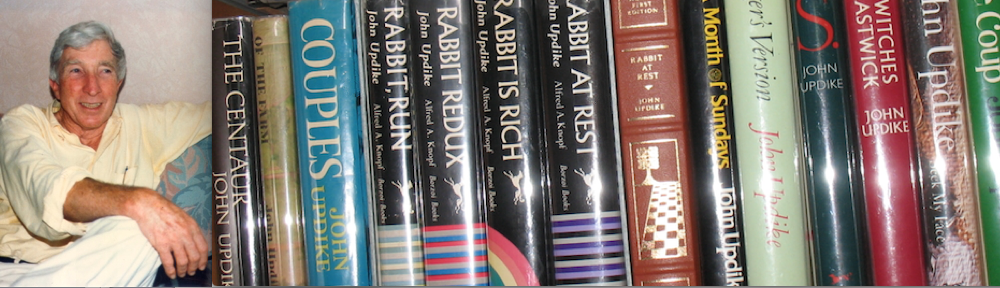
 In a recent blog-post musing, Andrew Gelman, a professor of statistics and political science at Columbia University, talked about picking up a copy of the LOA two-volume set of Updike’s Collected Stories and reading “The Varieties of Religious Experience.” Which led him to recall a similarly titled story by Irwin Shaw, “Main Currents of American Thought,” which led him (come on, keep up!) to think that rather than having anything in common with Shaw, “Updike is similar to Philip K. Dick as a writer in that he takes the same few characters and recycles them through lots of similar situations.
“Dick has the pathetic lead character (‘Joe Chip’), the reliable older man (‘Runciter’), and the nagging wife (the sister in Confessions of a Crap Artist). Updike has the ‘Updike’ character (a student or young man in the early stories, then a young husband and father, then a divorcing middle-aged man, then a rueful man in late middle age, drifting among his own thoughts) along with various supporting characters.”
Which leads Gelman, finally, to, “I like lots of individual Updike stories but I’ve gotta say that the best are the Maples stories because these are the only ones where the woman character is as strong as the man. Joan gives as good as she gets.” Then back again to “The Varieties of Religious Experience.”