Society learns the JU Childhood Home will get a historic marker

The Pennsylvania Historical and Museum Commission announced yesterday afternoon that The John Updike Childhood Home was one of 18 new historical markers approved out of 55 nominees. The other high-profile approval was musician Jim Croce’s home.

John Updike, who lived in the house at 117 Philadelphia Avenue until he was 13 (1932-45),  received the 1983 Distinguished Pennsylvania Artist Award from the governor in a Harrisburg ceremony. Updike wrote often about the house, Shillington, Reading, and the surrounding area, and was honored by presidents George H.W. and George W. Bush in White House ceremonies.

This article from the NBC Philadelphia affiliate gets the county wrong—Shillington is in Berks, not Bucks County—but it’s a fact that soon there will be a state-approved marker placed outside The John Updike Childhood Home. The property is owned by The John Updike Society and will be operated as a museum and literary landmark. A grand opening for the house-museum is scheduled for October 3, 2020. While the restoration is complete, what remains is to decide on which items would make for informative and satisfying displays, and to mouth those permanent exhibits.

Updike’s Pennsylvania-inspired fictions include The Poorhouse Fair, The Centaur, Of the Farm, Pigeon Feathers, Olinger Stories, and the Rabbit tetralogy (Rabbit, Run; Rabbit Redux; Rabbit Is Rich; Rabbit at Rest). The approval of the historic marker comes near the 10th anniversary of The John Updike Society’s founding in May 2009.

The society’s application for inclusion on the National Historic Register is separate, and is now with the National Park Service, who will make their determination sometime between now and the beginning of May.

See also “John Updike historical marker among 18 approved by state” (Reading Eagle)

Horticulturalist gives a shout-out to literary greats

Jim Chatfield, a horticultural educator with Ohio State University Extension, referenced T.S. Eliot and John Updike in his column, “Plant Lovers’ Almanac: Spring and its blooms have finally arrived.”

After alluding to Eliot’s famous reference to spring as “the cruelest month,” he wrote, of Updike,

“Dogwoods were important to one of my favorite writers, John Updike (1932-2009). In his 1965 autobiographical essay ‘The Dogwood Tree: A Boyhood’ he wrote:

“‘When I was born, my parents and my mother’s parents planted a dogwood tree in the side yard of the large white house in which we lived throughout my boyhood. This tree . . . was, in a sense, me.’

“This Shillington, Pa., tree was actually planted on John’s first birthday, according to his mother. John Updike wrote in 1965 that ‘My dogwood tree still stands in the side yard, taller than ever . . .’ and it still lives today.”

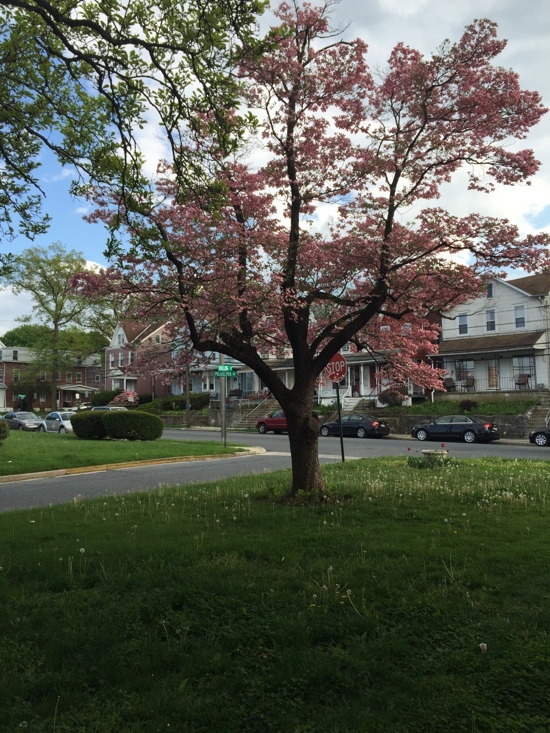
It might interest Prof. Chatfield to know that The John Updike Society is cultivating a cutting/graft taken from the still-thriving dogwood, since the tree has already lived longer than the typical pink dogwood. So when it does finally die, as all organic things must, a clone of it will grow in its place. Below is a photo of Updike’s dogwood, taken this past week by Dr. Susan Guay, director of The John Updike Childhood Home at 117 Philadelphia Ave. in Shillington.

Schiff Family Foundation increases JUS support

Fundraising to mount exhibits at the John Updike Childhood Home just became less of a priority, thanks to a more than generous donation from the Robert and Adele Schiff Family Foundation.

The Ohio-based foundation, which initially donated the money for the John Updike Society to purchase the house at 117 Philadelphia Ave. in Shillington, and which has supported the society’s ongoing efforts to restore the house and turn it into a literary center and museum, donated $200,000 to the society before the New Year.

That’s something to celebrate, John Updike Society president James Plath said. The donation ensures that once suitable curatorial help is found and a timetable created, the society will be able to take the next step and pay to have someone qualified help construct exhibits.

“This donation is enough to get us to the finish line,” said Plath, who was recently named to the Affiliates Steering Committee of the American Writers Museum in Chicago—a recognition of how far The John Updike Childhood Home has come.

“All of our donors have made a huge difference, but I think it’s safe to say that The Robert and Adele Schiff Family Foundation has been most responsible for the rapid growth of our organization.

The Robert and Adele Schiff Family Foundation was also responsible for seven Schiff Travel Grants that were recently awarded to young scholars to help them get to Serbia for the 5th Biennial John Updike Society Conference at the University of Belgrade.

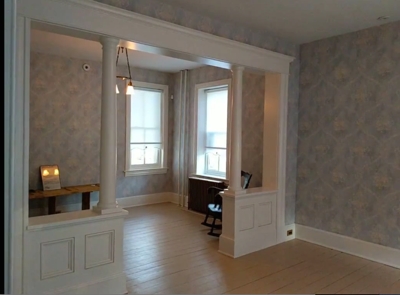
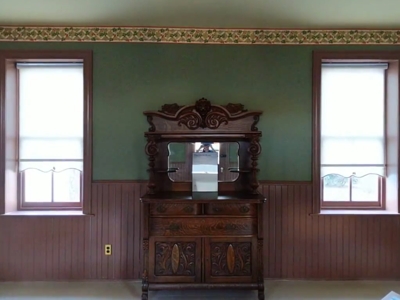
Pictured are the front parlor/”piano room” and dining room showing recently installed period-authentic roller shades.


McPhees, PECO Foundation honored for Updike house support

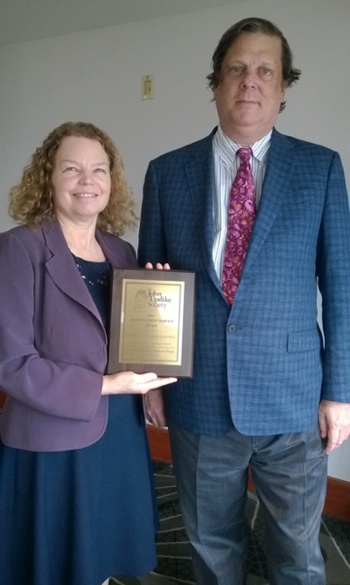
Roemer and Constance McPhee, whose support helped The John Updike Society to go all out and hire a historic restoration specialist to bring The John Updike Childhood Home in Shillington, Pa. back to the way it was when Updike lived there from “age zero to 13,” have received the society’s Distinguished Service Award.

In presenting the award at the society’s business meeting on Thursday, May 25, at the Westin Copley Place Hotel in Boston, society president James Plath recalled a phone call he received in December 2012 from “a man named Roemer McPhee, who told me he’d read about our efforts to turn The John Updike Childhood Home into a museum and wanted to help by sending us a check for $3000.” McPhee was a big John Updike fan and thought it was a perfect opportunity to give the writer his due.

Since that first donation, H. Roemer McPhee III—an author himself (The Boomer’s Guide to Story: A Search for Insight in Literature and Film) and a New York investor who studied at Princeton and the Wharton Graduate School of Business—has demonstrated his love of Updike by driving to Shillington to tour the house and Updike sites with his mother and later attended the Third Biennial John Updike Society Conference in Reading, Pa. with his wife and co-benefactor, Connie. Through their PECO Foundation, Roemer and Connie have contributed more than $70,000 over the years to help with the restoration, making them the second largest donor, behind the Robert and Adele Schiff Family Foundation, whose initial donation enabled the society to purchase the home. With some work still outstanding and museum display cases needed, the McPhees have also pledged additional help and said they are considering joining society members in Belgrade, Serbia for the Fifth Biennial John Updike Society Conference in June 2018.

“It’s fairly common to find foundations that care enough about a cause to donate money,” Plath said, “but to have the people behind those organizations also become involved on a personal level and to be so knowledgeable about Updike that they can discuss texts such as the Rabbit novels with members, that’s highly unusual, and it underscores the impact that Updike had as a writer.”

Because of their shared love of John Updike and his works, and because of the passion they’ve shown and the impact they’ve had in helping the society to fulfill its mission, the board of directors of The John Updike Society unanimously voted to award Roemer and Constance McPhee the society’s Distinguished Service Award, Plath said.

Over the nine years that The John Updike Society has been in existence, the society has given Distinguished Service Awards to James Yerkes, for his important contributions to Updike scholarship through The Centaurian print and online newsletter; Conrad Vanino, whose pro bono work as realtor helped the society acquire The John Updike Childhood Home and who continues to act as the society’s agent; and The Robert and Adele Schiff Family Foundation, whose generous support enabled the purchase and restoration of The John Updike Childhood Home.

Roemer McPhee’s most recent book is Killing the Market: Legendary Investor Robert W. Wilson.

Help the John Updike Society, shop Amazon Smile

It doesn’t sound like much—just .5 percent of every purchase you make—but it adds up. And it doesn’t cost you anything extra. Amazon makes a donation to the charity of your choice if you shop using the Amazon Smile url (which takes you to the Amazon site). It’s virtually the same shopping experience except that by going through Amazon Smile you help your favorite non-profit while you shop. And the set-up is one-time, easy, and intuitive. To start helping The John Updike Society now, go to:

http://smile.amazon.com/ch/45-1584125


Schiff Foundation supports Updike Society projects

In the past, The Robert and Adele Schiff Family Foundation had donated the money that enabled The John Updike Society to purchase the home at 117 Philadelphia Ave. in Shillington, where the Pulitzer Prize-winning author spent his first 13 years, and since then the foundation has contributed annually to help cover the costs of repairs, restorations, and maintenance.

This year’s donation provides a substantial increase—$280,000—for continued work on the house restoration, as well as $30,000 to be applied toward annual expenses, $50,000 “untouchable” money to grow an endowment that will help fund annual expenses well into the future ($1.5 million is needed, at bare minimum, to fund annual expenses moving forward), and $20,000 for a new initiative to help fund travel to the Fifth Biennial John Updike Society Conference in Belgrade, Serbia.

Details on the travel grants will be announced in a future post and email to members.
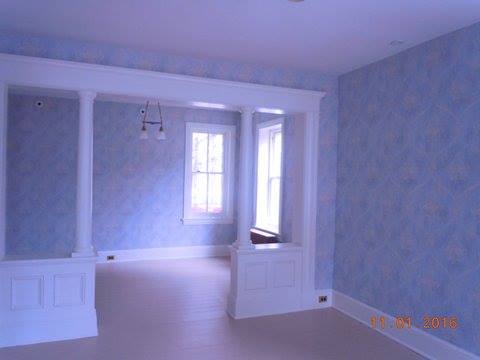
14991788_1813920192153127_8301741406437647514_nThe donation allows work on the house—which had temporarily stopped, due to a lack of funds—to proceed again, and the crew from R.J. Doerr has already begun tearout work in the kitchen and second-floor sleeping porch. Workmen found more marbles that had fallen from their Black Room hiding place under floorboards, and also found the “footprints” of the original cabinets, stove, and sink. Anyone who took a tour of the house and walked onto the second-floor porch and noticed how “spongey” it was will not be surprised to learn that the wood is rotted and that the porch needs to be completely rebuilt, for safety’s sake. That work proceeds now.

The John Updike Childhood Home has been ruled eligible to apply for the national register of historic places, and the application process as well as a separate application for a historic marker are also moving forward.

The society is grateful to The Robert and Adele Schiff Family Foundation for their continued support. Pictured is the restored parlor and living room.

Donors are still sought for other aspects of the complete restoration—which will include planting privet around the perimeter of the property, re-doing and expanding the parking area, and changing the landscaping to incorporate elements from Updike’s childhood—and sponsoring/supporting exhibits to be placed inside the museum. An archivally safe exhibit case costs $2,000 and up, depending on size, and the goal is to place exhibits in cases in every room and on every level. Corporate and foundation sponsors are especially sought to sponsor exhibits. Contact James Plath (jplath@iwu.edu) if interested in helping.
 

Shop to benefit the John Updike Society

It doesn’t cost any more and it doesn’t take any more time. But once you access the Amazon Smile site and declare your support of The John Updike Society, then bookmark that page, you can shop at Amazon as you always have. The big difference? Amazon will donate a small portion of each purchase to the Society to help us continue the good work that’s being done to preserve The John Updike Childhood Home. Click here or on the banner below to get started!

1015749_us_amazonsmileholiday_batch2_610x240v2-_v527339673_

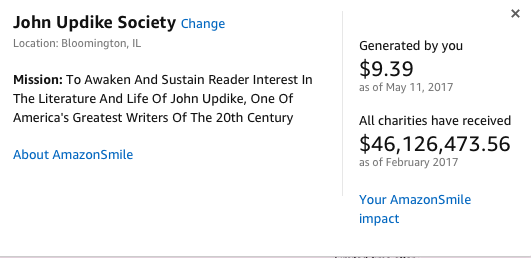
After you finish shopping, you’ll get a message like this:

screen-shot-2016-11-07-at-8-48-47-pm

Schiff Family Foundation increases support of The John Updike Childhood Home

With the R.J. Doerr Company making great progress on the historic restoration of The John Updike Childhood Home at 117 Philadelphia Ave. in Shillington, Pa., the Robert and Adele Schiff Family Foundation announced that they will increase their support of The John Updike Society’s efforts to turn the home into a museum. This fiscal year they are upping their donation from $75,000 to $175,000.

“This really gives us some breathing room,” John Updike Society president James Plath said, “and I hope that the Schiff Family Foundation donation spurs others to give to a restoration project that’s really picking up steam.” Plath said that Doerr has come up with a restoration plan that takes into account Updike’s writings about the house, interviews with people who were inside the house during Updike’s time, historic features in similar period architectural dwellings, and “footprints” and other clues found inside the house that identify where architectural features and finishes were located. Restoration plans include replacing modernized radiators with period-style radiators and installing UV-protective surfaces on all windows. Interior walls and ornate archways that had been removed or simplified after the Updikes left will be recreated.

The entire restoration process is expected to cost $300-350,000, and the society is committed to making this museum and literary site a showplace equivalent to such historic American literary venues as the Mark Twain Home & Museum in Hannibal, Mo., and the Hemingway homes in Oak Park, Ill. and Key West, Fla.

The Robert and Adele Schiff Family Foundation is located in Cincinnati and is particularly interested in supporting projects that have to do with education.


Society launches separate JU Childhood Home website, Facebook page

The John Updike Society has launched a separate website for The John Updike Childhood Home and a separate Facebook page because “the time had come,” society president James Plath said. “This helps us as we move forward with the restoration, the acquisition of exhibit material, the forging of community relationships, and the development of a market for the house as a literary and tourist destination.”

The John Updike Childhood Home webpage is at: johnupdikechildhoodhome.com.

The Facebook page for The John Updike Childhood Home is http://www.facebook.com/johnupdikechildhoodhome.

Please bookmark the former and “like” the latter. There will be, out of necessity, some overlapping, but Updike fans will see things at the Childhood Home webpage that they can’t see on the Society home page.


John Updike Society hires historic restoration expert

The John Updike Society board has approved the hiring of R.J. Doerr Co., an Easton, Pennsylvania-based contractor that specializes in historic restorations and home museums. As the Reading Eagle reported, Doerr has “a 25-year history of restoring historic properties for nonprofits, including the home of George Taylor, a signer of the Declaration of Independence.”

Screen Shot 2015-07-20 at 8.14.31 PMThis past Thursday Robert Doerr did a walk-through with society president James Plath at The John Updike Childhood Home at 117 Philadelphia Ave. in Shillington, and the two agreed to a three-phase restoration. Phase 1, which is projected to be completed by the end of summer 2016, will include all the rooms that have been “deconstructed”—the dining room, living room, parlor, foyer, and all upstairs bedrooms. During this phase, the entire house needs to be rewired and the radiators need to be removed so that a more archivally-friendly forced air system of heating and cooling can be installed. Phase 2 will include the restoration of the front, side, and second-floor porches. Phase 3 involves the addition of a grape arbor that was there prior to 1945 when the Updikes moved to Plowville, and the addition of decorative exterior corbels that had been removed to make repainting cheaper/easier. The kitchen and second-floor bathroom will also be upgraded to be period, but functional, during this phase. The total for the three-phase restoration is expected to be around $300,00 to $350,000, and Plath said he is “currently and always” looking for additional corporate, foundation and individual benefactors. Those who donate $500 or more will have their names on a donor wall inside the house.

Work will begin the end of summer, after Habitat for Humanity of Berks County finishes “tear-out.” Plath estimates that Habitat volunteers saved the society an estimated $20-30,000 by scraping wallpaper and removing everything that was added to the house after 1945.

The Reading Eagle has the story.