Inquirer spotlights John Updike Childhood Home

When John Updike was still alive, writer William Ecenbarger convinced the famed novelist to drive with him through Berks County to visit childhood haunts. That account first appeared in The Inquirer Sunday Magazine on June 12, 1983, and was reprinted in part in the first chapter of Adam Begley’s biography (Updike, HarperCollins 2014) and in full in John Updike’s Pennsylvania Interviews (Lehigh University Press, 2016).

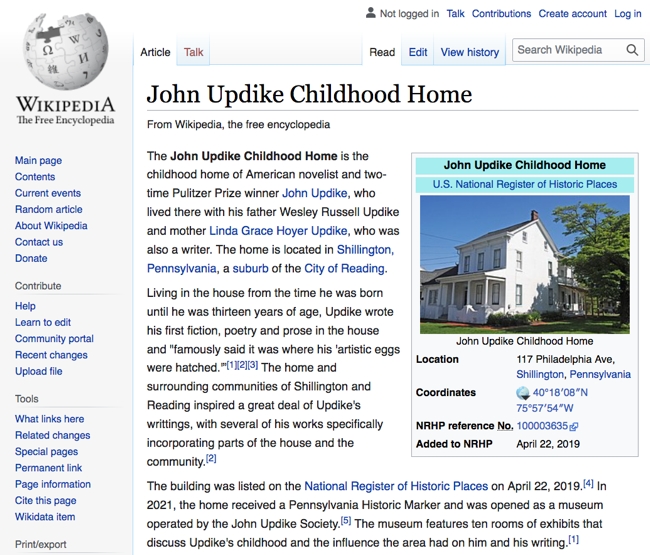
Recently Ecenbarger returned to Shillington to write about Updike again—this time to see for himself how Updike’s beloved childhood home looks now that it has been turned into a museum.

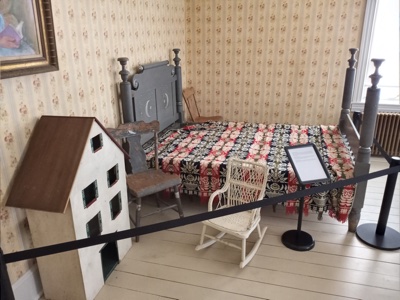
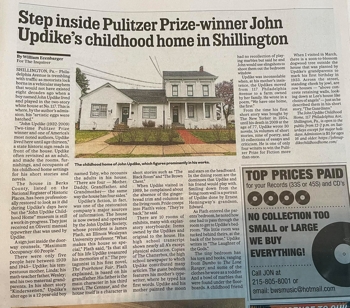
In “Step inside Pulitzer Prize-winner John Updike’s childhood home in Shillington, Pa.,” which appeared in the Sunday, April 2 Inquirer, Ecenbarger wrote, “The house in Berks County, listed on the National Register of Historic Places, has been professionally restored to look as it did during Updike’s days here but the ‘John Updike Childhood Home’ museum is still a work-in-progress. They just received an Olivetti manual typewriter that was used by Updike.”

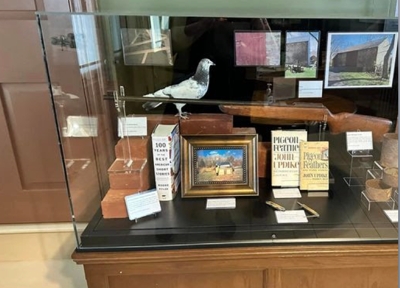
Ecenbarger added, “There are 10 rooms of exhibits, many with explanatory storyboards: Items owned by the Updikes and original to the house. His high school transcript shows nearly all A’s except physical education. Copies of The Chatterbox, the high school newspaper to which Updike contributed many articles. . . . Smiling down from the living room wall is a portrait of Updike done by Ernest Hemingway’s grandson, Edward.”

Ecenbarger wrote, “Updike was inconsolable when, at his mother’s insistence, the Updikes moved from 117 Philadelphia Avenue to a farm owned by her family. He wrote in a poem, ‘We have one home, the first.'” This home, once a source of pride for Updike, is now a source of pride for the community. Thanks to the efforts of director Maria Lester, close to 800 Berks County students toured the house last year to learn about one of Berks County’s most famous and accomplished residents. But Ecenbarger was right: the museum still is a work in progress. Seven new exhibit cases of unique items will be added within the next several months—reason enough to visit and revisit the place where Updike said his “artistic eggs were hatched.”

Writer recalls golfing with Updike, wants less AI, more Updike

In an opinion column (“Take That, ChatGPT!”) written for Boston Magazine, John D. Spooner voiced his reaction to a new artificial intelligence writing program and cited Updike as an example of “some things that only a human can do well. Writing is one of them.”

“John Updike was one of my gods,” Spooner wrote. “In my view, Updike was the greatest man of letters in America from the 1960s through the 1990s. He wrote novels and short stories. He wrote poems and essays. When he was president of the Harvard Lampoon, there were times when he wrote the entire issue. And illustrated it as well. He had gone to Oxford to study drawing. One of his classic pieces described Ted Williams’s last baseball game. ‘The Kid’ would never tip his hat to the crowd after a home run. He just ran the bases, with no expression and his classic, easy stride. Williams hit a home run that last day. He never acknowledged the fans. Updike wrote, ‘Gods do not answer letters.’ One of the greatest lines ever to describe an athlete.

“Amazingly, this most erudite of authors loved golf. A mutual friend arranged a game at Updike’s course, where they both belonged. I was excited about what I could ask him about his books, his life, and his insights on writing. But on the course, Updike was all business. It wasn’t ‘a good walk spoiled.’ It was his focus on the game, his game, and not about my favorite sport, ‘shootin’ the breeze.’ It was a drizzly day on the North Shore of Boston. Updike was polite, a gentleman on the course, long pants in the summertime. His swing was a manufactured one as if he had spent a lot of money on a lot of lessons, and it produced a routine with a lot of parts—a routine he completely focused on. We played for a few dollars, two players against two. The rain came down harder and harder, with no chance to ask my hero anything related to writing.

“We kept playing in the rain. Updike seemed, on every shot, to be replaying the lessons he had taken. The friend who had invited me to play said, ‘John is a focused dude. He goes through his routine like there’s no one else here. And he wants to win.’ My glasses were fogged up from the rain. Now I know that Updike was not going to give me any creative secrets, which, of course, I resented. So I did not want to fork over any money to my hero. My host, who was a really good player, said to me, ‘If we lose, it’s your fault.’

“We came to the 18th hole all even. Updike had a three-foot putt to win the match. It curled around the cup. And stayed out. I won two dollars, carried over from the front nine.

“We all shook hands and had a beer in the clubhouse. I figured that now was my chance to ask him about his writing life. But he tossed down his beer, got up, and said, ‘Nice playing with you, gentlemen.’ Updike walked out of the club bar. Gods do not answer letters.”

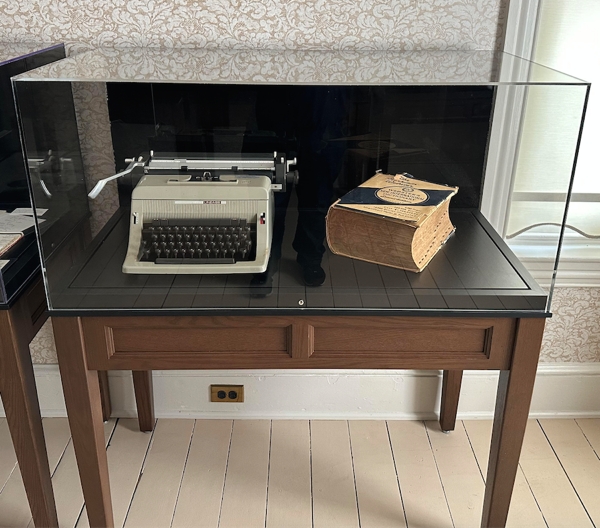
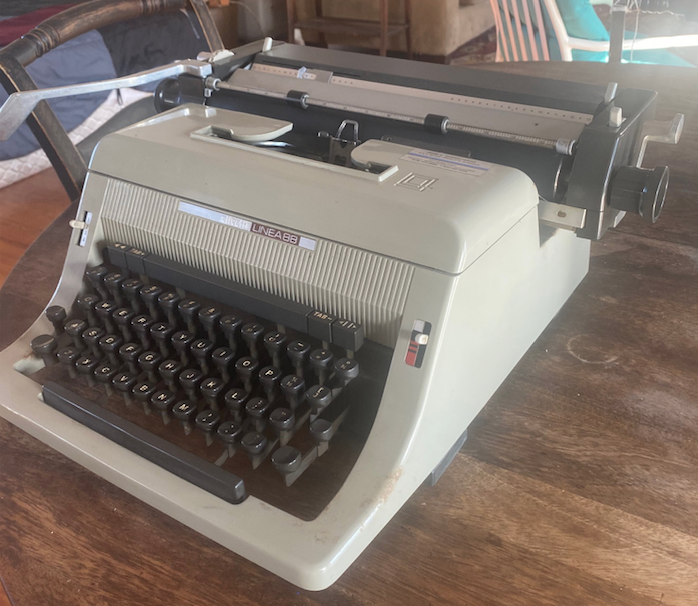
Updike’s favorite typewriter, a manual Olivetti Linea 88 made in Great Britain circa 1968-69. It will soon go on permanent display in The John Updike Childhood Home, 117 Philadelphia Ave., Shillington, Pa.

Updike Society acquires author’s typewriter

One day after what would have been John Updike’s 91st birthday, The John Updike Society acquired the Pulitzer Prizewinning author’s typewriter from his four children. The purchase was made possible by a donation from The Robert and Adele Schiff Family Foundation, which provided the initial funding for the society to buy and restore The John Updike Childhood Home in Shillington, Pa.

The manual typewriter—an Olivetti Linea 88—was made in Great Britain in 1968-69, the year Updike moved with his family to London following the publication of Couples. It will be displayed in a case upstairs in the house at 117 Philadelphia Ave., where Updike lived from “age zero to thirteen” and where he said his “artistic eggs were hatched.” In the front bedroom of this house, at age eight, Updike used his mother’s portable Remington to type his first story, which began, “The tribe of Bum-Bums looked very solemn as they sat around their cozy cave fire.” According to biographer Adam Begley, Updike said, “I still carry intact within me my happiness when, elevated by the thickness of some books to the level of my mother’s typewriter, I began to tap at the keyboard and saw the perfect letter-forms leap up on the paper rolled around the platen.”

When the typewriter is installed at some point in the near future, it will instantly become the most important piece in this small museum, which celebrates Updike and the affection he felt for the house, the neighborhood, and Berks County. The John Updike Childhood Home is presently open Saturdays from 12-2 p.m. See the house website for more details about Updike and the house, which officially opened on October 2, 2021. The John Updike Childhood Home is listed on the National Register of Historic Places and was awarded a Pennsylvania Historic Marker.

John Updike Childhood Home docents are celebrated

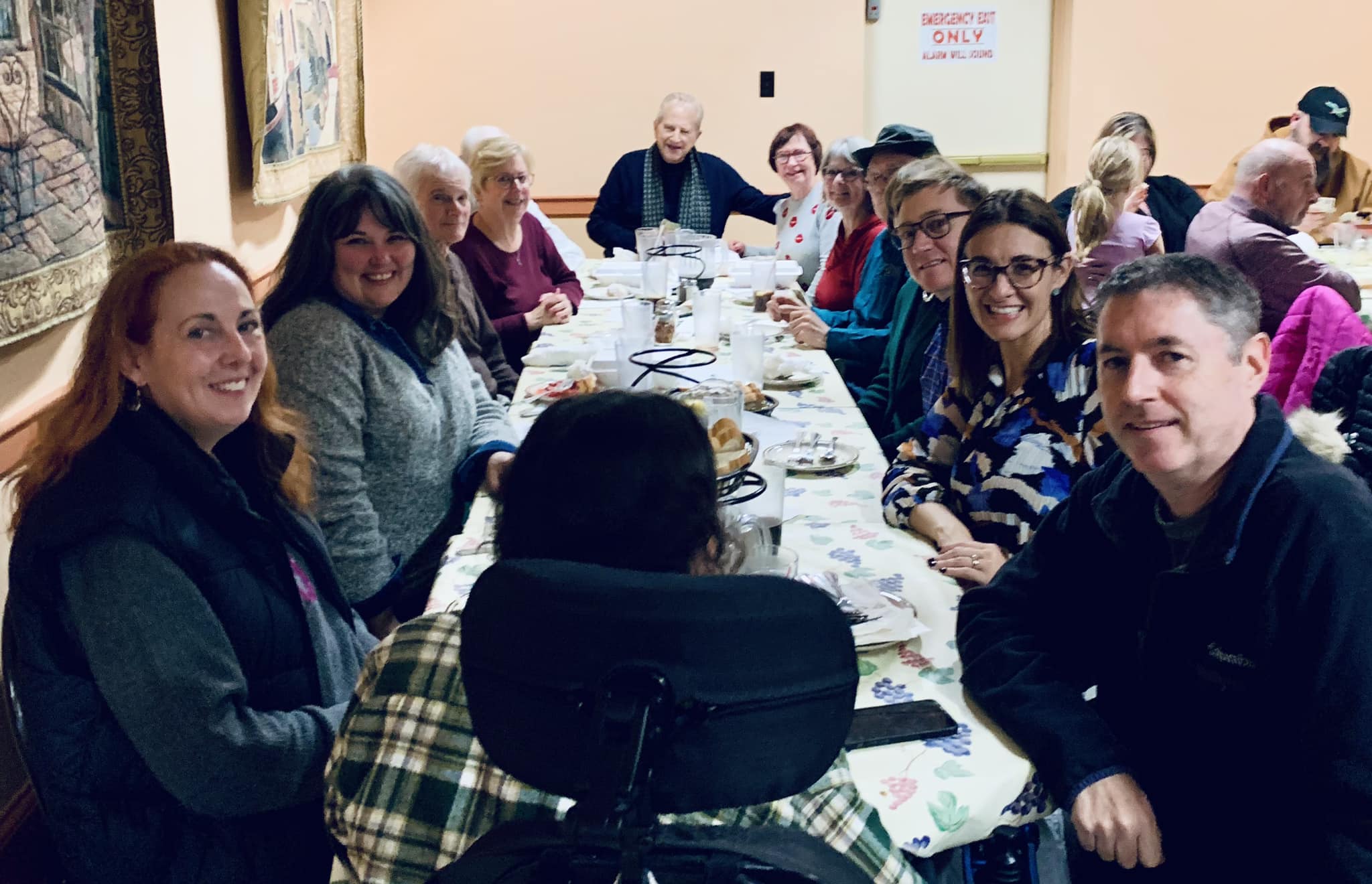
The John Updike Society thanked the volunteer docents that keep the John Updike Childhood Home running every weekend by treating them to a dinner at Victor Emmanuel, a local club. The idea for the dinner came from director Maria Lester, who organized the fete with help from the home’s very first docent, Dave Ruoff. Docents make small museums “work,” and the society is grateful for ours: Charlie Adams, Jill Koestel, Ken Krawchuk, Maria McDonnell, Sara Peek, Travis Peek, Paige Sechler, Linda Sepeda, Liz Siegfried, Susan Weiser, and Ruoff and Lester, who also give tours. Welcome too to three brand-new docents: Bob Fleck, Nancy Kennedy, and Shpresa Ymeraj.

Congratulations to this season’s Updike house Christmas ornament contest winners

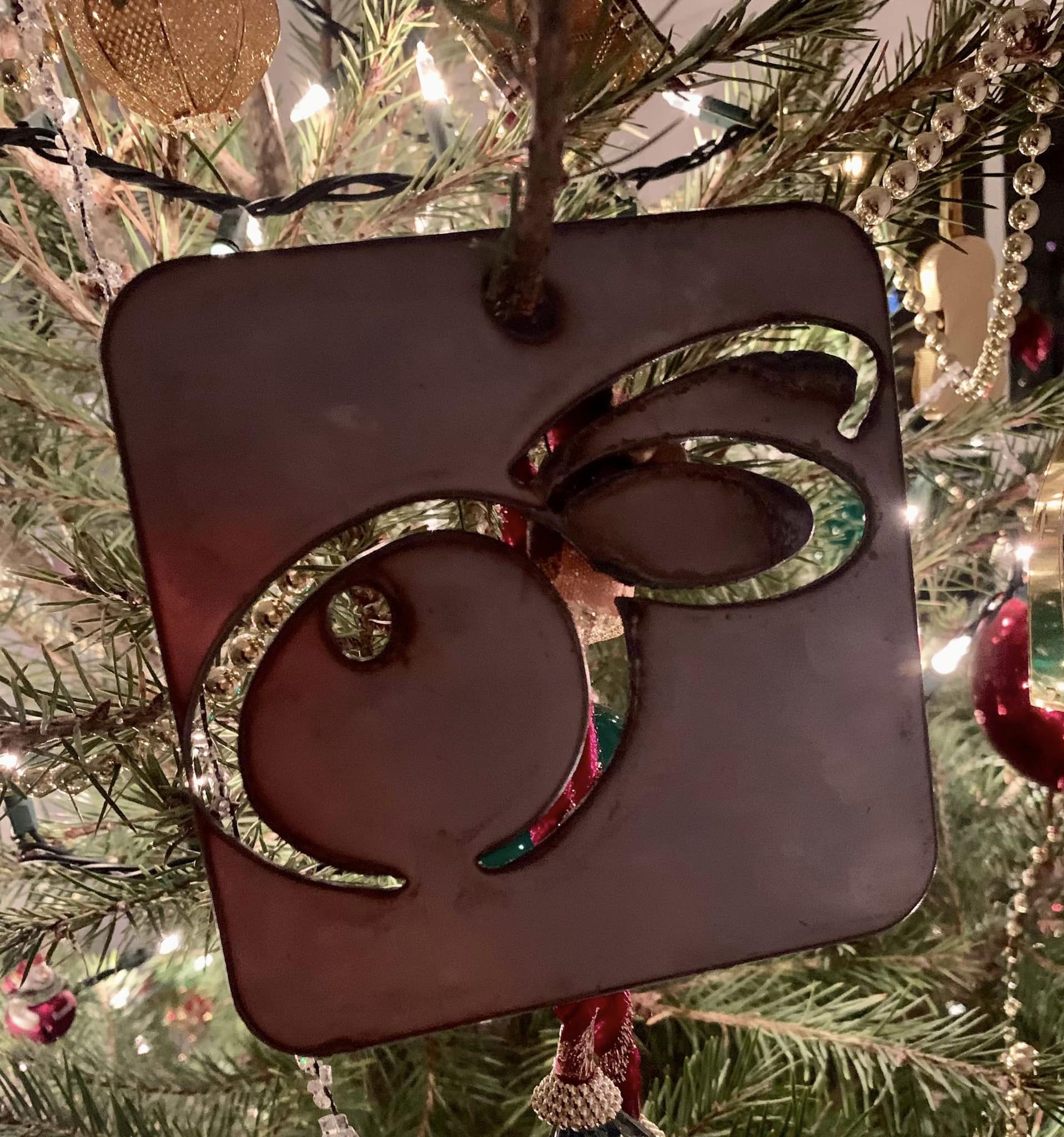
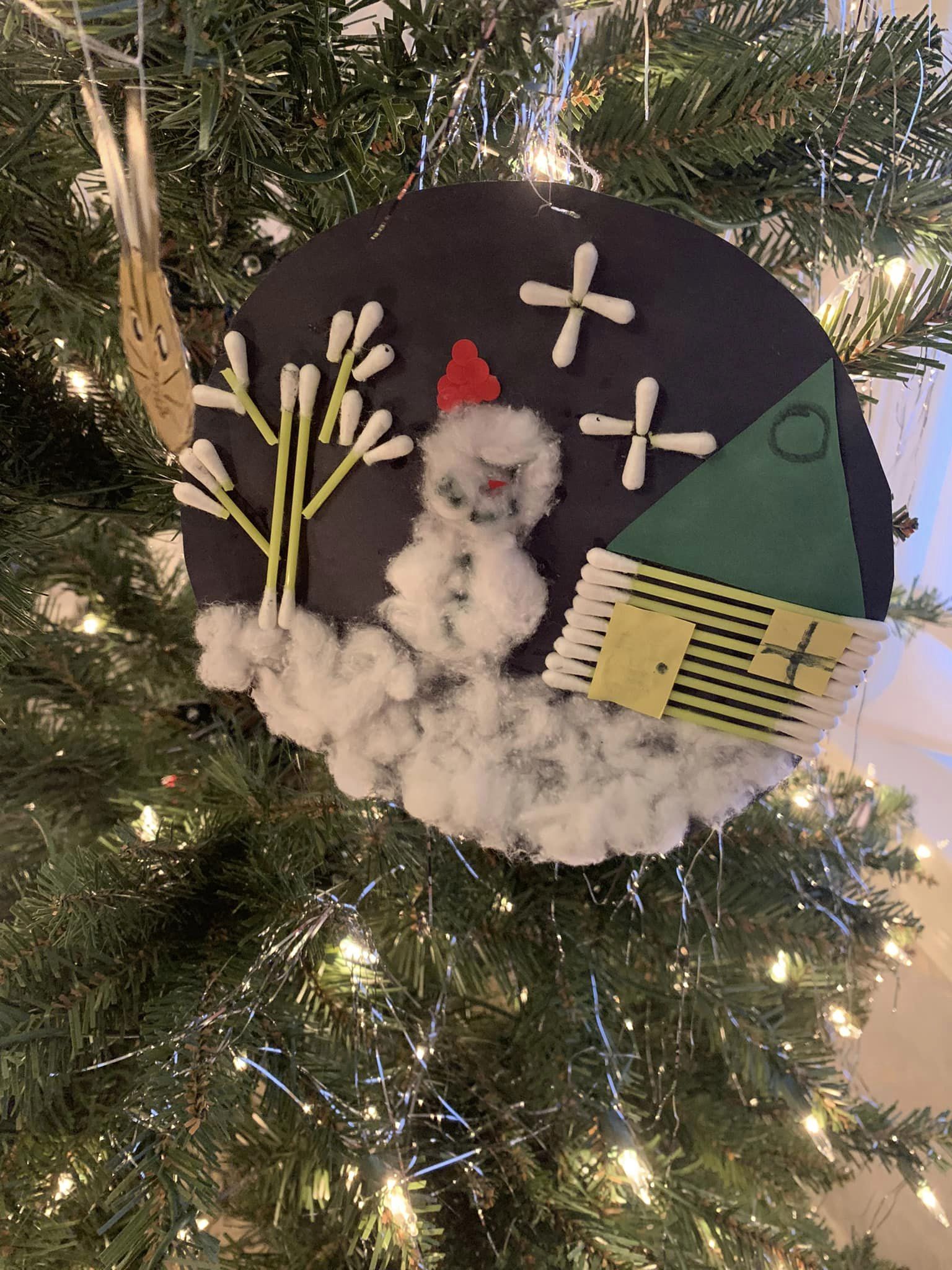
For the second year, The John Updike Childhood Home sponsored a Christmas ornament contest for area youths, with the winners prominently displayed on the Updike house tree in the parlor. In case you didn’t get to visit the museum when the tree was up, at least you can see this year’s winners. Congratulations to secondary school winner John Serrano, an 11th grader at Wyomissing Area School District and a welding student at Berks Career and Technology Center, for his stylized cut-out rabbit, and to elementary school winner Laasyda Sri, a 4th grader at Governor Mifflin Elementary School.

Updike scholar donates papers to John Updike Childhood Home

Edward Vargo, who was among the first wave of Updike critics and scholars, has donated his Updike papers to The John Updike Childhood Home. The materials are mostly from his 1973 monograph, Rainstorms and Fire: Ritual in the Novels of John Updike.

Vargo has been living in Thailand, and the donated materials include Updike-related printed matter from that part of the world and accompanying notes, drafts, correspondences, and bibliographies. Later items are also included, such as notes and typescripts from “Whose Africa? Culture Wars in John Updike’s The Coup,” which was presented at the XXI Congress of the International Federation for Modern Languages and Literatures in Harare, Zimbabwe in 1999.

It took the Houghton Library a year to catalog all materials so that they could become available for scholars by appointment, and the board of The John Updike Society, which owns and operates the house-museum at 117 Philadelphia Ave. in Shillington, Pa., predicts that it could take a year or longer before scholars can gain access to the Childhood Home materials. Some of the items that could help researchers include letters, early notes and drafts, cancelled checks, Updike’s travel log, and numerous books that bear his annotations and marginalia.

Gov. Mifflin Middle School budding poets visit Updike house

On Monday, May 2, about 120 students from Governor Mifflin Middle School toured The John Updike Childhood Home with their teachers, Ms. Werle and Miss McKay. Organizing the event and leading the tour was Director of Education Maria Lester, who also conducted a creative writing workshop.

After the tour and hearing/seeing what Shillington and Berks County meant to Updike, students went outside to write original “sense of place” poems based on their own childhood memories growing up in and around Shillington. Shown here are students at work and some posing together under Updike’s dogwood tree.

“Finally, students graduating from GM will know who John Updike was and how he put Shillington on the map,” said Dave Silcox, Updike’s longtime local contact who has been heavily involved in acquiring exhibit materials for the house museum. Thanks to the teachers and to Maria Lester for making it happen!

Local TV reports on Updike 90th birthday event

It was a soft (and occasionally noisy) spring day in Shillington when a crowd of around 30 gathered on the side lawn of The John Updike Childhood Home, 117 Philadelphia Ave., in Shillington, Pa.

They came on Friday, March 18, to celebrate what would have been the author’s 90th birthday, to hear leading Berks County citizens read from Updike’s works, letters, interviews, and even poems the Pulitzer Prize-winning author wrote as a love-struck 10 year old.

And WFMZ 69 News was there to report.

Updike’s 90th Birthday Celebration streamed on Facebook Live

John Updike was born 90 years ago on this date. To celebrate, John Updike Childhood Home Director of Education Maria Lester organized and hosted a reading featuring prominent Berks County residents. Watch the Facebook Live recording of the 90th Birthday Celebration at The John Updike Childhood Home, 117 Philadelphia Ave., Shillington, Pa., featuring readings from Updike’s works, interviews, letters, and even personal love poems written as a 10 year old in Shillington.

:01—Introduction and reading by Maria Lester, Director of Education at The John Updike Childhood Home (pictured)

4:54—Samantha J. Wesner, Senior Vice President Student & Campus Life, Albright College

17:18—Conrad Vanino, Shillington Councilperson and Fire Police Lt.

22:13—Charles J. Adams III, Editor, The Historical Review of Berks County

35:48—Bill McKay, Superintendent, Governor Mifflin School District

44:55—Melissa Adams, Executive Director, The Reading Public Library

49:10—Jackie Hirneisen Kendall, Updike’s classmate and first “crush”

53:55—Dave Silcox, Updike’s Berks County contact for 10 years

57:40—David W. Ruoff, former student and friend of Wesley Updike

1:01:00—Jack De Bellis, author of Updike’s Early Years, The John Updike Encyclopedia, and John Updike Remembered