Editor Schiff and Updike siblings interviewed about the Selected Letters

In his introduction to an interview he conducted with James Schiff, Joe Donahue wrote, “John Updike remains one of the most admired and prolific voices in American Literature. Over five decades he produced novels, short stories, poems, criticism, and essays that examine faith and art, desire, and the American experience in all its complexity. . . . Now in the new book ‘Selected Letters of John Updike’ editor James Schiff offers readers a window into that private world drawing from decades of correspondence. Schiff presents a portrait of Updike as both craftsman and confidante, generous, witty, and endlessly reflective about writing and life.”

Here’s the link to the WAMC Northeast Public Radio podcast.

More conversation about John Updike and the letters comes from a Radio Open Source interview with Michael Updike and Miranda Updike conducted by Christopher Lydon, a Boston-area fixture who interviewed John Updike on numerous occasions. In sending the link to the Updike siblings, Lydon wrote, “We want you to take a bow… and enjoy this piece as we do! You and Michael are heroic here, and funny and deep… And we all fall in love with your marvelous dad, all over again.”

Here’s the link to “John Updike’s Vocation.”

If you haven’t gotten a copy of the book yet, here’s a link to order from Bookshop.org, where every purchase supports local independent bookstores.

Volume of Updike’s selected letters draws praise

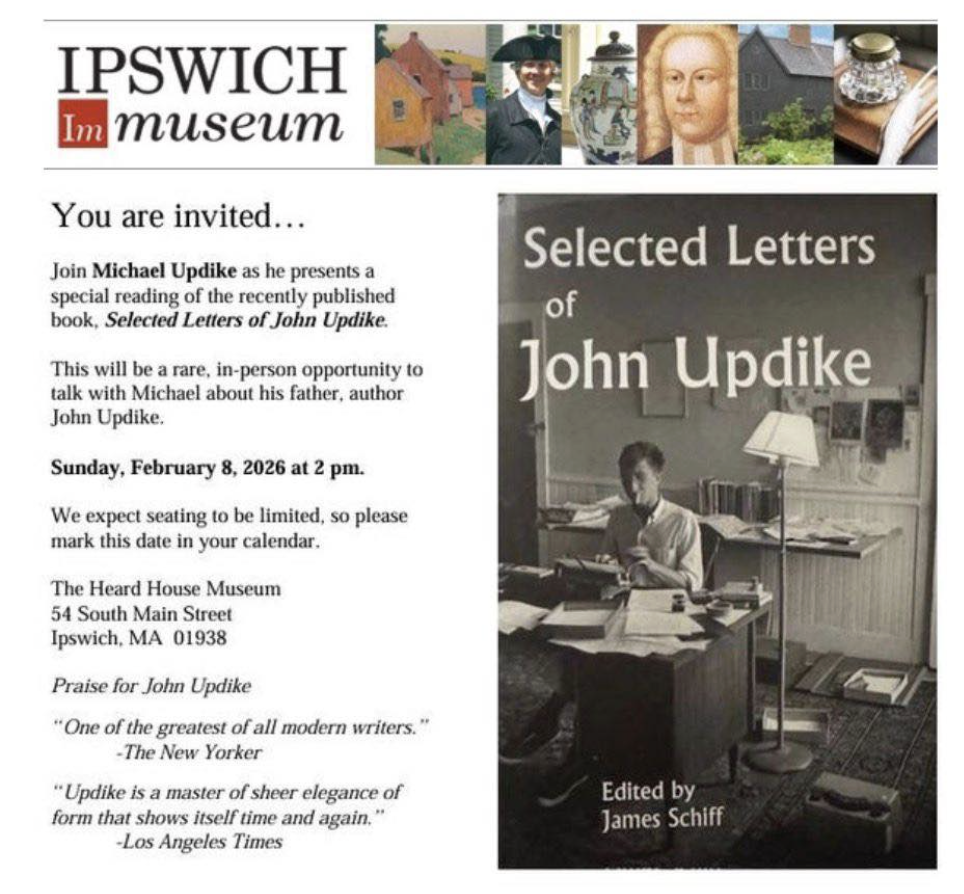
James Schiff’s long-awaited Selected Letters of John Updike will be released on Oct. 21, 2025, with a reading-booksigning-publication party scheduled that evening at the Salmagundi Club in New York City, where Schiff is in town to convene with other members of The John Updike Society for a joint Roth-Updike Conference with the Philip Roth Society.

The volume of Updike’s selected letters, decades in the making and years in the gathering, runs a whopping 912 pages and is published by Alfred A. Knopf, Updike’s publisher.

Early reviews have been positive . . . and insightful.

Kirkus Reviews
“Missives from the mountain. Updike . . . wrote to everyone, from famous writers and politicians to librarians and family members. ‘I can’t believe that you’re cutting ‘Spider-Man,’ he wrote in a letter to the editor of the Boston Globe in 1994; after the letter, the Globe reinstated the comic strip. . . . In 1960, he wrote to publisher Alfred A. Knopf that his novels sought to present an image of an averagely physical young American.’ He resisted censorship, feeling that to cave to it would be ‘to funk my job.’ At times, though, he can be dead-on in his judgments: ‘I feel in general that literary history is too much modelled on biology when it is really more like geology. There is not much evolution; there is a great deal of accidental thrusts and upheavals and whatnot and when it’s all over a map is drawn.”
Read the entire review 

WSJ – The Wall Street Journal, reviewed by Thomas Mallon
“In ‘Selected Letters of John Updike,’ a new and predictably enormous collection of Updike’s correspondence, we see all his lovers, spouses, neighbors and children as persons, and we experience Updike himself with even more candor than he displayed in his first-person essays. . . . The letters illuminate the consistency of Updike’s fiction aesthetic. Remarkably, at 19, he wrote of the need for ‘an author who can see America as clearly as Sinclair Lewis, but, unlike Lewis, is willing to take it to his bosom.’ He would maintain, decade after decade, that style ‘is nothing less than the writer’s habits of mind—it is not a kind of paint applied afterwards, but the very germ of the thing.”
Read the entire review (subscription required)

The New York Times, reviewed by Dwight Garner
“Schiff estimates Updike typed some 25,000 letters and postcards over the course of his life. . . . Some 700 of them have been resurfaced by the indefatigable Schiff, who teaches at the University of Cincinnati and is the founding editor of The John Updike Review. Despite Updike’s distance-creating geniality, what an enormous and beneficent bounty these letters are for anyone who cares about this country’s literature during the last half century.”
Read the entire review (subscription required)

Continue reading

New Yorker previews upcoming John Updike Selected Letters volume

Members of The John Updike Society are looking forward to the release of the Selected Letters of John Updike, edited by James Schiff and scheduled for October publication by Knopf, Updike’s main publisher since 1959. Members who attend the Roth-Updike Conference will have the chance to get signed copies in New York.  As a teaser, The New Yorker today posted “An Adolescent Crush That Never Let Up: An epistolary history of a fifty-five-year relationship with The New Yorker, by John Updike.” The post is dated July 11, 2025, which is sure to confuse people in the future, regardless of whether they know Updike died in 2009.

The letters begin with a March 1949 query from Updike, still a high school student, asking for “some information on those little filler drawings you publish, and, I presume, buy. What size should they be? Mounted or not? Are there any preferences as to subject matter, weight of cardboard, and technique?”

The remaining letters are directed to various editors, his parents (whom he addresses as “Plowvillians”), and others that collectively give some sense of his relationship with The New Yorker. The final letter, addressed to fiction editor Deborah Treisman, is a poignant one, given that it was written just 17 days before Updike passed away:

“. . . I suppose of the many things I have tried to write, short stories have given me most gratification and unqualified pleasure. I am glad that what looks to be my last book, to be published this June, is short stories, called My Father’s Tears, probably the best of the bunch. But I would feel less happy about the collection if you and your editorial colleagues had not allowed me to cap it with two New Yorker acceptances—the little suburban fling in the power outage, and the rambling reminisce about happiness and sex and water and the little journey of a NE American life. I feel much happier about a collection that begins and ends with The New Yorker, where I began and ended.

Release date announced for Selected Letters of John Updike

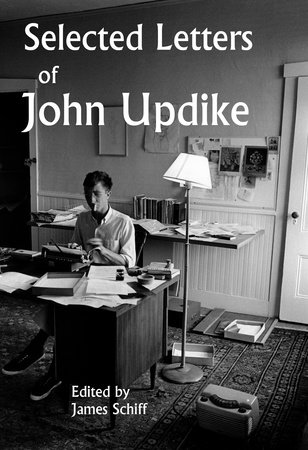
Knopf, now a division of Penguin-Random House, just released cover art for Selected Letters of John Updike, edited by Updike scholar and John Updike Society vice-president James Schiff. The hefty hardcover (900 pages) is roughly 6×9″ and slated for October 21, 2025 release. A book release event and signing will be scheduled as part of the joint Roth-Updike societies’ conference in New York City, Oct. 19-22. Those who plan on attending should count on getting a copy in NYC.

From the Penguin-Random House website, which offers purchase links to Amazon, Barnes & Noble, Books A Million, Bookshop.org, Hudson Booksellers, Powell’s, Target, and Walmart:

“The arc of literary giant John Updike’s life emerges in these luminous daily letters to family, friends, editors and lovers—a remarkable outpouring over six decades, from his earliest consciousness as a writer to his final days

“As James Schiff writes in the introduction to this volume, of the writer who would eventually express himself in written form as copiously and as elegantly as any American writer before him, ‘Updike needed to write the way the rest of us need to breathe or eat.’ With his stunning rhetorical gifts—allowing him to thrive in both fiction and nonfiction, in criticism as well as poetry—he was also a consummate letter writer. From his early writing attempts (he began submitting work to magazines as a teenager) to the 150 eye-opening letters home when he left the farm and family to go to Harvard, to the young adult correspondence with The New Yorker and other publications where his work began to appear, and on into the fullness of a long literary life, his correspondence, Schiff notes,’figures not as an adjunct to but rather an integral part of his astonishing literary output.’

Observer reader writes Updike was ‘no monk’

One of the March 10, 2024 letters to The Observer (U.K.), The Guardian‘s Sunday magazine, writes in a letter given the headline “Updike was no monk”:

“Tomiwa Owolade writes persuasively about the rewards of ritual in a simple life, but he might want to think again about describing John Updike as a “happy monk” (“Make coffee. Shower. Clean the loo. In an age of choice, rituals are the key to happiness”).

The great writer was serially unfaithful, seeking comfort in religious faith and sexual adventure. As Updike explained it: ‘If you have a secret, submerged, second life, you have somehow transcended or outwitted the confines of a single life.’ That’s one way of excusing infidelity.”
Suzy Powling
Leiston, Suffolk

Roth letters reveal a complex relationship with Updike

In his May 21, 2020 article on “The Philip Roth Archive,” Jesse Tisch described  “A fan’s obsessive rummage through the letters and papers of the writer who died two years ago today” that “reveals a playful, funny, brilliant man.”  The letters also reveal a great deal about the complicated relationship  Roth had with fellow literary giant John Updike.

“Their relationship is hard to categorize, not a friendship, exactly, nor merely an acquaintance,” Tisch wrote. “For all their similarities—two literary grandees of the same generation, both precocious, prolific, obsessed with male desire and waning potency—they were strikingly different. Religious and secular. Serene and intense. High style and vernacular. Whereas Updike poured out novels, Roth, a plebeian laborer, assembled them brick by brick. To say that writing was pleasure for Updike and torture for Roth is to overstate things only slightly.

“The Roth-Updike letters reveal a deeper, more complex relationship than I had known about. Despite their differences, Roth admired Updike extravagantly, both as a novelist and a critic. “There’s no other writer (which is to say no one at all) in America whose high opinion means more to me than yours,” Roth wrote Updike in 1988. Roth pored over Updike’s reviews of his books, taking them to heart even when he didn’t agree: ‘take a look at page 181 of The Anatomy Lesson,’ he urged Updike in 1984. ‘My answer to the last paragraph of your review.’

“Somehow, despite their mutual respect and occasional get-togethers, the friendship never deepened. Roth’s half of the correspondence is warm and funny (another difference: Roth was far funnier), his fondness tinged with envy. ‘Reading you when I’m at work discourages me terribly—that fucking fluency!’ Roth wrote Updike in 1978. That wasn’t the only source of envy. ‘He knows so much, about golf, about porn, about kids, about America,’ Roth told David Plante. ‘I don’t know anything about anything.’ Indeed, one picks up on a subtle antagonism to Roth’s joshing. ‘Poor Rabbit. Must he die just because you’re tired?’ he needled Updike in 1990. More than once, Roth bristled at Updike’s criticism. He couldn’t understand Jewish novels; he had no comprehension of Jewish history or the Jewish psyche. ‘We are in history up to our knees,’ he told an interviewer, dismissing Updike’s review of The Anatomy Lesson.

“To some degree, both men were guarded and self-protective. Updike’s shield was amiability; Roth’s was humor and flattery. Of the two, Roth seemed more eager to pursue a deeper friendship. Roth professed ‘affectionate sympathy and something even more than that’ to Updike in 1991, yet sensed a certain resistance, a studied aloofness, on Updike’s part. Any chance for friendship was ruined by Updike’s incisive criticism of Roth’s novels. Reviewing The Anatomy Lesson, Updike complained of ‘the grinding, whining paragraphs’ and suggested that ‘by the age of fifty a writer should have settled his old scores.’ That rankled. In 1993, Updike delivered several sharp blows to Roth’s ego in the process of criticizing Operation Shylock (final verdict: Roth was ‘an exhausting author to be with’). The final blow came in 1999, when Updike, writing in The New York Review of Books, endorsed Claire Bloom’s vindictive memoir of her relationship with Roth. That did it: Roth was furious; the men never spoke again. Late in life, his wounds somewhat healed, Roth would claim to regret their estrangement. ‘I think you are next after Gordimer,’ he wrote Updike in October 1991. Of course, neither would follow Gordimer, which proved another lasting connection between the men—America’s greatest nonwinners of the Nobel Prize.”

The fascinating article based on letters from the Philip Roth Archive covers a lot more ground than this. Here’s the link.

John Updike: a literal man of letters

Writers write. And the great ones were often great at correspondence. Like Ernest Hemingway, John Updike wrote for popular publications of his day, and like Hemingway he was a proliferate letter-writer. How MUCH of a letter-writer is now coming to light, as people have begun to respond to scholar James Schiff‘s call for Updike letters.

As Schiff told The Guardian, “While it is hardly surprising that he carried on a correspondence with editors, translators, publicists, critics, journalists and fellow writers, what is remarkable is how often and generously he responded to letters from readers, fans and complete strangers.”

Schiff said Updike even responded to “a stranger who asked him to write a note of encouragement to his nine-year-old son who suffered from psoriasis,” a condition Updike shared and wrote about in his essay “At War with My Skin.” Schiff speculates that Updike’s experience as a teenager requesting samples of work from his favorite cartoonists might help to explain his own “pay it forward” attitude toward correspondence.

“Though some of his letters and postcards are perfunctory and mundane, the large majority reveal his attempt to say something witty, funny, or clever,” The Guardian article notes.

Schiff is still gathering letters for a volume of collected letters to be published in 2021. If you have any, send a scan or photocopy to updikeletters@gmail.com.

John Updike letters sought

schiff-130x150The John Updike Letters Project

For those who may have missed the announcement, The John H. Updike Literary Trust has named John Updike Society vice president James Schiff as editor of a volume of John Updike’s letters.

Schiff, who edits The John Updike Review, expects to complete the project in 2020 and has begun collecting letters from institutional libraries, in addition to requesting them from private owners and recipients.

If you have letters, notes, or postcards from John Updike—a single one, or many—Schiff would appreciate receiving photocopies or digital scans. All materials and inquiries will be handled with care and discretion.

Contact:  James Schiff, 2 Forest Hill Dr., Cincinnati, OH  45208; (513) 284-6012; james.schiff@uc.edu.