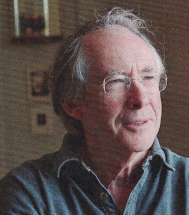
Ian McEwan talks about the Updike influence

In a Culture segment for Five Books, novelist Ian McEwan “talks about the books that have helped shape his own—from the biography of a scientific genius to a treatise on the end of time—and the importance of finding ‘mental freedom.'”

Here are the exchanges having to do with the Updike influence:

Would you go to Updike for sex, if not Larkin?
I think some of the descriptions of sex in Updike are extraordinary. I could never follow him down his route because his gift is one I’ve never hoped to emulate, which is the visual. In a sense he almost debunks or destroys the thing he’s describing, because of his clinical eye, but it does take my breath away. In this realm he’s a master of the hyper-real.

Talk a little about John Updike if you will, who died not long ago, in 2009. Your third book is Rabbit at Rest, the fourth of his ‘Rabbit’ novels.
Updike has been a very important writer for me, the one I’ve admired most, read most, and returned to most often. I was deeply touched by his death. I felt that we had conversations unfulfilled – we got to know each other a little in the last six or seven years of his life, and we had a correspondence.

What was he like, his character?
He was impenetrably courteous. At first, quite difficult to get beyond his very gentlemanly, polite and considerate shell. He protected himself. Behind this shell was all of his work. It was easier to get a more intimate Updike by writing letters. If I wrote, I’d get a response by return of post, apologising for being so quick, just as I would be apologising for my delayed replies. He said it was the only way he could keep his desk clear. But of course it was not that at all. This was a highly organised mind with boundless creative energy. He could turn in 1200 words of fiction in a day, write a review or an essay, and still address his correspondence.

You’ve called him ‘the greatest novelist writing in English at the time of his death’. What is it about Updike that deserves that praise?
Great sentence-maker; extraordinary noticer; wonderful eye for detail; great fondler of details, to use Nabokov’s phrase. Huge comic gift, finding its supreme expression in the Bech trilogy. A great chronicler, in the Rabbit tetralogy, of American social change in the 40 years spanned by those books. Ruthless about women, ruthless about men. (Feminists are wrong to complain. There’s a hilarious streak of misanthropy in Updike). He reminds us that all good writing, good observation contains a seed of comedy. A wonderful maker of similes. His gift was to render for us the fine print, the minute detail of consciousness, of what it’s like in a certain moment to be another person, to inhabit another mind. In that respect, Angstrom will be his monument.

You say feminists are wrong to criticise him, but there is that criticism – that he has a ‘male gaze’. Do you face the same challenges when you write female characters?
I have done occasionally. It means nothing to me. This is a visual form. Remember Conrad’s exhortations in the preface to The Nigger of the Narcissus: ‘I am trying…by the power of the written word…to make you see.’

Harry ‘Rabbit’ Angstrom was, I gather, an inspiration for Michael Beard, the protagonist of Solar?
I crouched in Updike’s shadow. I set myself the problem of having an unsympathetic hero, and enticing a reader to stay in his company for the length of a novel. With Rabbit, Updike showed us how this is achieved. Rabbit is not the nicest of men, his is a narrow consciousness, he’s of limited education, deeply ungenerous in the private life – remember how he makes love to his son’s wife? Grumpy, irritable, bigoted in some respects, and yet somehow Updike succeeds in making him the prism through which 40 years of American social change is observed, and 40 years of close shifts within family relations, adulterous affairs and the tragedy of a lost child.
How does he do this? Well, he invents an altered or heightened realism. He gives Rabbit his own – Updike’s – thoughts, and yet somehow he makes them plausibly Rabbit’s. Rabbit has reflections on mortality that could only be, in any realistic frame, Updike’s. But he makes them Rabbit’s; he shoehorns them into this limited mental space. It’s a rhetorical trick. In short, what Updike succeeds in doing is to make Rabbit interesting. He might not be good, but he’s interesting, and we travel with him for that reason alone. I can’t claim for a moment to have come anywhere near this with Michael Beard, but that was the example at my side.

When I feel my faith flagging in the whole enterprise of fiction – and all writers experience this – a few pages of Updike will restore my energies and optimism.

“Ian McEwan recommends Books That Have Helped Shape His Novels”
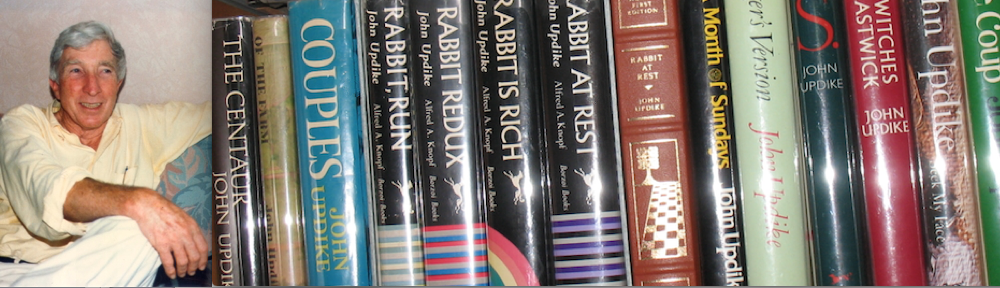
De Bellis featured in WDIY interview

jackdebellis-webJohn Updike Society cofounder and former director Jack De Bellis, whose John Updike Encyclopedia and John Updike’s Early Years have been indispensable for Updike scholars, was featured in an interview on WDIY, Lehigh Valley’s Community NPR Station, on Dec. 6, 2016.

Asking the questions was Lehigh Valley Discourse host John Pearce.

Here’s the audio link.

Ozick on Updike: steadily remarkable

Screen Shot 2016-08-09 at 9.34.09 AMIn a summer New York Times Book Review interview, “Cynthia Ozick: By the Book,” Ozick mentions Updike in her very first response. Asked what books are currently on her night stand, she replies,

“Nowadays my night stand is a roughly cubical archaeological mount (33 by 25 inches), long awaiting shelf space. From a middle stratum I’ve excavated the regenerative pleasures of rediscovery—all old books: John Updike’s Villages (an aching reminder of the absence of that steadily remarkable literary voice); a Library of America collection of four novels by William Dean Howells (who ought to be venerated at least as much as Willa Cather, if not more); Frank Kermode’s Pieces of My Mind (consummate reflections on subjects ranging from Don DeLillo and Raymond Carver to ‘Secrets and Narrative Sequence’). And from a lower lode, a pair of memoirs by two boyhood escapees from Nazified Vienna, marking Austria’s loss of a stellar composer and a questioning poet: Robert Starer’s Continuo: A Life in Music and Arthur Gregor’s A Longing in the Land. Finally, on the mound always accreting surface, a weighty volume turned upside down to conceal the face on its cover: a new biography of Adolph Hitler by Volker Ullrich, translated from the German, not yet opened. Will I read it? Will I? Sometimes repugnance overrides psychological curiosity, and sometimes psychological curiosity is no more illuminating than pornography.”

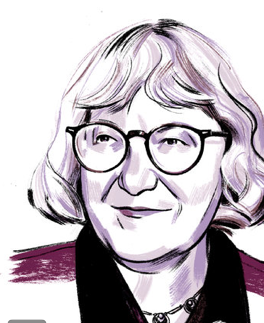
The illustration is by Jillian Tamaki.


Tanenhaus on Bill Buckley . . . and John Updike

96iiRXJ1_400x400The Daily Beast today published an interview Scott Porch did with biographer Sam Tanenhaus, “Bill Buckley Gets Bigger Over Time.” In it, Tanenhaus talks about his work-in-progress but also shares a few thoughts about Updike:

“For me, Updike and Bellow and Roth are giants now; they were writing when I was young. My copy of Updike’s Rabbit Is Rich is the copy I got when I was 15 or 16 through the Book of the Month Club. It’s the only book I ever had signed by an author in all of my years at the book review. We did a long video interview with him for the website. Those figures to me are very large and important. I think of them almost like family, and some of them are still working. Bob Caro is still working. Gay Talese is still working. I saw Garry Wills at the Aspen Ideas Festival a couple of weeks ago, brilliant as ever. Those figures are really important to me.”

Allegra Goodman reads and discusses A&P on a New Yorker podcast

AllegraGoodmanAllegra Goodman, author of such novels as The Cookbook Collector, The Other Side of the Island, and Intuition, is featured in a New Yorker: Fiction podcast. Each month a fiction writer whose work appears regularly in The New Yorker selects a story to read and discuss, and Goodman picked Updike’s “A&P,” which she said had special meaning for her because she grew up in Hawaii and had her share of experiences with people in bathing suits in supermarkets, and she said she and her sister had names that began with “A” and “P” and began calling themselves that.

Here’s the link to the podcast.

Russian lit expert shares Updike’s response to this and that

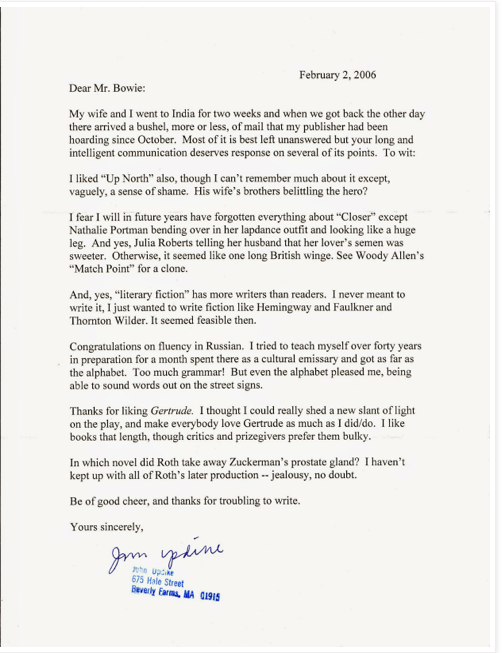
photoU.R. Bowie, who taught Russian literature for 30 years at Miami University and now writes a blog, recently shared a response from Updike to his questions about Charles D’Ambrosio (Up North), Natalie Portman and Julia Roberts (Closer), Woody Allen (Match Point), literary fiction, fluency in Russian, Philip Roth, Zuckerman, Zuckerman’s prostate gland, “etc.”

Here is Updike’s response to his 2006 letter:

classical-russian-literature.blogspot.com

Begley interviewed on BYU Radio

In a radio interview given just days after his keynote address at the 3rd Biennial John Updike Society Conference in Reading, Pa., Updike biographer Adam Begley talked about Updike on “The Morning Show,” BYU Radio, Brigham Young University, Provo, Utah.

“‘[Updike] was ambitious and charming, but there was an element of selfishness and a brutal, driven desire to impose himself on the world,’ says Begley, author of ‘Updike.'”

Both a written story and full audio are available here.

McEwan says he and Updike talked about mortality

Novelist Ian McEwan was recently interviewed for the Books/Culture section of The Observer in a piece published on Saturday, August 30, 2014:  “Ian McEwan: ‘I’m only 66—my notebook is still full of ideas.'”

Although interviewer Robert McCrum mostly asks about McEwan’s latest book, The Children Act, he also describes a moment in the interview in which McEwan evoked John Updike:

“Out of the blue he remembers interviewing the late John Updike in his final years. ‘We talked about all this,’ he recalls. ‘He told me: The older you get the less frightening death becomes.’ He frowns in puzzlement. ‘I’m not sure whether to believe him.’

“So does he believe him?

“‘No.’ A beat. ‘Do you believe those obituaries that say, ‘Died peacefully in his sleep?’ (McEwan was at Christopher Hitchens’s bedside shortly before he died.) ‘Still, wouldn’t be a bad way to go.'”

Begley: Updike’s last sin was writing

Adam Begley, in Scotland for the Edinburgh International Book Festival, gave an interview to Alan Taylor of The Herald that was assigned the somewhat titillating headline “The final sin of John Updike.”

In the long interview, which was published in the Saturday, August 9 online version, Begley covers a lot of ground and concludes that Updike had given up all but one of his vices—smoking, drinking, sleeping around. “‘It’s true, his last sin was writing,’ says Adam Begley. ‘This compulsion to take other people’s lives and use them for his own ends. Other than that, he had given up naughtiness.'”

Says Begley, “I didn’t think Updike’s biography was difficult to write because my training is in literary criticism and my inclination is towards literary criticism. What Updike offers to me is much more valuable that [Norman Mailer-esque] derring-do or political campaigns; punching one’s colleagues in the faces or biting their ears or stabbing your wife. What he did is write books that drew me to them like a magnet and stories that I could turn to.”

“The character who emerges from Begley’s book is complex and fascinating and, to a degree, elusive,” Taylor writes. “There was, for example, the public figure, who could turn on the charm as one might a light. He was studiedly polite and played the part of literary gent almost to the point of parody. By nature, Updike was also careful and cautious and conservative. For much of his life, moreover, he had a stammer and was plagued with psoriasis. And, having grown up as a single child in a family that always had to count pennies, he could never fall back on privilege.

“But there was also another side to him, observes Begley, that of the daredevil and the practical joker. As a teenager he would woo his pals with stunts, jumping on the running board of his parents’ old black Buick and steering it downhill through the open window. He was prone to tomfoolery, as if determined to draw attention to himself. He liked to leap over parking meters and would through himself downstairs as if he were part of a slapstick act. ‘So there is that contradiction in him,’ says Begley, ‘that is elemental in him and that biographers like and which they pretend they can explain, but can’t.”

In a new interview, Garrison Keillor cites Updike as a hero

KeillorGarrison Keillor, the American humorist and writer best known for hosting “A Prairie Home Companion,” has featured poems by John Updike on his website, so it’s no surprise that he thinks highly of Updike.

In an interview published today, August 7, in the New York Times Sunday Book Review, Keillor was asked about his literary heroes:

“John Updike for his vast ambition and the Lutheran diligence that realized it. Edward Hoagland for his style and bravery and love of the world. May Swenson, again for bravery, independence, also wit. A.J. Liebling and Roy Blount Jr. as reporters who wrote literature: You can read them over and over and over. P.G. Wodehouse for sheer elegance and invention. Robery Bly, a wonderful poet into his 80s, a great old troublemaker.”

The illustration is by Jillian Tamaki, and you can read the whole interview here:  “Garrison Keillor: By the Book”