Begley: Updike’s last sin was writing

Adam Begley, in Scotland for the Edinburgh International Book Festival, gave an interview to Alan Taylor of The Herald that was assigned the somewhat titillating headline “The final sin of John Updike.”

In the long interview, which was published in the Saturday, August 9 online version, Begley covers a lot of ground and concludes that Updike had given up all but one of his vices—smoking, drinking, sleeping around. “‘It’s true, his last sin was writing,’ says Adam Begley. ‘This compulsion to take other people’s lives and use them for his own ends. Other than that, he had given up naughtiness.'”

Says Begley, “I didn’t think Updike’s biography was difficult to write because my training is in literary criticism and my inclination is towards literary criticism. What Updike offers to me is much more valuable that [Norman Mailer-esque] derring-do or political campaigns; punching one’s colleagues in the faces or biting their ears or stabbing your wife. What he did is write books that drew me to them like a magnet and stories that I could turn to.”

“The character who emerges from Begley’s book is complex and fascinating and, to a degree, elusive,” Taylor writes. “There was, for example, the public figure, who could turn on the charm as one might a light. He was studiedly polite and played the part of literary gent almost to the point of parody. By nature, Updike was also careful and cautious and conservative. For much of his life, moreover, he had a stammer and was plagued with psoriasis. And, having grown up as a single child in a family that always had to count pennies, he could never fall back on privilege.

“But there was also another side to him, observes Begley, that of the daredevil and the practical joker. As a teenager he would woo his pals with stunts, jumping on the running board of his parents’ old black Buick and steering it downhill through the open window. He was prone to tomfoolery, as if determined to draw attention to himself. He liked to leap over parking meters and would through himself downstairs as if he were part of a slapstick act. ‘So there is that contradiction in him,’ says Begley, ‘that is elemental in him and that biographers like and which they pretend they can explain, but can’t.”
In a new interview, Garrison Keillor cites Updike as a hero

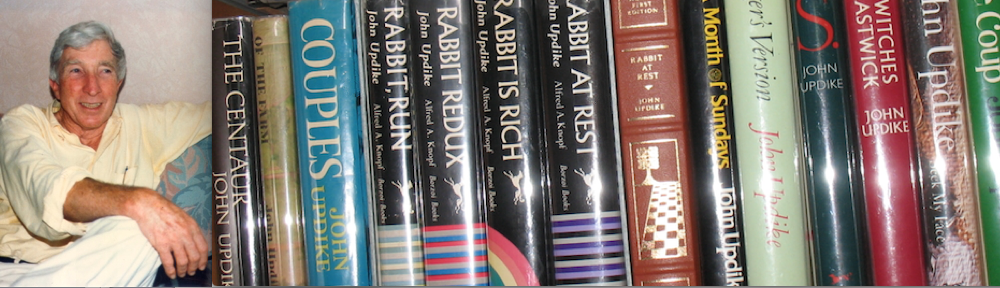
KeillorGarrison Keillor, the American humorist and writer best known for hosting “A Prairie Home Companion,” has featured poems by John Updike on his website, so it’s no surprise that he thinks highly of Updike.

In an interview published today, August 7, in the New York Times Sunday Book Review, Keillor was asked about his literary heroes:

“John Updike for his vast ambition and the Lutheran diligence that realized it. Edward Hoagland for his style and bravery and love of the world. May Swenson, again for bravery, independence, also wit. A.J. Liebling and Roy Blount Jr. as reporters who wrote literature: You can read them over and over and over. P.G. Wodehouse for sheer elegance and invention. Robery Bly, a wonderful poet into his 80s, a great old troublemaker.”

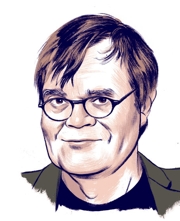
The illustration is by Jillian Tamaki, and you can read the whole interview here:  “Garrison Keillor: By the Book”


Radio Open Source uploads David Updike clip


DavidUpdike
Radio Open Source, which recently uploaded a podcast featuring Adam Begley intercut with John Updike audio quotes, also uploaded “From WHAT MAKES RABBIT RUN?: David Updike on being a writer’s child.” The clip only runs a minute and a half, but Updike enthusiasts might appreciate seeing the difference in philosophy between Updike and his son, who is also a writer.

David Updike is the author of numerous books, among them Old Girlfriends: Stories, of which Kirkus Reviews noted, “Thoughtful work from a writer clearly unintimidated by the family name.” And a reviewer for Elle wrote, “David Updike does himself—and his late father, John—proud with his second collection, Old Girlfriends . . . these 10 ruminative stories set in New England sport a winning sense of whimsy, quiet surprise, and fresh, frank sensuality.”

Blogger features Begley Q&A

Blogger Mark Stevens published a Q&A with Updike biographer Adam Begley on May 13 in which Begley talks about the issues central to Updike’s work and life.

Among Begley’s responses:

“I think his misbehavior was very fruitful for him: he made hay out of his peccadillos—or his sins, really, if you want to talk about it that way. The key passage for [me] is in Roger’s Version, when Roger finally allows Verna—his half-niece, his half-sister’s daughter—to seduce him and they are lying on the soiled futon in a rundown housing estate and they have just committed quasi-incest and adultery, because he’s married, and at that moment he, this character Roger, has this great religious epiphany, which is that even in abasement you are subject to God. I think that is a crystallization of his attitude, if you will, of his attitude toward his own transgressions and his religious faith. Both were equally important to him. I don’t think John Updike could have been the artist he was without his philandering and I don’t think he could have been the artist he was without his faith.”

“Q&A with Adam Begley — ‘Updike'”

Salon interviews Begley on Updike

On May 5, 2014, Salon published an interview that David Daley conducted with Updike biographer Adam Begley,

“Adam Begley on John Updike: ‘He believed he was doing something more important than the feelings of the people around him.'”

In it, Begley talks about the hazards of writing a biography and shares his thoughts on some of Updike’s friends and harshest critics, among them:

“[Christopher Lasch and Updike], I think, egged each other on, and pushed each other to greater academic feats. It’s weird enough that they were roommates, what’s even weirder is that they then both graduate summa, that Kit Lasch gets the prize for best thesis, and Updike gets the No. 2 prize. I mean, I don’t suppose that’s ever happened before in the history of Harvard, freshman year roommates getting No. 1 and No. 2 essay prizes, and graduate summa. It’s an extraordinary coincidence.”

“Jonathan [Franzen] has very harsh words for Updike. And I remain convinced—and I admire Jonathan’s work and I’m fond of Jonathan personally—but I believe that he’s suffering from a bit of anxiety of influence here. That he feels the need to denigrate Updike because his project is really not very different from Updike.”

“Let’s go back to 1996, ’97. David Foster Wallace is the flavor of the month. He’s just published ‘Infinite Jest.’ John Updike has just published a novel set a couple years in the future, which is somewhat eerily like the future world of ‘Infinite Jest.’ . . . So yes, I got David Foster Wallace [to review the novel], but no, I was not involved in the attempt to assassinate Updike . . . . David Foster Wallace was not a full-blooded critic of Updike. He had in his collection a heavily annotated copy of ‘Rabbit, Run.’ He is an Updike fan. But ‘Toward the End of Time’ is not a good novel.”

More Begley: Kirkus interviews the Updike biographer

Kirkus Reviews on April 9, 2014 published an interview with Adam Begley, who dished, “I spoke to people he’d had affairs with. He had a lot of friends, and there was a great deal of interconnecting there. If you’ve read Couples, you know exactly what I mean,” Begley said.

“The first time he wrote about adultery was a book called Marry Me that was published 10 years after he wrote it, and it’s the only book in his cannon that was published out of sequence,” Begley said. “That was a book about an affair that he had had in the mid-’60s and it wasn’t published until the ’70s. It’s a novel, but it’s very closely based on the facts of an affair.”

The interview was conducted by Scott Porch. Here’s the link.

Interview: How to Write John Updike’s Deathbed

The AWL today (April 21, 2014) published an interview with Updike biographer Adam Begley titled, “How to Write John Updike’s Deathbed.” Asking the questions was Elon Green.

In it, Begley is asked about the deathbed section in Updike, and whether family members saw the book before publication. Begley says that there were numerous corrections to the death scene and also answers questions about the book’s fact-checking, what he regretted leaving out of the book, whether Updike suffered for his art, and what women writers he admired.

Here’s the link to the article, “How to Write John Updike’s Deathbed.”


Biographile asks Begley about Updike

Biographile posted an interview with Updike biographer Adam Begley yesterday in which they asked about Updike’s mother, the importance of religion to his fiction, and the challenges Begley faced in writing a biography of a man whose career seemed, at least to the outside world, smooth.

Here’s the story:

“Alive to the World of Literature: Biographer Adam Begley on John Updike”

NPR spotlights Begley’s UPDIKE

NPR spotlights Adam Begley’s biography Updike today, featuring an audio interview and a published version that includes “Interview Highlights”:

“Biographer Explains How John Updike ‘Captured America'”

Asked what kind of dinner guest Updike was, Begley responds, “You would be aware that he was noticing you with terrific intensity, and you might find even that he’d put you in a story next time.”