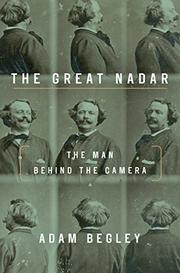

Begley cites Updike in his new biography of The Great Nadar

In his new well-reviewed biography, The Great Nadar: The Man Behind the Camera, Updike biographer Adam Begley writes,

“I saw the exhibition at the Metropolitan Museum, and Nadar instantly claimed a place in my private pantheon of great artists. But as John Updike observed in his review of the show, ‘Photography is a matter of time’—nearly twenty years passed before I tried to find out about Nadar’s life. The catalyst was Julian Barnes’s Levels of Life, an unusual book, part essay, part short story, part memoir, in which Barnes briefly sketches the contours of Nadar’s curious career and irrepressible character. Thanks to Barnes, Félix charmed me, as he had charmed so many others. And so I went back to the photographs to look again.”

“The Great Nadar by Adam Begley — Kirkus Reviews: “A lively portrait of a photography pioneer who altered the cultural landscape of 19th-century France.

Amazon link

Updike is still frequently anthologized

American short story master Raymond Carver leads the pack when it comes to writers whose stories appear most frequently in anthologies, but right behind him are John Updike and Joyce Carol Oates.

Literary Hub‘s Emily Temple looked at 20 short fiction anthologies published between 1983 and 2017. She says she also consulted the “best of” and “prize” anthologies. Carver turned up in 15 of them, while Updike and Oates appeared in 14. From there it was Flannery O’Connor (13), Richard Ford and Tim O’Brien (12), John Cheever and Tobias Wolff (11), Donald Barthelme (10), and tied with nine each were James Baldwin, Ann Beattie, William Faulkner, Ernest Hemingway, James Joyce, Jamaica Kincaid, Edgar Allan Poe, and Eudora Welty.

The most frequently anthologized story was Tim O’Brien’s “The Things They Carried” (10), followed by Baldwin’s “Sonny’s Blues,” Kincaid’s “Girl,” and then Carver’s “Cathedral” with seven appearances.

Updike’s stories that appeared in those 14 anthologies were:

“A&P” (3)
“Separating” (2)
“Brother Grasshopper”
“Packed Dirt, Churchgoing, a Dying Cat, a Traded Car”
“Pigeon Feathers”
“The Lucid Eye in Silver Town”
“The Christian Roommates”
“The Persistence of Desire”
“Gesturing”
“The Brown Chest”
“Here Come the Maples”

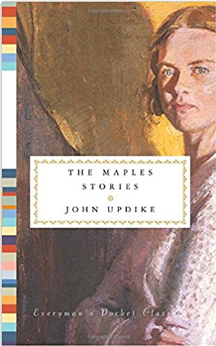
It’s worth noting that three of the stories, accounting for four appearances, come from The Maples Stories, a related series of stories based on Updike’s marriage to his first wife, Mary.

“The Most Anthologized Short Stories of All Time: A (Mostly) Definitive List” 

Volume published on Legendary Authors and the Clothes They Wore

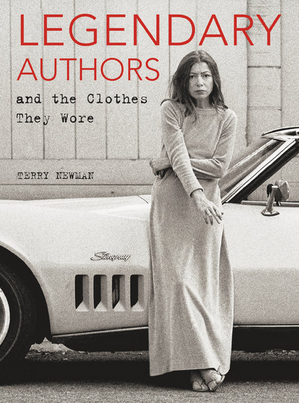
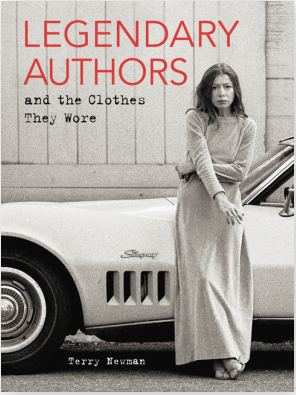
If you like literature and coffee table books, you might enjoy Legendary Authors and the Clothes They Wore, by Terry Newman.

“Out of the 50 writers included in the book—from T.S. Eliot and George Sand to Malcolm Gladwell and Joyce Carol Oates—there wasn’t one, Ms. Newman said, who didn’t prove a rich subject as she combed through their writing and interviews. Though they often overtly rejected the diktats of the runway, in doing so they drafted diktats of their own.”

“In the same way that pet owners sometimes come to resemble their animals, writers often come to resemble their discourse (or, in the case of John Updike, their main character — which is to say, suburbia). Ms. Stern refers to it as a ‘stylistic earmark.’ And she is not referring to just those authors who are part of the ‘write what you know’ contingent, or those who use their own life as fodder for their imagination.”

from “Your Literary Idols and Their Wardrobes,” by Vanessa Friedman (NY Times 29 June 2017)

New book published by Updike’s literary progeny

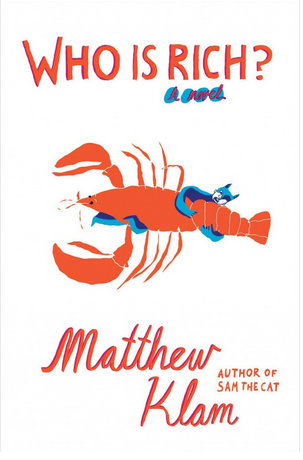
John Updike was famously one of the American writers who put sex in fiction because it’s part of “the continuum of life,” Updike had said. His depiction of sexual escapades in Couples landed him a Time magazine cover, and he paved the way for writers wishing to explore sexual situations and language in literature. But he may have been one-upped—at least according to Ron Charles, who reviewed the new book by Matthew Klam.

Klam was one of the New Yorker’s Best Fiction Writers Under 40 back in 2000, Charles writes, but then fell off the map until his recent publication of Who Is Rich?, “about a writer who once enjoyed ‘precocious success’ and then sank into obscurity. ‘I’d had an appointment with destiny,’ the narrator says. ‘I’d barely started, then I blinked and it was over.’

“We could speculate about how much this falls under the category of Write What You Know, but here’s what I do know,” Charles writes. “This is an irresistible comic novel that pumps blood back into the anemic tales of middle-aged white guys. Klam may be working in a well-established tradition, but he’s sexier than Richard Russo and more fun than John Updike, whose Protestant angst was always trying to transubstantiate some man’s horniness into a spiritual crisis.”

The novel is set at a summer artists conference “where hopeful adults of middling talent are taught by writers and painters of fading repute,” Charles writes. “Klam’s narrator is a 42-year-old graphic novelist named Rich Fischer, who first signed on with this summer program years ago when he was the hot new thing. Now he’s just a poor illustrator for a failing political magazine—a crisply satirized version of the New Republic.”

Full review

Amazon link

Updike included in aging masculinity in the American novel study

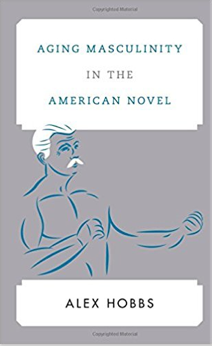
It’s been out for a year, but sometimes it takes a while to discover academic books. One of those titles that was displayed at the recent American Literature Association conference in Boston was Aging Masculinity in the American Novel, by Alex Hobbs, published by Rowman & Littlefield in May 2016.

In a chapter titled “Late Writing,” Hobbs focuses on John Updike, Philip Roth, Don DeLillo, and Cormac McCarthy, while in her conclusion she asks,

“Why should sexual identity be any less valued than professional identity, for example? Roland Blythe contends, ‘Old age is not an emancipation from desire for most of us, that is a large part of its tragedy. . . . Most of all [the old] want to be wanted.’ This is certainly accurate for Roth and Updike’s protagonists, and, to a lesser degree, perhaps, Paul Auster, Ethan Canin, and Anne Tyler’s characters, too. The long-term pessimism that is displayed by Roth and Updike’s men, but not by those in Auster, Canin, and Tyler’s novels, arguably stems from the way they try to use sexual relationships as their project; they rely on women to make their life whole and worthwhile. Thus, while there should be no vilification of the need or desire to retain an active sex life in old age, the characters analyzed here indicate that it is unhealthy to make this the sole focus for this stage of life. ”

Amazon link

Hobbes earned her doctorate in English from Anglia Ruskin University and teaches through The Open University. Her critical essays have appeared in Journal of American Culture, Critique: Studies in Contemporary Fiction, and Philip Roth Studies.

Updike’s sartorial style on display in new coffee table book

Everyone has a style, a “look”—even John Updike, who’s more famous for his elegant and erudite literary style. That style is on display in a new book by Terry Newman, Legendary Authors and the Clothes They Wore, which comes out in hardcover on June 27, 2017.

From the HarperCollins website:

Discover the signature sartorial and literary style of fifty men and women of letters, including Maya Angelou; Truman Capote; Colette; Bret Easton Ellis; Allen Ginsberg; Patti Smith; Karl Ove Knausgaard; and David Foster Wallace; in this unique compendium of profiles—packed with eighty black-and-white photographs, excerpts, quotes, and fast facts—that illuminates their impact on modern fashion.

Whether it’s Zadie Smith’s exotic turban, James Joyce’s wire-framed glasses, or Samuel Beckett’s Wallabees, a writer’s attire often reflects the creative and spiritual essence of his or her work. As a non-linear sensibility has come to dominate modern style, curious trendsetters have increasingly found a stimulating muse in writers—many, like Joan Didion, whose personal aesthetic is distinctly “out of fashion.” For decades, Didion has used her work, both her journalism and experimental fiction, as a mirror to reflect her innermost emotions and ideas—an originality that has inspired Millennials, resonated with a new generation of fashion designers and cultural tastemakers, and made Didion, in her eighties, the face of Celine in 2015.

Legendary Authors and the Clothes They Wore examines fifty revered writers—among them Samuel Beckett; Quentin Crisp; Simone de Beauvoir; T.S. Eliot; F. Scott and Zelda Fitzgerald; Malcolm Gladwell; Donna Tartt; John Updike; Oscar Wilde; and Tom Wolfe—whose work and way of dress bears an idiosyncratic stamp influencing culture today. Terry Newman combines illuminating anecdotes about authors and their work, archival photography, first-person quotations from each writer and current designers, little-known facts, and clothing-oriented excerpts that exemplify their original writing style.

Each entry spotlights an author and a signature wardrobe moment that expresses his or her persona, and reveals how it influences the fashion world today. Newman explores how the particular item of clothing or style has contributed to fashion’s lingua franca—delving deeper to appraise its historical trajectory and distinctive effect. Legendary Authors and the Clothes They Wore is an invaluable and engaging look at the writers we love—and why we love what they wear—that is sure to captivate lovers of great literature and sophisticated fashion.

HarperCollins pre-order link

Amazon pre-order link


New De Bellis book on Updike slated for summer release

John Updike Remembered:  Friends, Family and Colleagues Reflect on the Writer and the Man, edited by Jack De Bellis, will be published this summer by McFarland Books and is now available to pre-order. The softcover volume features 53 remembrances that “present a prismatic view of the two-time Pulitzer Prize winner and his work through anecdote and insight” as “interviews and essays from family, friends and associates reveal sides of the novelist perhaps unfamiliar to the public—Updike the high school prankster, the golfer, the creator of bedtime stories, the charming ironist, the faithful correspondent with scholars, the devoted friend and the dedicated practitioner of his craft,” as described on the McFarland website. List price is $29.95.

“Contributors include: his first wife, Mary Pennington, and three of their children; high school and college friends; authors John Barth, Joyce Carol Oates and Nicholson Baker; journalists Terri Gross and Ann Goldstein; and scholars Jay Parini, William Pritchard, James Plath, and Adam Begley, Updike’s biographer.”

De Bellis, who is Professor Emeritus of English at Lehigh University, was a founder of The John Updike Society and served on the board of directors from 2009-14. A member of the editorial board of The John Updike Review, he is best known among scholars for the books he has edited or written on Updike:

John Updike, 1967-1993: A Bibliography of Primary and Secondary Sources (Greenwood Publishing Group, 1994)
The John Updike Encyclopedia (Greenwood Publishing Group, 2000)
John Updike: The Critical Responses to the “Rabbit” Saga (Oak Knoll Press, 2003)
John Updike: A Bibliography of Primary and Secondary Materials, 1948-2007, co-authored by Michael Broomfield (Oak Knoll Press, 2008)
John Updike’s Early Years (Lehigh University Press, 2013)

Updike one of three to comment on Pamuk novel

“Back in 2004,” Literary Hub writes, “three literary heavyweights reviewed Orhan Pamuk’s novel of Modern Turkey,” and in the article “Atwood, Updike and Hitchens on Snow the site compiles remarks from three individual book reviews.

In a review published in the August 30, 2004 New Yorker, Updike concluded, “If at times Snow seems attenuated and opaque, we should not forget that in Turkey, insofar as it partakes of the Islamic world’s present murderous war of censorious fanaticism versus free speech and truth-seeking, to write with honest complexity about such matters as head scarves and religious belief takes courage. Pamuk, relatively young as he is, at the age of fifty-two, qualifies as that country’s most likely candidate for the Nobel Prize, and the near-assassination of Islam’s last winner must cross his mind. To produce a major work so frankly troubled and provocatively bemused and, against the grain of the author’s usual antiquarian bent, entirely contemporary in its setting and subjects, took the courage that art sometimes visits upon even its most detached practitioners.”

Read the entire article.

On Rabbit’s alter ego and new LOA editions

On Feb. 21 in New York City at a Library of America event, writer Kevin Morris and Cornell professor Glenn Altschuler took the stage to discuss Updike’s legacy.

Morris, who had “adopted” John Updike: The Collected Stories through the Guardian of American Letters Fund, is the author of All Joe Knight, a novel in which he “engages in a dialogue with Updike’s famous quartet of Rabbit novels,” as a March 9, 2017 LOA website story summarizes.

“Like Rabbit Angstrom, Morris’s protagonist Joe Knight is from Pennsylvania, is unhappily married to a woman named Janice, and is haunted by the sense that his entire life has been a falling-off since the days when he was a high-school basketball star. Perhaps appropriately for America in the early twenty-first century, however, Joe is even angrier and more profane than his predecessor ever was.

“The resonances between these two characters, along with Updike’s ability to capture the passions, doubts, and longings of America’s post-World War II generation—to ‘give the mundane its beautiful due,’ to use his oft-quoted phrase—were the grist for Morris’s talk with Altschuler.

“Updike fans will be excited to learn that Library of America inaugurates a planned five-volume edition of his novels in 2018; the lead-off volume will include the first book in the Rabbit Angstrom sage, 1960’s Rabbit, Run.

All Joe Knight Amazon link