We’re saddened to report the passing of Myrtle Council, an avid and knowledgeable local historian who was an honored guest at the grand opening of The John Updike Childhood Home in October 2021. She was 99.
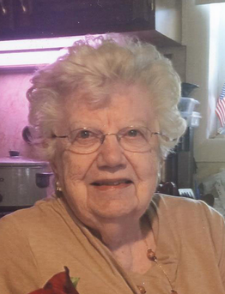 Myrtle was a 1941 graduate of Shillington High School, and after serving in the Navy WAVES during WWII she worked at the Reading Eagle-Times, Jacobs Aircraft Engineering Co., and Edelman’s Law Office in Reading.
But Berks County knew her mostly from her extensive volunteerism and advocacy for the preservation of local history. The list of organizations she served is almost as long as her rich life. She was a member of the National Parliamentarians Association, the American Institute of Parliamentarians, Berks Unit of PAP, the General Federation of Women’s Clubs, the PA Federation of Women’s Clubs, Southeastern District of PFWC, Berks County Federation of Women’s Clubs, Women’s Club of Shillington, Federation of Past Presidents Club, and the Shillington/Mifflin Alumni Association, frequently serving as president or a board member of those organizations. She was also a lifetime member of the Immanuel UCC, Shillington, where she was a youth group leader, Altar Guild Chairman, founder/leader of the Shawl Ministry for 10 years, and a kitchen helper.
Her intersecting interests of Shillington High School, John Updike, and local history and its preservation led her to take an active role in passing on archival materials that the Shillington/Mifflin Alumni Association had acquired to the John Updike Childhood Home, where some items could be displayed and others catalogued and safely protected for the future. Items currently at the house museum—including Shillington H.S. pennants, pins, hats, athletic letters, and a student handbook—are on display because of Myrtle’s vision and dedication to preserving local history for future generations to understand and appreciate.
Inurnment, with full military honors, will take place in Fairview Cemetery, 375 New Holland Ave., Shillington, at 10 a.m. on Dec. 30, 2023. A celebration of life service will follow at 11 a.m. at Immanuel United Church of Christ, 99 S. Waverly St., Shillington. The family will receive friends immediately following services in the church fellowship hall.
Contributions in memory of Myrtle Council can be made to Immanuel UCC at the above address. Here is a link to the obituary where memories can be shared.
The society sends its deepest sympathies to Myrtle’s daughter, Elizabeth, and to the rest of the family. Myrtle will be missed, but her work lives on.
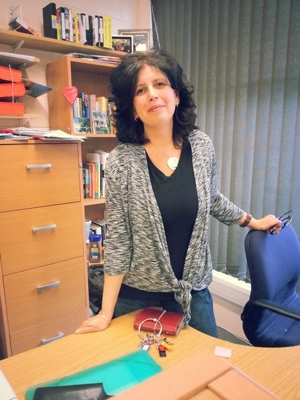 The selection committee for the John Updike Tucson Casitas Fellowship has chosen Dr. Sue Norton, Lecturer of English in the Faculty of Arts and Humanities at Technological University Dublin, to serve as the first fellow in residence.
 Laurence W. Mazzeno: Contemporary American Fiction in the European Clasroom: Teaching and Texts (Palgrave Macmillan, 2022) and European Perspectives on John Updike (Camden House, 2018). Norton came to Updike studies through her doctoral work on family in contemporary American fiction, which she completed in 2001 at University College Dublin. Her first article on Updike (The John Updike Review, 2014) was on the “regulating daughter” in the Rabbit novels. She has maintained an interest in the treatment of girls and women in Updike’s writing and beyond. It is on this topic that she will focus during her residency as the 2024 Fellow at the Tucson Casitas.
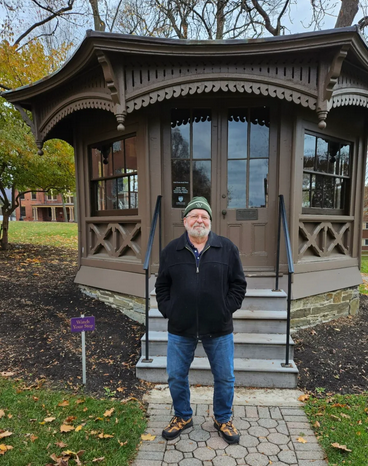 James Plath, whose most recent published criticism—”Updike’s ‘Wife-Wooing’: The Seven Year Itch and the Soliloquy of Seduction”—appeared in The John Updike Review Vol. 10, No. 1 (Fall 2023), recently spent two weeks researching an essay on Mark Twain and John Updike as a Quarry Farm Fellow.
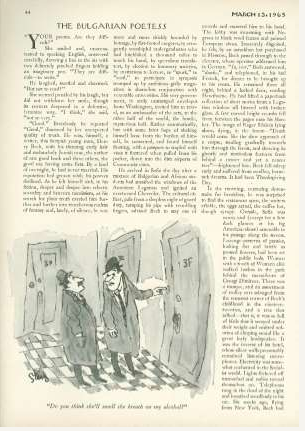 ABSTRACT: This article provides an innovative perspective on John Updike’s visit to Eastern Europe in the 1960s, including Bulgaria, as reflected in his short story “The Bulgarian Poetess” first published in The New Yorker on March 13, 1965. The inspiration for this interpretation is as much academic as it is anthropological. It comes from Updike’s use of my own surname, Glavanakova, which is not a common Slavic one, for the fictional character of the real-life Bulgarian poetess he met, whom researchers have established to be Blaga Dimitrova. Many have delved into the text aiming at a detailed and, more significantly, an authentic reconstruction of events, places and people appearing in the story (Katsarova 2010; Kosturkov 2012; Briggs and Dojčinović 2015). A main preoccupation of these analyses has been to establish the degree of factual distortion in Updike’s representation of the people and places behind the Iron Curtain. The pervasive imagery of the mirror, implying both its reflecting and doubling function, and the repetitive use of cognates associated with truth and honesty in the story suggest the focus of this article, which falls on the dynamics between authenticity and artifice from the perspective of autofiction by way of illustrating how one culture translates into another “at the opposite side[s] of the world” (Updike, “The Bulgarian Poetess”). In my interpretation, autofiction opens ample spaces for representations and discussions of identity and self-/reflexivity in a transcultural context.
 Not everyone who recognizes themselves in a writer’s fiction or poetry is pleased, but William Ecenbarger took delight in recalling his 1983 interview with John Updike that inspired Updike to write “One More Interview.” Then a writer for the Philadelphia Inquirer, Ecenbarger managed to score his interview with Updike through the writer’s mother, Linda. It was no ordinary interview.