Imaginative Conservative writer contemplates ‘wokeness’ and Updike

In “John Updike’s ‘In the Beauty of the Lilies’: The Children” (The Imaginative Conservative, Aug. 19, 2023), Daniel J. Sundahl began with two quotes from Updike:

“As to critics, it seems to be my fate to disappoint my theological friends by not being Christian enough, while I’m too Christian for Harold Bloom’s blessing. So be it,” and “The mature and well-balanced man, standing firmly with both feet on the earth, who has never been blamed and broken and half-blinded by the scandal of life, is such the existentially godless man.”
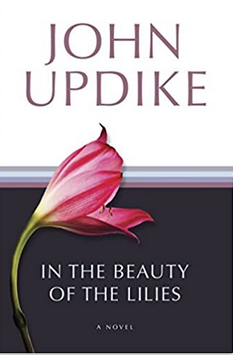
Mid-way through his essay, Sundahl remarked, “Of course there’s religion and then there’s religion and there are books and there are dirty books. . . which raises the question: Can one write about life, even life’s carnality and concupiscence, while maintaining Christian aspects?” He also, of course, attempted to answer his own question in a classical, meandering way, prompted by the last words (“the children”) of Updike’s novel, In the Beauty of the Lilies.

“I became fond over the years of the many contradictions regarding parents’ expectations about religion and literature, which included a smallish broo ha ha with a fundamentalist father when he learned his daughter would be reading a John Updike novel in an upper division American Literature course devoted to American Contemporary Fiction—the father arguing that although he had never read Updike he believed him scandalous and a writer of titillating, stylized pornography. Those are my words not his . . . which was singular: ‘dirty.’

“And he has a point and a good one, and I am not without empathy. As with many writers whose personal life and writings own a certain kind of ‘smudginess,’ greasy fingers on the pages, Updike is no exception. His embrace of realism as an artistic criterion (often concerning the breakdown of a marriage) is often passé these days and with gray humor. One question that emerges is whether a narrative Updike presents to his readers is a full and authentic report of human experience, which includes the particulars of the times and places of the narrative’s action, which would argue that Updike is a formal realist. Like his characters, he also put himself through many personal hardships. He had faults, and they were ‘smudgy’ and blurred.”
Read the whole essay.

Updike Society members head to Tucson, Ariz.

Some are in transit already, while others are just starting to write their packing lists. But on Thursday, September 21, 2023, members of the John Updike Society will travel to Tucson, Arizona for the 7th Biennial John Updike Society Conference in Tucson, Arizona, where John and Martha Updike owned two adjacent casitas (condos) and spent roughly five months each year during the early 2000s.

Below is a PDF of the schedule of events, including the academic sessions, side trips, and social events. If it looks like something you’re sorry to have missed, plan ahead:  the 2025 conference will be held in the Republic of Georgia, known as the birthplace of wine and the former ancient kingdom of Colchis. Follow us on Facebook to keep current with what’s happening.

UPDIKE IN TUCSON program 9-12-23

Wall Street Journal recommends Updike house museum

On Sept. 4, 2023, Philadelphia-based cultural reporter and critic Julia Klein’s review of The John Updike Childhood Home was published in The Wall Street Journal. Klein, an expert on museums, spent three hours walking through the house and taking notes on the 10 rooms of exhibits.

“For such a clear-eyed chronicler of America’s angst-ridden middle class, John Updike was surprisingly sentimental about his Pennsylvania roots. Here, one of his narrators declared, ‘the basic treasure of his life was buried,’” Klein wrote.

“In the short story ‘The Brown Chest,’ Updike’s narrator recalls ‘the house that he inhabited as if he would never live in any other’ and the ‘strange, and ancient, and almost frightening’ wooden chest that served as a repository of family memories.

“Both its hold on the author and the allure of its intimate artifacts, from that chest to Updike’s earliest drawings, make the John Updike Childhood Home a worthy site of literary pilgrimage.

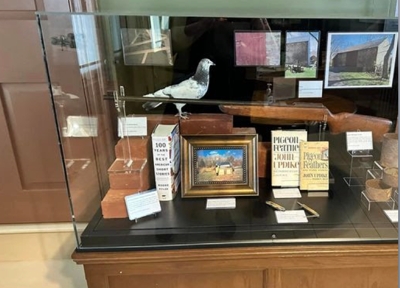
“The house museum, opened in October 2021, recently added seven vitrines, with artifacts including the Remington rifle of Updike’s short story ‘Pigeon Feathers’ and the Olivetti manual typewriter he used for four decades.”

The John Updike Society purchased The John Updike Childhood Home in 2012 with the intent of turning it into a literary site and museum to celebrate one of America’s greatest writers. The purchase was made possible by a grant from The Robert and Adele Schiff Family Foundation, which also supported every year of the meticulous restoration so that the house would look, inside and out, as it did during Updike’s time there. That foundation and others—most notably The PECO Foundation and The John and Gaye Patton Charitable Foundation—enabled the society to complete work and acquire many exhibits, while Elizabeth Updike Cobblah, David Updike, Michael Updike, and Miranda Updike contributed a great many family treasures. But donations also came from society members, Updike’s childhood friends, and members of the community who have embraced the museum as their own.

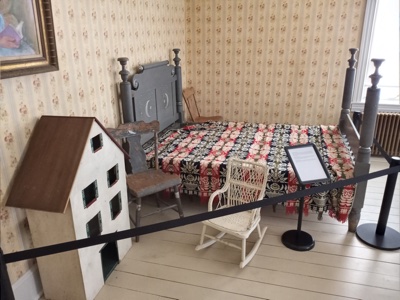
“Curated by James Plath, an Illinois Wesleyan University professor and president of the Updike Society, the museum celebrates Updike’s career, emphasizing how Shillington formed him as a writer,” Klein wrote, adding that the museum’s thematic approach “pays off particularly well in his mother’s writing room,” where images and artifacts suggest the complicated mother-son relationship with each other and their shared goal of becoming a writer. “The relationship seems to have been at once close and embattled, with the son vaulting to the literary success his mother craved.”

Updike Society members can be proud that the nine-year project has been positively received. It’s been a long journey that began with Habitat for Humanity of Berks County volunteers stripping wallpaper and tile flooring and knocking out walls that had been added after the Updikes moved out. Then restoration expert Bob Doerr and his crew carefully researched the details of the house during Updike’s time and restored it so meticulously that an older couple who had visited the house when the Updikes lived there said it was just as they remembered it.

Society community members donated Updike and Shillington artifacts and books, while Dave Silcox helped to find local treasures for the museum.  John Updike Childhood Home director Maria Lester, and before her Sue Guay, worked with Plath to move the project forward, while property manager John Trimble arranged all of the objects that had been selected for display in cases and took care of printing all the IDs that were provided and hanging all of the wall art and artifacts. And more than a dozen docents, Dave Ruoff the most senior among them, volunteered their time to staff the museum. Many more people were involved, of course—too many to name—because it truly takes a borough to create and sustain a museum like this.

If you would like to become involved in the Updike society, email jplath@iwu.edu; if you live in the area and would like to volunteer as a docent, contact Maria Lester, johnupdikeeducation@gmail.com.

In Memoriam: Christopher Carduff

Christopher Carduff, Books Editor of The Wall Street Journal, died unexpectedly on August 14, 2023. He was 66. According to his obituary, “The cause was complications related to a sudden brain bleed and blood clot. An extremely talented editor, he left a large literary legacy and made an enormous contribution to the canon of American letters.”

As an expert on John Updike, he was asked to serve as a trustee for the John H. Updike Literary Trust, and in his capacity as publishing consultant to the Trust he edited the posthumously published Updike volumes Higher Gossip, Always Looking, Collected Stories, Selected Poems, and multiple collections of Updike’s novels. Recently he oversaw publication of a forthcoming collection of selected letters compiled by Updike scholar and John Updike Society vice-president James Schiff—a volume now expected to be released sometime in 2024-25.

As his obituary notes, “In addition to Updike, Chris was the estate-appointed editor of posthumous works by Maeve Brennan, Penelope Fitzgerald, Daniel Fuchs, and William Maxwell. From 2006 to 2017, he was an editor and publishing consultant at The Library of America, overseeing the publication of American classics. He conceived and supervised multivolume editions of the collected works of many writers, including Carson McCullers, Katherine Anne Porter, Virgil Thomson, Kurt Vonnegut, and Laura Ingalls Wilder.” Carduff has been the Books Editor at The Wall Street Journal since 2017.

Chris was also an occasional but valued advisor to the Updike Society, president James Plath said. “He was a resource whose opinions I trusted and appreciated, whether they were about our work on an Updike museum-in-progress or, more recently, concerning a campaign the society plans to mount to get Updike on a U.S. postage stamp,” Plath said. “He will be missed, and his passing leaves a void on the John H. Updike Literary Trust that has yet to be filled.”

In “A friend’s passing reminds me that life is precious,” Danny Heitman wrote, “Among his favorite writers was John Updike, whom Chris admired for describing everyday experience in a way that makes it seem worthy of respect. That ideal, which Updike called giving ‘the mundane its beautiful due,’ is something that Chris seemed to regard as a kind of prayer.”

The society sends its condolences to Chris’s wife, Elizabeth Skinner Carduff, his two sisters, a brother, and nieces and nephews. See his obituary for details on how to donate to the Christopher Carduff Scholarship fund at The Columbia University Publishing Course.