 Since the society incorporated as a 501c3, Marshall Boswell, an English professor at Rhodes College, has been writing out checks (10-15 per month) and following up with phone calls to square things when a check wasn’t received or when there was some other problem. Each year he also collects information and prepares the checkbook to give to the society’s accountant at tax time. Because people are always in need of being reimbursed and bills always needing to be paid on time, he even takes the checkbook with him when he goes on vacation.
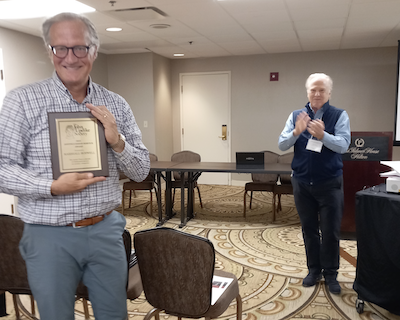
It’s a time-consuming job that Marshall has done faithfully without complaint for more than two decades, and for that the society board voted to present him with The John Updike Society Distinguished Service Award, an honor reserved for those who have assisted the society in important ways and donated a great deal of themselves, their time, their expertise, and in some cases, their financial support.
The award was to have been presented at the Roth-Updike Conference in New York City last October, but a family emergency kept Marshall from attending. Hence, it was presented to him on May 21, 2026 at the society’s annual business meeting, held at The Palmer House in Chicago during the 37th Annual American Literature Association Conference. Well done, Prof. Boswell!
Pictured in the background is society vice-president James Schiff, who presented the award.
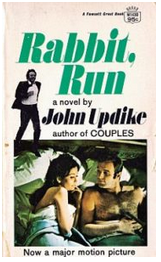 In an
In an  The Philip Roth and John Updike societies announced that registration is now open to participate in a joint conference to be held in New York City, Oct. 19-22, 2025.
 Displays will include founding documents, rare manuscripts, photos, cover and cartoon art, and artifacts on loan from other institutions–all intended to take visitors “behind the scenes of the making of one of the United States’s most important magazines,” according to City Life Org.
 “In the small town of Eastwick, Rhode Island, three women — Alexandra, Jane, and Sukie — discover they have magical powers after their marriages end.
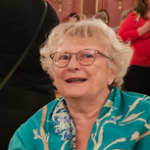 John Updike Society board member Sylvie Mathé was profiled in the series “Persistence of Character — Major interview: Archaeology of a journey” in e-Rea, electronic journal of studies on the English-speaking world. The series, published in French, tracks the breadth of an entire career of distinguished intellectuals, including early influences. An English translation exists in PDF form, but in a file to big to upload and no link to share. Here is the link to a French version online:
  Mathé talks about the full trajectory of her career, including the experience of spending her senior year in high school in Rock Island, Ill. “Compared to my final year in French, the amount of work was nothing like it was, nor the demands of the homework,” she told the interviewer. She shared that her host family was “extremely puritanical,” with the mother “surprised, even horrified, that I had read texts by Hemingway, or Sanctuary by Faulkner…It must be said that 1968 in a small town in Illinois was still the 50s. It had nothing to do with what was happening on campuses at the same time, with women’s lib, demonstrations against the Vietnam War, for civil rights, etc.” In summary, “Let’s say that compared to my final year in French, or my life in France, which was essentially focused on high school, work and success, it was a much more varied life, more entertaining…I was doing things I had never done before: I was caught up in the rhythm, I went to matches according to the football, basketball, baseball seasons,” and she dated, went to parties where there was drinking and marijuana brownies, and was generally inducted into American culture.
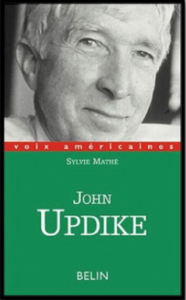 Mathé’s introduction to John Updike came when she went to Oxford and studied “Puritanism in John Updike’s Fiction” with Jeanne-Marie Santraud, “who was the only Americanist at Paris IV.” She would go on to write her master’s thesis on Updike and compose a monograph for the American Voices series edited by Marc Chénetier titled John Updike: Nostalgia for America.