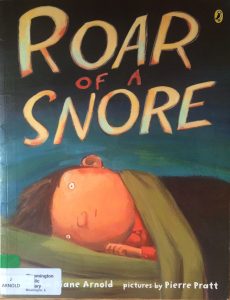
Roar of a Snore

Author: Marsha Diane Arnold

Illustrator: Pierre Pratt

Publisher and year: Puffin Books 2008

Number of pages: 30

Genre: Fiction
IMG_3388
Roar of a Snore is about a boy who is woken up by a very loud snore and he goes on a hunt to figure out who is snoring so loud. In a series of events he wakes his family and friends up to see if they are the snoring person and then they wake up and help the boy find the snorer. In the end it turns out that the snoring person is actually a tiny cat and the family ends up sleeping in the barn with all their animals and the tiny snoring cat.

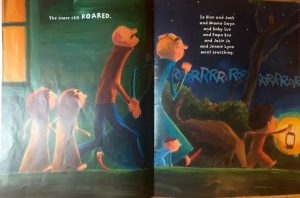
This text would function as a window for readers since they are looking into what is happening and the plot is something that they probably will not go through. If the reader is someone who lives on a farm they might be able to connect with the images since there are a lot of farm animals within the book. Sadly culture is poorly represented in this book; there are no characters of color, just a white family living on a farm. The images at first are pretty plain and not that much going on but once the boy starts waking up his family members the images get more and more hectic and detailed. The images have a lot of different colors that are not too bright, this makes it feel more like it is at night. The pages are full with images and the only time white is seen is where the text is. Since the images are not framed the reader gets the feeling that they are going on the hunt with the boy and his family to find the snorer. In the images the people are all facing the right while they are trying to find the snorer, this shows that they are moving forward after waking someone up and finding out they are not the snorer. Once they are able to find the snoring cat they face the left, which shows they are no longer moving forward in the story since they have found the snorer. I did not see a lesson that was supposed to be learned from this text; Roar of a Snore is meant to be more of a comedy that doesn’t have much meaning behind. It was a cute story that was fun to follow since a whole farm was woken up by a tiny cat.IMG_3389
Take Me Out to The Yakyu

Author: Aaron Meshon

Illustrator: Aaron Meshon

Publisher: Atheneum Books for Young Readers 2013

Number of pages: 35 pages

Genre: Cultural Fiction
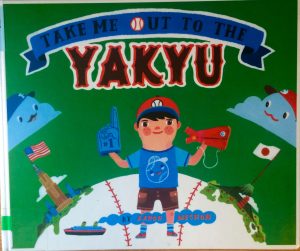
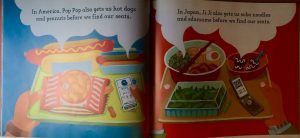
IMG_3394Take Me Out to The Yakyu is a story about a boy who loves baseball in American and Japan. Through out the story he explains his favorite part about baseball in both countries. I believe that this text would be considered a window because not a lot of people have the opportunity to get the same experiences as the boy in the story so they are unable to connect on a personal level. This text can also be considered a mirror since baseball is a big part of American culture. Although Americans are unable to connect with the Japanese baseball games, they both are the same sport. So if an American or Japanese reader picked up with book they would have the opportunity to connect with it. I really love how this text displays culture. It showed both American and Japanese culture equally and I actually learned some new things about Japanese culture from this book. The images are the main thing that really shows the different culture. On all the left pages there are images of what the boy does at American baseball games and on all the right pages it is an image of what the boy does at Japanese baseball games. So for example on page 10 he is talking about the food he gets at the games. On the left side there is a picture of a hot dog and peanuts, on the right side there is a picture of soba noodles and edamame. The images are full of color and have a lot of detail, and the text mirrors the pictures perfectly which helps describe what is going on in the culture one might not know well. One of my favorite things about the text is that on each page they have American sayings like fastball then on the opposite page they have the Japanese version of that saying. I never expected to learn a couple words in a different language from a children’s book. The text really shows two different cultures and that it is okay to have two different things part of your life. I also think that this text does a good job at showing that activities may not be as different as we think in other cultures. In both countries they are playing the same sport with the same rules. The only difference is the culture that is surrounding the game. I really enjoyed this text and I think it would be a great book to use in the classroom to show that culture can make people different and that it is important to have a good understanding of culture and that its okay to be different.IMG_3395
The Three Pigs

IMG_9614 [405971]

Author/Illustrator: David Wiesner

Publisher and Year: Clarion Books, 2001

Number of Pages: 38

Genre: Fantasy/Fiction

IMG_9615 [405972]

Analysis: “The Three Pigs” is a book where Wiesner puts a weird but interesting twist on the typical “The Three Little Pigs” story by not only allowing the pigs to stand strong, but to move on into a whole different story. From there, they escape the big bad wolf along with a new friend. This book could function as a door into the imaginative world of the three pigs. An old tale that many of us grew up on now has a huge twist on it, opening up our eyes to the many possibilities. In the typical beginning of the story, the wolf has all of the power. Then, the pigs become powerful and essentially “create their own ending” to the story. The images align with my understanding of culture by allowing the pigs to go in and out of reality. They are also allowed to dip into another story and experience something from that and (literally) take something from it.

Perceptually, the words in this book sometimes contradict the images, but it works. The words are typical “The Three Little Pigs,” and dialog is used often.

Structurally, the pigs “come out” of story and “go into” another. They look realistic when they’re not in their story, and the pictures are framed when their classic story is being told. The pigs move in the right direction into the new story.

Similar to the original story, “The Three Pigs” shows us that bullies never prevail.


Elmer

IMG_9616 [405973]

Author/Illustrator: David McKee

Publisher and Year: McGraw-Hill, 1968

Number of Pages: 30

Genre: Fable/Fiction

IMG_9617 [405974]

Analysis: Elmer the elephant is beautifully different, but he doesn’t see it that way. He goes through some extreme measures to be “normal” until he realizes that it’s good to be different. This book can work as a mirror for children who feel that they are different in some way. Often times in society, being outside of the “norm” is frowned upon, and it shouldn’t be. People should feel comfortable with their differences because those are what make them unique. The jungle life is prevalent in this book, and even the non-elephants accept Elmer for who he is. Rarely did the animals express a face of disgust for Elmer’s appearance. As long as he plays his part in society, he is okay in their eyes.

Perceptually, this book has very plain text, and it clearly explains pictures and stays off to the side.

Structurally, Elmer walks to the right until he is like the rest of the elephants, which is when he feels normal. All of the animals appear to be the same size as Elmer, even though elephants are clearly bigger than pigs. There appears to be many bright colors at the end when Elmer feels free.

“Elmer” teaches that people should accept who they are because it is not the outside that matters.

Flotsam

IMG_9620 [405977]

Author/Illustrator: David Wiesner

Publisher and Year: Clarion Books, 2006

Number of Pages: 36

Genre: Realistic Fiction

IMG_9621 [405978]

Analysis: “Flotsam” is about a boy who goes on a casual trip to the beach with his family. On the trip, he finds a camera with a long-lasting tradition attached to it. This book could work as a window to perhaps view another culture through this little boy’s adventures. There is a sample of each child’s culture through their picture, and although every person’s culture may differ, they are all still brought together with the camera. This may even work as a mirror for those who could see themselves as the young boy who finds the camera. The images provided portray each child in a different light, and we can see it in the way that they dress and their background.

Perceptually, this book has no words, it is a picture narrative.

Structurally, some pictures are framed with a limited view, and the entire story is “told” through expressions and pictures.

Ideologically, this book teaches the importance of tradition, and that the curiosity and imagination of child could go a long way.

The Faithful Friend

Title: The Faithful Friend

Friend1

Author: Robert D. San Souci

Illustrator: Brian Pinkney

Publisher and Year: Simon & Schuster Books for Young Adults, 1995

Number of Pages: 36

Genre: Fable, Folktale

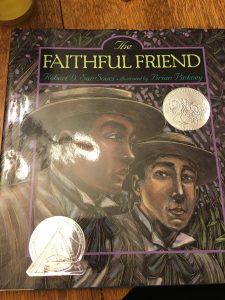
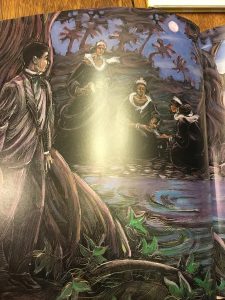
Analysis: The Faithful Friend is a book about two friends, Clement and Hippolyte, who take a journey to find a young girl named Pauline for Clement. Once arriving things take a turn for the worse and Hippolyte must keep trying to not let the zombie’s spells harm Clement and Pauline. In the end Hippolyte sacrifices himself so Clement and Pauline can live happily ever after.

This book can function as a mirror or a window for two friends. Friends who truly care for one another, grow close like siblings, similar to Clement and Hippolyte. The actions portrayed by Hippolyte were sacrificial. This book could function as either a mirror or a window because for the mirror, two friends would be sacrificing for the other friend in this exact moment, but this book could be a window for friends who could see themselves sacrificing for the better of the other friend in the future.

Friend3

Perceptually, the book cover has two silver honor awards, a Caldecott Honor and Coretta Scott King Award, which stick out immediately. However, the colors on the cover are dark creating a bad feeling. The size and color of the text make it easy to read and flow from page to page.

Friend2

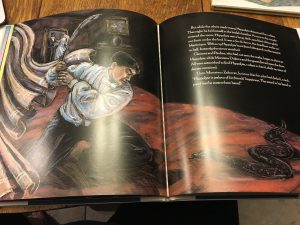
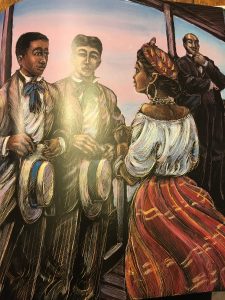
Structurally, the two boys are on the same level because of their similar status or power. However, Monsieur Zabocat, the plantation owner of Pauline, appears higher than Hippolyte, Clement and Pauline throughout the book. Since Zabocat is shown higher than the three friends, this shows that he has more power and status than the others. A horizon typically appears throughout the book, but the horizon disappears when Hippolyte is about to prevent the zombie’s spell from harming Clement and Pauline, which shows that danger is near. The text adds to the images because of the complexity of the message within. The words could cause some confusion if there was an absence of images. Both the images and the text work together to complete the message and story.

Friend4

Ideologically, sacrificial friendship is the main lesson to take away from the book. The author does a great job of showing the sacrifices that were made by one friend. However, some of the actions prior to the sacrifices like zombies, threats from Pauline’s owner, and spells are all actions and behaviors that children should not read about. The spells and zombies could easily scare young children. So, yes the lesson about friendship is important, but that lesson does not reveal itself until after the inappropriate action by some of the characters in the book. The concept as a whole is great, but some of the minor details are worrisome for children.

Blueberries for Sal

Title: Blueberries for Sal

Blueberries1

Author: Robert McCloskey

Illustrator: Robert McCloskey

Publisher and Year: The Viking Press, 1948

Number of Pages: 55

Genre: Fiction

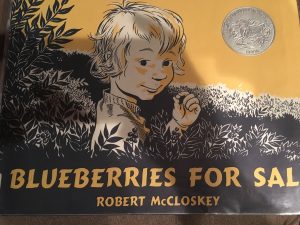
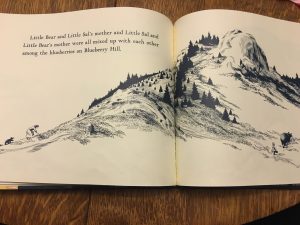
Analysis: Blueberries for Sal is about a young girl, Sal, her mother, and a little bear and her mother bear who all go to the Blueberry Hill to get blueberries in order to save for the winter. While Sal and little bear are separated from their mothers, they encounter the other mother, but in the end and reunite with their own mothers and gather enough blueberries to save for winter. This book received a Caldecott Honor.

This book can function as a mirror for children who wander away or are selective listeners to their mothers, but could also function as a mirror for mothers whom children do not listen to instructions. The initial fear that both mother and child feel when getting lost is an emotion thoroughly expressed within this book. Not only does this book function as a mirror but can also function as a window for children nowadays to learn about a different time period, specifically about the role of mother and daughter.

Blueberries5

Perceptually, the book appears to be a happy book with the yellow and blue front cover.  The text throughout the book is easy to read and written in blue print and a white background. The words are also big enough to read from a distance and in a clean cut print. The length of the sentences and paragraphs is not too long, just enough to tell the story before turning the page. Although the images are detailed, they simply  mirror the text, not adding much detail to the story at all.

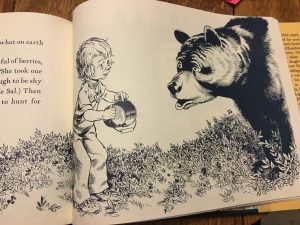
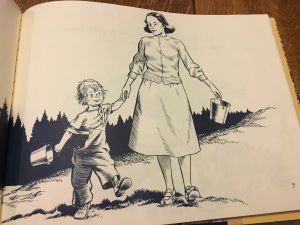
Structurally, the images are all in blue and white and appear to be pencil drawings, detailed and intricate. Both the human mother and bear mother are larger than their child, demonstrating that the mothers are stronger and the children are weaker. Often times throughout this book, the children are looking toward the right, showing that they are less secure, and the mothers are looking towards the left, which shows that they are more stable and secure. A child’s security can be less than the mother’s because the children get lost throughout the book, feeling insecure without their mothers.

Blueberries3

Ideologically, this book portrays stereotypical gender roles. Specifically speaking, the mother wears a skirt and does more feminine jobs, like pick and can blueberries. This book is from an older time period, so for the time period, the idea of collecting blueberries to save for the winter while wearing a skirt is appropriate for the time period. However nowadays the roles portrayed throughout the book are stereotypical. Society should want to move further away from stereotypical roles being reinforced. This book encouraged the audience that stereotypical roles are okay and that the women should be the ones collecting and canning blueberries, not the men or even the entire family. Throughout the book Sal and Little Bear are always wandering and not collecting blueberries. A lesson that children should not learn from this book is that it is not okay to wander away from adults.   Also, Sal and the cub were told by their mothers to save blueberries for the winter and both Sal and the cub did not listen to their mothers’ instructions, which again demonstrate a poor message to the readers.

Blueberries4

Trouble with Trolls

Title: Trouble with Trolls

Trolls1

Author: Jan Brett

Illustrator: Jan Brett

Publisher and Year: G. P. Putnam’s Sons, 1992

Number of Pages: 30

Genre: Fantasy

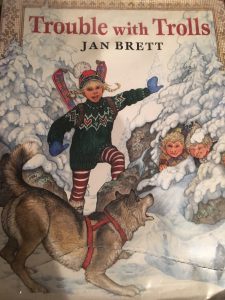
Analysis: In Trouble with Trolls, a young girl Treva and her dog, Tuffi, like to go on hikes up the mountain and then to ski down the mountain. Whenever they go up the mountain they encounter trolls that try and take her dog. Each time Treva runs into a different troll, she uses manipulation in order to save her dog from the trolls.

This book can function as a window for an audience who does not know about mountains, hiking or dogs. This book gives an insight into what life is like in the mountains. However, another function could be a mirror because people who live near or in mountains and are used to hiking or other problems that may arise while hiking may see themselves throughout the book.

Perceptually, the words are easy to read and the length is just right per page. The images seem to stop or create their own framing around the words. Since this pattern within the text repeats itself, at first the images mirror the meaning of the text but as the pattern continues some of the images begin to add meaning to the text.

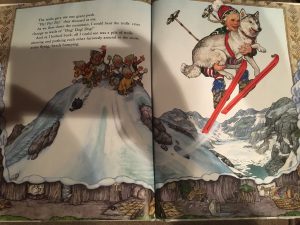
Structurally, each image is detailed and framed. The frame around each image is detailed as well. However, on some of the pages the images seem to be coming out of the frame. For example, the underground cave for the trolls comes out of the frame and allows the audience to feel part of the sneaky action with the trolls, while the framed pictures only allow the audience to see a glimpse into Treva’s world. The partially framed and unframed structure creates two different experiences, depending on what is first seen while looking at each page. The images that crawl out of the frame blend in which can go unnoticed while first reading the book. After re-reading the book, the reader picks up on the detail of the underground cave outside of the frame creating a more involved feeling with the book a second or third time reading it.

Trolls2

Ideologically, this book teaches a negative message and a positive lesson. First off, Treva is intelligent and creative. She uses problem solving skills and techniques that can be applicable and interesting for young children to read about. Students could learn how to use their creativity and problem solving skills to fix a situation. However, Treva’s intelligence and creativity is sneaky and she is manipulative of the trolls. Although teachers strive to teach problem solving skills to students, problem-solving skills should not be sneaky.

Papa Gave Me a Stick

Title: Papa Gave Me a Stick

unnamed-3

Author: Janice Levy

Illustrator/Photographer: Simone Shin

Publisher and Year: Star Bright Books and 2015

Number of pages: 28 pgs

Tags: Olivia Simkins, Fiction, 2-3, Culture, Picture Book, Fantasy, Animals, Adventure

Genre: Fiction

Analysis:

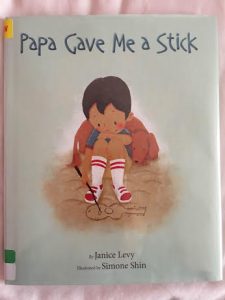
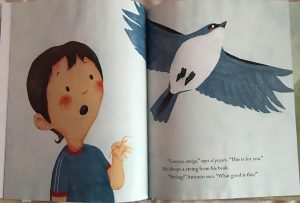
Antonio is a little boy who dreams of having a guitar. Throughout this story he meets animals and people who help him achieve owning his very own guitar. This story could act as a window for the audience. I feel that this story will not be one where the audience who read it will want to do exactly what Antonio did. This story will open up a window for everyone to view how Antonio handled the items he received and how they might have handled it differently. It also acts as a window into the Spanish culture. This book does an excellent job of incorporating the Spanish culture and language. Throughout the book it talks about mariachi bands and the different words/phrases in Spanish. As the readers read along, the text explains the words in English then tells the audience what the word for it is in Spanish. To go along with these words, it has a Glossary and the different instruments that are in a mariachi band. The illustrations do an excellent job of depicting the culture. This story also shows the little boy moving towards the right of the page as the story goes on. I believe that this shows that as the boy receives each item, he is moving forward, or closer to receiving the guitar that he has always wanting. However, this book bring up the ideological thinking that, the little boy was ungrateful of the gift he received from his father and by him not appreciating the different gifts that he was given long the way, it helped him get what he wanted.

unnamed-4