Alvernia University just posted an online version of an earlier published memoir by David Updike, “Growing up Updike.” Here’s an excerpt:
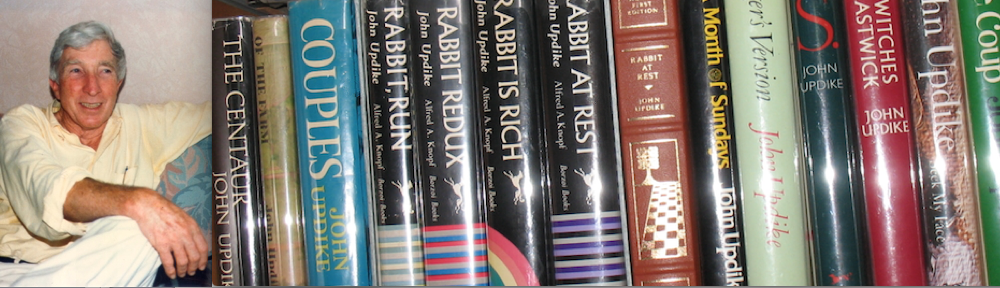
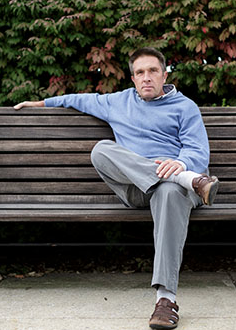 “As children, we grew up with the click-and-clackety sound of his typewriter — a battleship gray, Olympia manual — in our ears, and a gathering sense of his success, then growing fame. By the time I was seven he had published Rabbit, Run, then won the national book award from The Centaur, and moved his office from our house to a larger space in a modest, somewhat run-down office building downtown that he shared with a dentist, accountants and other such small businesses,” David writes.
“There, on a side table, lay The Centaur, with a picture of a half horse, half man. At night, he sat in a chair, reading proofs — long, scroll-like pieces of paper, on which he made small adjustments with a pencil. One fall, my grandparents arrived from Pennsylvania, with a basketful of fruit and a skittish dog, to look after us while my parents went to Russia for a month on a state department tour. His picture began to appear in magazines, and he was even sometimes on TV. A year or two later, Russians visited us, bearing gifts, and we took them for a lively walk on the beach, dogs and children included. Perhaps only with the publication of Couples in 1968, and the news from my friends that my father wrote a ‘dirty book,’ did I feel a twinge of unease, tempered by the knowledge he would be paid $400,000 for the movie rights! For soon we were on a boat, crossing the ocean in my new gray flannel pants, to spend the year in England attending a fancy American school and making side trips to Amsterdam, Austria for skiing, and then Morocco in April, to get some warmth and sun. Then by June, we flew back to America.
“My parents were still very young, in their thirties, and by my estimation the best-looking couple in their groups of friends — my father certainly the cleverest and most famous, my mother surely the most beautiful. But as a child my father had psoriasis, and asthma, and so shied away from organized sports, and even, I believe, felt inferior to the sports stars at Shillington High — the Harry Angstroms of his class.
“My mother had played field hockey in high school, and was an excellent ice skater, and they took us for long skating expeditions up the Ipswich River, back when it still froze solid. They played volleyball on Sunday afternoons, and then all migrated to someone else’s house, for ‘cocktails.’ They learned to play tennis, and ski, and we all went on Pleasant Mountain in February, where they had renamed the beginners slope Rabbit, Run, after his best-known novel.
“In tennis and skiing, they both became what I might call elegant intermediates. My father played kickball with us in the backyard, wheeling around the bases on long, loose legs while we frantically tried to retrieve the ball in some distant bushes. In the fall, there was touch football with the men, and in spring, before volleyball, half-court basketball, where he played shirtless and had a reliable, baby sky hook.”