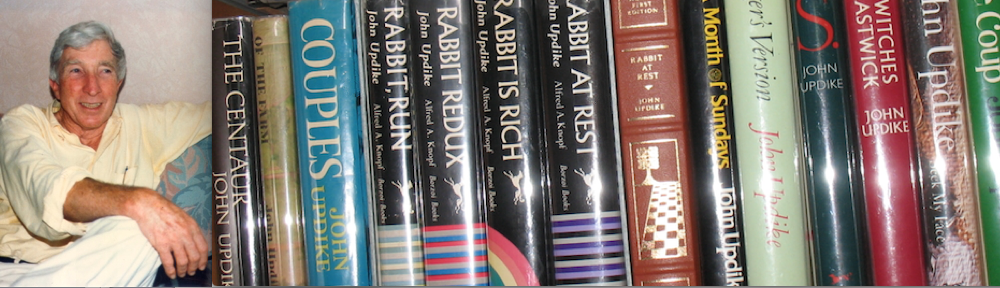
Paul Moran decides to sell The Other John Updike Archive

Screen Shot 2015-02-22 at 2.28.47 PMAt one time Paul Moran said he wasn’t interested in the money, but just wanted to find a good home for the Updike materials he famously scrounged from the author’s curbside in Beverly Farms.

That time has apparently passed. Now he’s wanting $250,000 for the contents of all the trash bags he hauled away, with the blog he used to showcase the items—The Other John Updike Archive—thrown in. Moran says that bids will be accepted until 5 p.m. on March 31, 2015.

It would have been nice to have those materials for The John Updike Childhood Home at 117 Philadelphia Avenue, but $250,000 is an insane amount of money . . . more than the Society paid for the house itself.

Still, if there’s an extremely wealthy person out there who has enough disposable income to spend it on disposed-of Updike items, the Society, a 501 c 3 non-profit, would be happy to be the beneficiary!

Here’s a link to the post announcing the sale, with detailed visuals of what we may never see again.

 

Guardian offers a brief survey of the short story: Updike


Screen Shot 2015-02-22 at 11.58.08 AMThe Guardian
Books Blog has been writing their version of “A brief survey of the short story,” and this past week writer Chris Power got around to John Updike. He writes that “there is enough Updike, with enough difference in quality, that you could plausibly read a lot of him without encountering a dud, and read just as much in another, unluckier direction without encountering anything particularly good. Few writers are more in need of a well-chosen collection of selected stories.”

He’s right, actually. A single volume of “greatest hits” would be a sure contender for another Pulitzer Prize and make Updike the all-time leader in fiction Pulitzers. Right now he’s tied with Booth Tarkington and William Faulkner as the only American writers to win the prize twice.

Power, who says the “best place to begin is in Olinger,” concludes with a quote from Updike:  “‘I cannot greatly care what critics say of my work,’ Updike said in 1968. ‘If it is good, it will come to the surface in a generation or two and float, and if not, it will sink.’ Much of his work, despite the nearly unfailing presence of a memorable simile, or pitch-perfect phrase, will disappear in time. Some—a small amount by Updike’s standards perhaps, but more than many can hope for—deserve the permanence we ourselves are denied.”

“A brief survey of the short story: John Updike”

New Yorker copy editor talks about work . . . and Updike

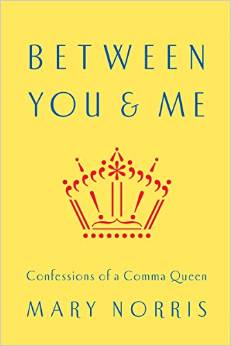
UnknownIn an essay titled “Holy Writ: Learning to love the house style,” Mary Norris writes a “personal history” that covers her first job and how she came to be a copy editor for The New Yorker. She also talks about some of the writers she admired, among them, John Updike:

“And there were writers whose prose came in so highly polished that I couldn’t believe I was getting paid to read them: John Updike, Pauline Kael, Mark Singer, Ian Frazier! In a way, these were the hardest, because the prose lulled me into complacency. They transcended the office of the copy editor. It was hard to stay alert for opportunities to meddle in an immaculate manuscript, yet if you missed something you couldn’t use that as an excuse. The only thing to do was style the spelling, and even that could be fraught. . . .

“I was on the copydesk when John McPhee’s pieces on geology were set up. I tried to keep my head. There was not much to do. McPhee was like John Updike, in that he turned in immaculate copy. Really, all I had to do was read,” she writes.

Norris began working at The New Yorker in 1978 and has been a query proofreader at the magazine since 1993. Her book, Between You & Me: Confessions of a Comma Queen, will be published by W. W. Norton & Co. on April 6, 2015.

Irish actor’s favorite book: Rabbit, Run

Screen Shot 2015-02-15 at 7.35.27 AMThe entertainment section of The Independent today ran a Q&A interview, “A question of culture: Actor Emmet Kirwan,” in which they asked the young Irish actor what his favorite book was.

Rabbit, Run by John Updike,” he answered. “The first of a quartet of Rabbit books, but still my favorite. It speaks to a restlessness in people edging towards 30. Updike makes a flawed American everyman character likable, even as he wrecks the lives of everyone around him.”

Ironically, when asked to name a book he couldn’t finish, Kirwan cited the Jack Kerouac novel that inspired Updike to write Rabbit, Run as a kind of counter-argument:

On the Road. It’s one I felt I should read as opposed to wanting to. I was encouraged to give it a second chance, but found it tough work and boring.”

For Kirwan, “favourite city” was no contest: “It would have to be Dublin, wouldn’t it? It’s a capital city but it’s also a village. Just the right size.”

Updike and Kierkegaard spotlighted in a new book

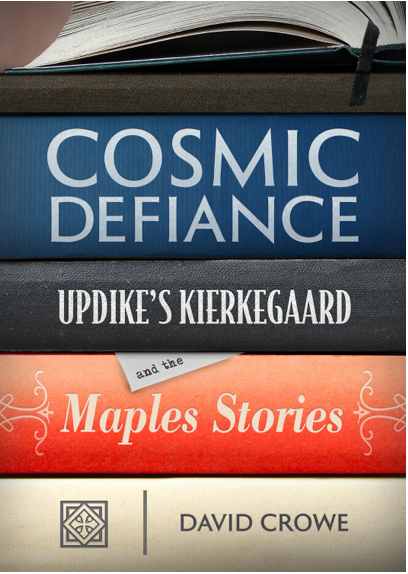
Screen Shot 2015-02-08 at 9.10.55 AMDavid Crowe, Professor of English at Augustana College, recently saw his book on Cosmic Defiance:  Updike’s Kierkegaard and the Maples Stories published by Mercer Press.

According to an article in the Aledo Times Record, Crowe tells the “story of Updike’s life-altering encounter with Fear and Trembling in his early career” and traces “the subsequent evolution of Updike’s complex and coherent theology.”

Crowe told the Times Record, “I wrote the book so that even people who haven’t read Kierkegaard can get up to speed on his central claims. Unlike most literary critics, I also avoid jargon and believe that if you can’t state a theory plainly and clearly you’re probably hiding something.”

George Hunt devoted a great deal of time and space to a discussion of Kierkegaard in his seminal work on Updike’s “three great secret things,” but this is the first book-length study on Updike and Kierkegaard.

We’ll post a review of the book on this site within the next week.

British comedian picks Updike for his one book on a desert island

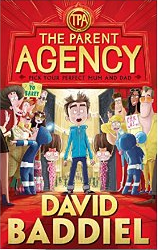
Screen Shot 2015-02-07 at 7.51.33 PMThe Daily Mail asked British comedian David Baddiel (The Mary Whitehouse Experience) which book he’d take to a desert island, and he chose John Updike. Or more specifically,

“The Rabbit omnibus by John Updike. This is actually five books all about the same character:  Rabbit, Run; Rabbit Redux; Rabbit Is Rich; Rabbit at Rest and Rabbit, Remembered. All human life is there.”

The occasion for the interview was the publication of Baddiel’s first children’s book, The Parent Agency (HarperCollins). It’s available from Amazon.

Panels set for 2015 American Literature Association conference

Screen Shot 2015-02-01 at 9.55.52 AMPanels are set now for the two sessions that The John Updike Society will sponsor at the 26th Annual American Literature Association Conference, May 21-24, 2015 at The Westin Copley Place in Boston, Mass. Times and days for the presentations will be announced later.

Perspectives on John Updike (I)
Chair: Peter Quinones, Independent Scholar

  1. “Solipsism and the American Self: Rethinking David Foster Wallace’s Reading of John Updike,” Matthew Shipe, Washington University
  2. “Embracing Death: Aging in Updike’s Late Works,” Yue Wang, Dalian University of Technology
  3. “A Comparison/Contrast of Edward Abbey’s The Fool’s Progress and John Updike’s Rabbit Tetralogy,” Maria Mogford and James Speese, Albright College

Perspectives on John Updike (II)
Chair: Sylvie Mathé, Aix-Marseille University

  1. “’Real Enough . . . for Now’: Nudity as Aperture in John Updike’s ‘Nakedness,’” Avis Hewitt, Grand Valley State University
  2. “Echoes of J.D. Salinger and Ernest Hemingway in John Updike’s The Centaur: An Alternative to Contemporary American Canonical Discourse,” Takashi Nakatani, Yokohama City University
  3. “’Rabbit Remembered’ and Its Various Intertexts,” James Schiff, University of Cincinnati

Thanks to everyone who submitted proposals, and to Peter Quinones for coordinating the sessions.

Artist makes handmade author dolls, including Updike

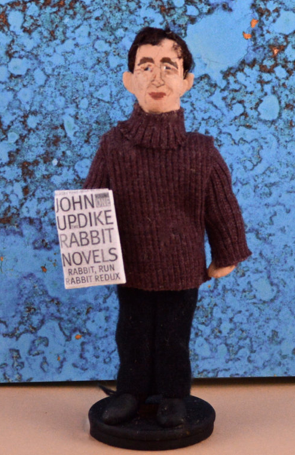
Screen Shot 2015-01-27 at 6.52.17 PMLike Updike’s main witch in The Witches of Eastwick, artist Debbie Ritter makes small figurines—not women, like Alex’s “bubbies,” but authors and characters from literature.

Her company is UneekDollDesigns, and you can buy dolls of authors like Lewis Caroll, Virginia Woolf, Gwendolyn Brooks, Flannery O’Connor, Dashiell Hammett, Cormac McCarthy, Mark Twain, Edgar Allan Poe, and, of course, John Updike.

“This creative author doll is crafted out of wood, wire, clay, and paint. He wears a costume of black pants, plum colored, ribbed turtleneck, and holds a copy of one of his famed works. His hair is real fiber and his face is hand painted. A perfect addition to the fan of Updike’s literary works!”

Updike holds a miniature version of the 2003 Ballantine Books paperback edition of the first two Rabbit novels.

Ritter, who is from Huntsville, Ala., has gotten some notice for her dolls, including The Today Show, At Home in Illinois magazine, Vanity Fair online, Showtime, a PBS documentary on Rachel Carson, and Doll Collector Magazine.

Knopf celebrates 100 years with downloadable calendar

knopf100Updike’s longtime publisher, Alfred A. Knopf, celebrates 100 years of publishing in 2015, and according to their website,

“Each week, we will tell you about the new books we are publishing in this anniversary year, as well as throw in a bit of nostalgia. We’ll remember books that were once upon a time published by Knopf in the particular month. We’ll share with you a bit of our personal history, i.e.: entertaining correspondence with authors, iconic dust jackets, remembrances by our editors and other members of the publishing team. We’ll dig up and share archival materials we think you’d like to see. In general, our Tumblr page (#Knopf100) for 2015 will be a running exhibition of the history and the present of the publishing house that is Alfred A. Knopf. Enjoy the ride.”

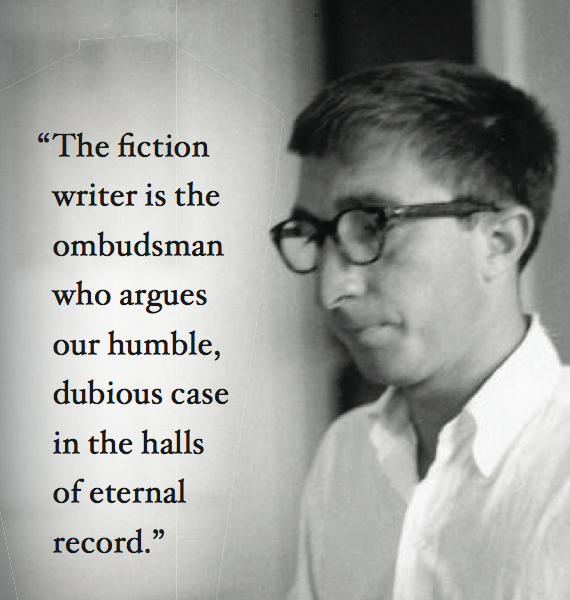
Among the “goodies” is a list of all their Pulitzer Prize winners (Updike, of course, won twice—for Rabbit Is Rich and Rabbit at Rest) and a downloadable literary calendar that you can access month by month. For January, appropriately, they begin with John Updike. Below is a cropped version of that page, sans calendar, with a photo by Irving L. Fisk. All rights are reserved.

Screen Shot 2015-01-21 at 6.27.06 PM

North Shore writer reacts to Begley’s Updike bio

Screen Shot 2015-01-21 at 5.54.11 PMDyke Hendrickson, writing for the Newburyport Daily News, listened to the audio-book version of Adam Begley’s biography of John Updike, who lived in Boston’s North Shore area for much of his adult life, and had a list of observations about the “brilliant, productive writer” who lived in Ipswich and Beverly Farms, and Begley, whose “research was exhaustive but his prose is energizing.”

“Begley biography brings alive John Updike, life on North Shore”

You need to be a subscriber to access the full article, but Hendrickson, who says he’s a friend of Michael Updike,  lists two take-aways from the Begley bio that you don’t need to pay to read:

—”Unlike most writers, Updike was a success from the start”

—”His writing was remarkably autobiographical. If Updike ran into a hedge with his auto or walked into the bedroom of a neighborhood volleyball wife, the reader was likely to hear about it.”