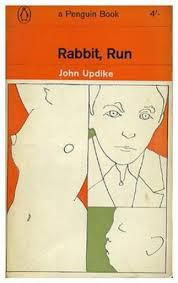
Schlemiel Theory considers Rabbit

unknown-1At Schlemiel Theory, subtitles “The Place Where the Laugh Laughs at the Laugh,” Menachem Feuer published a piece titled “The Rise and Fall of American Dreams: On John Updike’s ‘Rabbit, Run’.” In it, he considers the opening scene in Rabbit, Run where an older Rabbit plays basketball with young men and notices a “natural” among them. Then he realizes that his own basketball fame has faded:  “They’ve not forgotten him: worse, they never heard of him.”

“What Updike manages to do in this passage is to show the contradictions at the heart of the American dream. It may lift you up but at a certain point you may have to realize that you’re just one-in-a-million. But, to be sure, the struggle between being someone and being no-one is at the core of modernist art, literature, and philosophy. The question we have, as readers, is how Rabbit deals with his sinking into significance. Will he give up, will he try to be someone, or will he just . . . run away? Will he hurt people along the way?

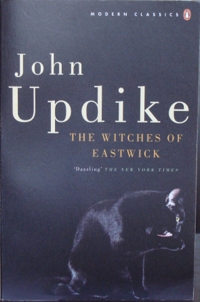
Retro review: Blogger praises The Witches of Eastwick

WOEOn November 3, 2015, Jason Fernandes posted a retro review of The Witches of Eastwick, the book he read years ago as an introduction to John Updike, on his blog, Rants & Raves.

“From the opening pages of The Witches of Eastwick, I was immediately put to mind of Pride and Prejudice. That might sound like a strange connection to make,” he writes. “Whether this is just a coincidence or Updike is consciously having some fun with the reader is something I cannot say. Neither would surprise me. But it did give me a warm first impression and the sense that I was in for a treat. . . .

“The prose is exquisite. I have been fed on mostly contemporary fiction in recent years, and even the ‘modern classics’ I have read have not impressed me greatly. This novel was a welcome return to a higher class of writing,” he writes.

“Book Review: The Witches of Eastwick”


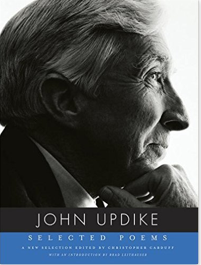
Milwaukee journalist moves on to Updike’s poetry

recreadingJim Higgins, of the Milwaukee Journal Sentinel, has been reading his way through the two-volume Library of America Collected Stories, but decided to take a detour this week and read and respond to the recently published volume of Updike’s Selected Poems. This post he reads and briefly comments on “Ex-Basketball Player,” “Seven Stanzas at Easter,” and “Fever.”

“Reading John Updike: ‘Selected Poems'”

Updike mentioned in Beerbohm review

Screen Shot 2015-10-30 at 8.25.56 AMJohn Updike gets a brief mention in Adam Gopnik’s review of a new New York Review of Books Classics anthology of Max Beerbohm‘s work “with the unfortunately patronizing title The Prince of Minor Writers.”

Updike, he reminds us, had written the introduction to a previous N.Y.R.B. Classics reprint edition of Beerbohm’s Seven Men.

Full story:  “The Comparable Max; Max Beerbohm’s cult of the diminutive”

John Updike: Selected Poems: reviews

Screen Shot 2015-09-28 at 5.00.49 PMThe reviews have started coming in for John Updike: Selected Poems, edited by Christopher Carduff and published by Alfred A. Knopf (cloth, 320pp., $30). To keep them consolidated we will add new reviews to this page as we become aware of them, so check back. Below is a link to an abridged version of poet Brad Leithauser’s introduction and reviews arranged according to date of publication.

“Updike’s naked poetry.” Brad Leithauser. The New Criterion. October 2015. “To my mind, he was the twentieth-century American writer who created the greatest number of zingers—sentences you want to place check marks beside, and extract from their surroundings to scrutinize as separate entities, and eventually perhaps tinker with, in an attempt to understand better why they perform so well. (In this, he was to the twentieth century what Henry James was to the nineteenth.)”

“Selected Poems establishes Updike as a serious poet.” James Plath. The John Updike Society. 15 October 2015. “Collected and compressed, this volume offers proof that Updike is in fact a gifted poet whose verse should not be ignored. He displays a poetic range that would be impressive even if it had come from an award-winning poet like [Brad] Leithauser.”

“Book Review: Updike compilation of poems evocative.” Peter Tonguette. The Columbus Dispatch. 1 November 2015. “Updike may have been a part-time poet, but this carefully chosen selection shows his facility with the form.

“Boston Boys: The poetry of John Wieners and John Updike.” Dan Chiasson. The New Yorker. 2 November 2015. “Updike’s poems are not trifles; he could be surprisingly formally ambitious, even experimental. The problem is that all of his poems about strain, discomfort, and regret cheer him, and we don’t associate cheer with great poetry. The poems often feel like the by-products of the happy diversion they provided their author while he was writing them. . . . His best poems are mild evocations of local eccentricity, seasonal anomie, domestic frisson.”

“Review: John Updike the poet?” Michael D. Langan. NBC-2. 4 December 2015. “For me, Updike seemed to be able to write a poem about anything. I’d hazard that if he blew on the inside of a window pane during a harsh winter in southeastern Pennsylvania, hurriedly scribbling a few lines with his finger on the frost, a lasting poem would appear.”

“Updike’s Violin.” Jonathan Galassi. The New York Review of Books. 17 December 2015. “You could almost call his early verse ‘applied poetry,’ entertainments written with his left hand, as it were. As time went by, though, he distinguished his light verse from what he later called his ‘secret bliss.’ ‘My poems are my oeuvre’s beloved waifs,’ he wrote in the preface to his 1993 Collected Poems. Lurking in the shadows of Updike’s will to shine is another, more surreptitious aspiration, one he never fully came to terms with.”

“Updike in Verse; Has justice been done to a lifetime of poetry?” Joseph Bottum. The [Weekly Standard] Magazine. 21 December 2015. “No, this is a disappointment. To read the 132 poems chosen by this volume’s editor, Christopher Carduff, is to realize that John Updike is not a poet well served by the popular impulse that reduces a large body of work to a greatest-hits anthology.

“Review: Men of Letters, John Updike and Jim Harrison, and Their Poems.” Dwight Garner. The New York Times. 22 December 2015. “Updike’s best verse is presented now in Selected Poems . . . with a wise introduction by Brad Leithauser. Updike’s gift for close observation, in these poems as elsewhere, is near to supernatural.”

“Staff Picks: The Poetry of John Updike.” Rand Richards Cooper. Commonweal. 23 December 2015. “Like his prose, Updike’s poetry—much of it written in variations on the sonnet—highlights his skill in noticing the world, and his life in it, in trenchant and surprising ways. The poems convey wry humor, exquisite attentiveness to daily life, and an abiding preoccupation with mortality and time.”

“Likely Stories: Selected Poems by John Updike.” Jim McKeown. KWBU (Texas Public Radio). 12 May 2016. “I wish I had an hour or two to read to you aloud more of the words and phrases, the mastery of language so evident in everything Updike wrote. . . . Updike can evoke all those feelings as quickly and lightly as a feather duster, capturing motes of images and emotions. John Updike: Selected Poems is a fantastic place to explore one of the great writers of the 20th century. 5 stars.”

Society gets its first U.S.-based lifetime benefactor

ZimmermanJohn Updike Society member Lang Zimmerman, whom society members may have met at the most recent conference in Reading, Pa., has become the first U.S.-based lifetime benefactor. Zimmerman is vice president of Yelcot, a family-owned communications company based in Mountain Home, Arkansas, and is also commissioner for the Arkansas Economic Development Commission. In a note he added that his donation was written, appropriately, using a pen made from Updike’s dogwood tree.

The new dues structure announced in August included options to become a lifetime member ($500) and a lifetime benefactor ($1000). So far no one has chosen to become a lifetime member, but Zimmerman now joins Takashi Nakatani as the society’s lifetime benefactors.


Carduff picks his 10 Best John Updike Books

Publishers Weekly asked Christopher Carduff, “who was handpicked by John Updike to edit the Library of America edition of his work” and  “also edits the posthumous Updike publications for Knopf, the later of which, John Updike: Selected Poems, will be published this month,” to choose 10 of “his favorite books by Updike in a variety of genres.”

The Centaur, which won the National Book Award, didn’t make Carduff’s list, nor did any of the so-called Scarlet Letter trilogy novels or the Bech books. Neither did Midpoint, Updike’s mid-life poetic crisis, nor Couples, the steamy novel that vaulted Updike into national prominence.

Click here to see Carduff’s “10 Best John Updike Books.”

Selected Poems establishes Updike as a serious poet

Screen Shot 2015-09-28 at 5.00.49 PMJohn Updike once told an interviewer, “I began as a writer of light verse, and have tried to carry over into my serious or lyric verse something of the strictness and liveliness of the lesser form.” A man of few regrets, Updike also remarked that he wished he were taken more seriously as a poet. His Selected Poems, edited by Christopher Carduff and published earlier this week, ought to go a long way toward reinforcing that.

When Knopf published 300+ poems in Collected Poems, 1953-1993, it reinforced quite another thing: that Updike wrote a LOT, and that some poems were more successful than others. But winnowing those poems in order to present 132 of the very best highlights Updike’s considerable strengths as a poet.

Carduff has done a fine job editing the volume, eliminating light verse and selecting a range of Updike’s poetry that he ordered according to dates of completion, with the first poem being one that Updike wrote in 1953 at age 21—a poem that son Michael would later chisel on the back of Updike’s grave marker. The last was composed in 2008 at age 76. In that poem, written after Updike knew he had little time left in this world, Updike contemplates religion one last time and ends with a quote from Psalm 23: “Surely—magnificent, that ‘surely— / goodness and mercy shall follow me all / the days of my life, my life, forever.” The enjambment, of course, puts emphasis on “the days of my life . . . forever,” so that Updike’s last line reads like both an epitaph and a reaffirmation of the faith—whether certain or wavering—that informed much of Updike’s writing.

The longest poem in the collection is one that Updike scholars consider most important—Updike’s assessment at the “Midpoint” of his life—and that’s balanced by the inclusion of the poems that were published under the title “Endpoint.” The shortest is “Boil,” a mere six lines: “In the night the white skin / cries aloud to be broken, / but finds itself a cruel prison; / so it is with reason, / which holds the terror in, / undoubted though the infection.”

MacArthur- and Guggenheim-winning poet Brad Leithauser wrote in his introductory essay, “I’m tempted to call what [Updike] does naked poetry, not least because he so often focused on erotic and bodily functions. . . . But the poems are naked in a broader sense. They typically come to us unmediated through any fictional presence. You feel that it’s Updike himself (or perhaps John himself, since the poems foster, even between strangers, a companionable familiarity) who is addressing you. . . . Others have the apportioned stiffness of a studio portrait. But in the aggregate the poems present an album of himself more accurate and intimate and multifaceted than any similar-sized collection of his prose.”

“Naked poetry,” let’s call it, is only one type that is included in this volume, and those poems do stand out because there are no other big-name poets working in the English language who write raw or ribald but nonetheless accomplished poems about “The Beautiful Bowel Movement,” “Elderly Sex,” or “Two Cunts in Paris.” With all the lyric marvel of Amy Lowell’s “Sea Shell” or Oliver Wendell Holmes’ “The Chambered Nautilus,” Updike looks down into the toilet and can’t help but comment on “a flawless coil, / unbroken, in the bowl, as if a potter / who worked in this most frail, least grateful clay / had set himself to shape a topaz vase. / O spiral perfection, not seashell nor / stardust, how can I keep you? With this poem.” One suspects that Updike is caught, like many of his characters, in a dialectic—in this case, between writing a serious lyric poem and penning a wry and sophisticated parody of such poems, as if the challenge to write a lyric about something so base was too tempting to forego, but also a little outrageous. But the poem also anticipates the last line in this collection by affirming Updike’s conviction that immortality, or at least the illusion of it, is achieved through not only belief but also through writing.

There are a number of “naked” poems, in this volume, but there are also a number of ekphrastic poems (“Calder’s Hands”), nostalgic poems (“Dutch Cleanser,” “My Mother at Her Desk”), formal verse (“Spanish Sonnets,” “Airport,” “Oxford, Thirty Years After”), personal poems and tributes (“To Ed Sissman,” “Elegy for a Real Golfer”), lyric poems (“Saguaros,” “Chicory”), literary poems (“Marching through a Novel,” “Big Bard”), and narrative poem (“Leaving Church Early,” “Crab Crack”). There are also a good many travel poems (“Poisoned in Nassau,” “Heading for Nandi”) inspired by Updike’s adventures, which make it into verse more often than in his prose.

Topically, Updike covers just as much ground. Included are poems about sports, music, art, food, nature, and descriptions of ordinary activities that underscore Updike’s aesthetic credo that all of life is worthy of documenting in literature and that “culture” includes all human activity. Collectively these are powerful poems, and many of them—like “Dog’s Death”—resonate emotionally long after they’re read. Yet such poems are also highly formal, employing carefully considered stanzas and such poetic devices as slant rhyme.

Poems such as “Dog’s Death” stand up against the best written by contemporary authors, and Selected Poems is rich with similarly powerful poems. The nakedness might stand out, but there are carefully constructed skeletons here too, and a use of language that rivals Updike’s fiction for its judiciousness. Even when the poems begin in a highly prosaic manner, as happens with “Crab Crack,” Updike’s poetic language still asserts itself, gilding philosophical musings that are as much a part of his poetry as his frank, raw, and highly personal sharings:

“Now they are done, red. Cracking / their preposterous backs, we cannot bear / to touch the tender fossils of their mouths / and marvel at the beauty of the gills, / the sweetness of the swimmerets. All is exposed, / an intricate toy. Life spins such miracles / by multiples of millions, yet our hearts / never quite harden, never quite cease / to look for the hand of mercy in / such workmanship. If when we die we’re dead, / then the world is ours like gaudy grain / to be reaped while we’re here, without guilt. / If not, then an ominous duty to feel / with the mite and the dragon is ours, / and a burden in being.”

Collected and compressed, this volume offers proof that Updike is in fact a gifted poet whose verse should not be ignored. He displays a poetic range that would be impressive even had it come from an award-winning poet like Leithauser. John Updike’s Selected Poems is 320 pages and cloth bound, with notes on each poem detailing completion date, publication history, and relevant annotations (“Dog’s Death” includes the name of the dog and a remark from Updike about pet deaths). The suggested retail price is $30, but it’s selling for $18.51 at Amazon.

—James Plath
New short story anthology includes Pigeon Feathers

9780547485850On October 6, 2015, Houghton Mifflin Harcourt published 100 Years of the Best American Short Stories, edited by Lorrie Moore and Heidi Pitlor. And, of course, Updike was included.

This is the best of the best, really, as it’s culled from The Best American Short Stories Series. This is the centennial celebration of the series.

The editors were careful to distribute their picks so that a wide range of American authors could be represented, and no author got more than one story in this collection—though, of course, many writers deserved more than one.

Their are some surprises, but for the classic American authors the classic stories seem to have been chosen. Ernest Hemingway’s “My Old Man” was included, as was F. Scott Fitzgerald’s “Babylon Revisited” and James Baldwin’s “Sonny’s Blues.” Updike’s “Pigeon Feathers” made the cut, as did Philip Roth’s “The Conversion of the Jews,” along with frequent anthology standards like John Cheever’s “The Enormous Radio” and Tillie Olsen’s “I Stand Here Ironing.”

Raymond Carver fans might be surprised that “Will You Please Be Quiet, Please?” was selected over “Cathedral” or “So Much Water So Close to Home,” as might Donald Barthelme fans that “The School” (a great short story) was chosen over some of his more popular ones. The editors clearly put some thought into this, and the fact that a Pennsylvania story was chosen from Updike reinforces how much his home state meant to his fiction . . . and poetry, and creative non-fiction and criticism.