 The New Yorker fiction podcast “Roger Angell Reads John Updike” features Updike’s long-time editor reading his story “Playing with Dynamite” and talking with current New Yorker fiction editor Deborah Treisman about editing Updike.
Here’s the link.
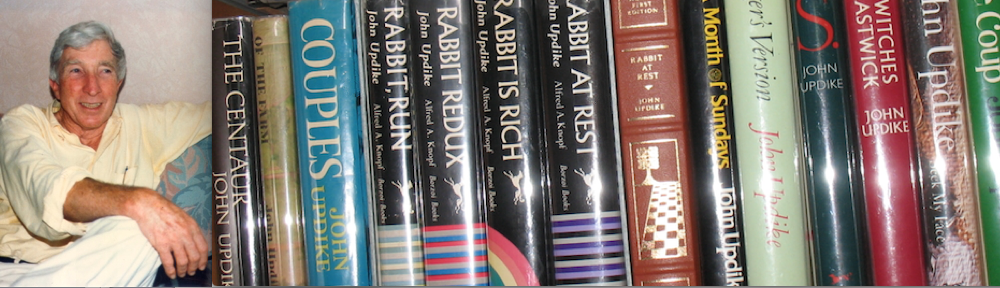
The New Yorker fiction podcast “Roger Angell Reads John Updike” features Updike’s long-time editor reading his story “Playing with Dynamite” and talking with current New Yorker fiction editor Deborah Treisman about editing Updike.
Here’s the link.
James Howden, Sports, Culture & Other Obsessions posted an entry this past week on “John Updike: On Race and Being American” that quotes large sections from an essay in Self-Consciousness and reacts to Updike’s remarks about race in America.
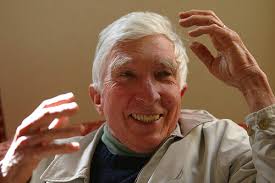 One line that particularly stands out in a letter to his half-Ghanian grandchildren: “When Anoff was born . . . my instinctive thought was that he would do better if his parents settled in Ghana; that is, I trusted an African country to treat a half-white person better than my own country would treat a half-black. Now I wonder. Ours is a changing, merging, exogamous world, and while racial prejudice operates in the United States against blacks in many ways overt and oblique . . . at least our laws now formally insist upon equal rights. . . .”
“An ideal colorblind society flickers at the forward edge of a sluggishly evolving one . . . America is slowly becoming yours, I want to think,” Updike wrote many years before the current state of racism in America, fueled by politics.
Adrienne LaFrance contemplates “The Human Fear of Total Knowledge; Why infinite libraries are treated skeptically in the annals of science fiction and fantasy” and quotes John Updike in the process.
“Libraries tend to occupy a sacred space in modern culture,” she writes in her June 3, 2016 Atlantic article. “People adore them. (Perhaps even more than that, people love the idea of them….)”
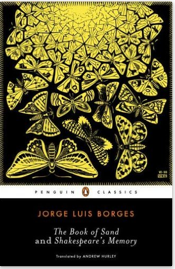 “In The Book of Sand, Jorge Luis Borges tells the story of an unexpected visit from a Bible salesman, who has in his collection a most unusual object. ‘It can’t be, but it is,’ the salesman says. ‘The number of pages is no more or less than infinite. None is the first page, none is the last.’ The strange book is so engrossing as to be sinister,” LaFrance writes, adding that in Borges’ The Library of Babel “‘each bookshelf holds thirty-two books identical in format; each book contains four hundred ten pages; each page, forty lines; each line, approximately eighty black letters.’ The appearance of order is an illusion….”
“I feel in Borges a curious implication: the unrealities of physical science and the senseless repetitions of history have made the world outside the library an uninhabitable vacuum,’ John Updike wrote in an essay about Borges in 1965. ‘Just as physical man, in his cities, has manufactured an environment whose scope and challenge and hostility eclipse that of the natural world, so literate man has heaped up a counterfeit universe capable of supporting life.’
“Borges was not just interested in literary artifice, as Updike points out, but fundamentally concerned with the nature of reality, a preoccupation that often led him to interrogate the scope and organization of human knowledge.”
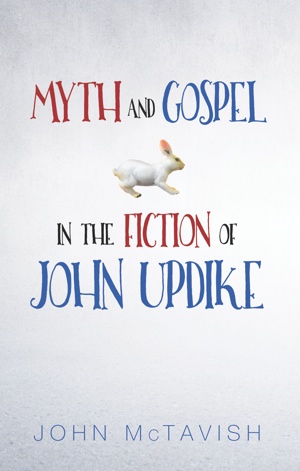 John McTavish, whom John Updike Society members know from past conferences, has published a book on Myth and Gospel in the Fiction of John Updike with Cascade Books, an imprint of Wipf and Stock Publishers.
McTavish, a minister of the United Church of Canada, had previously published essays on Updike in such journals as Touchstone, Theology Today, The United Church Observer, and The Presbyterian Record.
Although the book is so new that it doesn’t appear yet on the Wipf and Stock website, we can share the back flap copy:
“Big on style, slight on substance: that has been a common charge over the years by critics of John Updike. In fact, however, John Updike is one of the most serious writers of modern times. Myth, as this book shows, unlocks his fictional universe and repeatedly breaks open the powerful themes in his literary parables of the gospel. Myth and Gospel in the Fiction of John Updike also includes a personal tribute to John by his son David, two essays by pioneer Updike scholars Alice and Kenneth Hamilton, and an anecdotal chapter in which readers share Updike discoveries and recommendations. All in all, weight is added to the complaint that the master of myth and gospel was shortchanged by the Nobel committee.”
Updike is the topic again at The Home of Schlemiel Theory: The Place Where the Laugh Laughs at the Laugh, and this time blogger Menachem Feuer writes “On Literary Pain: Comic and Tragic (From John Updike and Franz Kafka to Louis CK).”
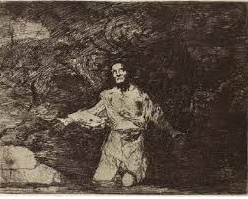 Feuer begins, “The feeling of pain (what Emmanuel Levinas calls ‘the little death’) and the existential onset of death are the most private experiences. It goes without saying that nobody can feel my pain or experience my death for me. . . . It can be argued that pain gives one a sense of selfhood. What narrative—as opposed to myth—can do is make the reader aware of pain and that all pain is not necessary. The innocent suffer. It can give us a view into the character’s private pain and contrast it to a public which cannot or refuses to see it. A thinker named Rene Girard argues that this perspective is what distinguishes monotheism from paganism.
“It is plausible to argue that this perspective on pain is a key ingredient of modern literature. The more we can see the literary pain of a fictional character in contrast to his surroundings or people, the more valuable a piece of literature can be for us. It can help us to understand the relationship of pain to selfhood and the world. However, there is another side to this coin. This perspective is tragic, not comic. Comedy isn’t interested in pain so much as in what Freud would call the release of tension (for Freud the psyche feels pleasure when it releases such tension). In modern literature, we also experience such a release from pain. It may not be complete, but its release does make things better. It may not be as deep but it means a lot to us. When we laugh at ourselves, we can live better. (To put it simply: pain is heavy; comedy is light.)
“John Updike . . . tends more toward a fiction that is about pain and sharing that pain as a kind of secret with his audience. I find his theology of pain interesting. His obsession with pain is affected by his belief that suffering has a religious quality (perhaps in a sense similar to Kierkegaard). In his novel, The Centaur, he takes a Kafkaesque premise (of a human turning into a creature) but instead of having the character turn into a bug he has the main character turn into a centaur. And instead of having this happen in the privacy of the home and within the space of the family, Updike has it happen in the midst of the public sphere (in front of a class). The subject is—immediately—a kind of Christ figure who is publicly ridiculed when he ‘turns.'”
Feuer posits, “Updike is telling his reader about how significant private pain is and how the inability to feel one’s own pain—as a result of humiliation—marks the ‘crush(ing)’ of selfhood. Updike’s close descriptions of the pain suggest that it is not merely a private affair. Its description takes on a kind of religious aura. . . .”
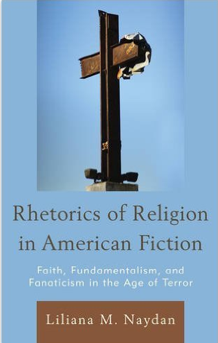 John Updike Society member Liliana M. Naydan, Assistant Professor of English and Writing Program Coordinator at Penn State Abington, has recently published a book on writers and religion that includes (not surprisingly) a chapter on Updike.
According to the Amazon.com description, Rhetorics of Religion in American Fiction: Faith, Fundamentalism, and Fanaticism in the Age of Terror (234pp., Bucknell Univ. Press) “considers the way in which contemporary American authors address the subject of belief in the post-9/11 Age of Terror. Naydan suggests that after 9/11, fiction by Mohsin Hamid, Laila Halaby, Philip Roth, Don DeLillo, John Updike, and Barbara Kingsolver dramatizes and works to resolve impasses that exist between believers of different kinds at the extremes. These impasses emerge out of the religious paradox that shapes America as simultaneously theocratic and secular, and they exist, for instance, between liberals and fundamentalists, between liberals and certain evangelicals, between fundamentalists and artists, and between fundamentalists of different varieties. Ultimately, Naydan argues that these authors function as literary theologians of sorts and forge a relevant space beyond or between extremes. They fashion faith or lack thereof as hybridized and hence as a negotiation among secularism, atheism, faith, fundamentalism, and fanaticism. In so doing, they invite their readers into contemplations of religious difference and new ways of memorializing 9/11.”
The essay on Updike is titled “Emergent Varieties of Religious Experience from a Protestant Perspective: Fundamentalist, Fanatical, and Hybrid Faith in John Updike’s ‘Varieties of Religious Experience’ and Terrorist.”
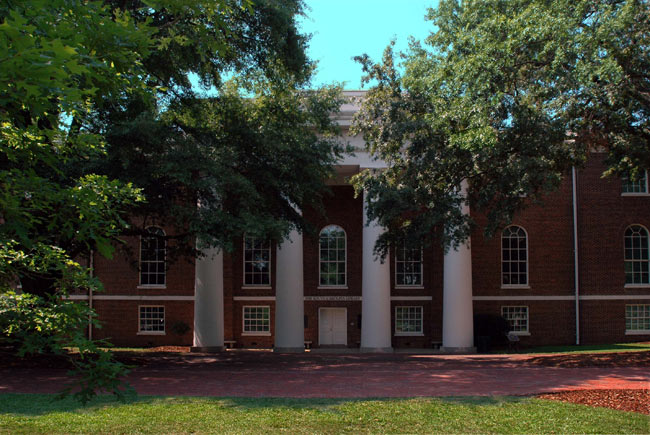
 Registration is now open for the 4th Biennial John Updike Society Conference October 12-15, 2016, celebrating manuscripts, research, and special collections and hosted by the University of South Carolina Libraries in Columbia, S.C. It will be the first chance that society members have to see the Don and Ellen Greiner Updike Collection. Greiner is serving as conference director, and the conference hotel is The Inn at USC Wyndham Garden, right on USC’s campus.
Conference highlights:
Though attendees must be members of the society, all are welcome to join and experience this celebration of manuscripts, research, and special collections, with a focus on John Updike. Click on the link below to download a draft of the program and all registration and hotel information:
THE 4TH BIENNIAL JOHN UPDIKE SOCIETY CONFERENCE
 The recent issue of IJAS (Irish Journal of American Studies) features a collaborative critical essay on “Thirty-Six-Point Perpetua: John Updike’s Personal Essays in the Later Years,” by Laurence W. Mazzeno (Alvernia University) and Sue Norton (Dublin Institute of Technology).
The authors note that “determined as John Updike was to write himself into immortality to the greatest extent possible, he was noticeably less determined, especially in his later years, to render himself his own subject matter. He explains his reticence in Self-Consciousness (1989): ‘The fabricated truth of poetry and fiction makes a shelter in which I feel safe, sheltered within interlaced plausibilities in the image of a real world for which I am not to blame.'”
“When he does yield, overtly, to the personal essay form,” the authors conclude, “his writing tends to have a texture more revelatory than divulging. He will tell us how he feels about his childhood, his adolescence, his young adulthood, his more recent past and his present, but he is not drawn to gross self-exposure. He does not veer toward the taboo or to the explication of intense inner pain, as so-called confessional writers often do. Nor does he appear to be seeking empathy or absolution. Instead, he gazes calmly upon his own life and articulates what he sees in terms as neutral and exacting as words will allow. . . . Instead, what Updike as essayist seems most preoccupied with is a kind of public self-construction, an identity of record.”
Here’s the full article.
 Blogger Lori Carlson has challenged herself to post entries from “A to Z” and her entry for “U” is “John Updike Inspires Me.” On her blog, As the Fates Would Have It, she writes that she was told not to read Updike when she was 13 but did so anyway.
“His Rabbit series was my first taste of his writing, which I continued to read up until the last one was published in 1990. I also read The Witches of Eastwick around 1984 and The Widows of Eastwick in 2008. Over the years, I have probably devoured around 15 of his novels, two of his poetry books and even a few of his non-fiction works. What inspires me the most about Updike’s writing is that he speaks to the everyman with his topics of morality, mortality, religion, death and sex. And as my old high school English teacher would say, he ‘knows how to use his words.'”
 Writing for the L.A. Review of Books, writer Meghan O’Gieblyn confesses, “Like so many women who came of age after the turn of the millennium, I was warned about John Updike almost as soon as I became aware of him. There was David Foster Wallace, who, in a 1997 review, popularized the epithet (attributed to a female friend), ‘Just a penis with a thesaurus.’ Then there was the writer Emily Gould, who placed him among the ‘midcentury misogynists’—a pantheon that also included Roth, Mailer, and Bellow. Perhaps most memorably, there was novelist and essayist Anna Shapiro, who claimed that Updike’s novels left the female reader ‘hoping that the men in your own life weren’t, secretly, seeing you that way—as a collection of compelling sexual organs the possession of which doomed you to ridicule-worthy tastes and concerns.'”
In “Paradise Lost: On (Finally) Reading John Updike,” she views the criticism of Updike through the lens of her own cultural experience and offers her belated analysis of Couples, the first edition of which she found at a condo she rented in Florida, having “decided it was time to give the old leech a shot.”
“Beneath the antiquated details of Updike’s description, there are surely echoes of my own generation, whose mild rebellions have involved learning to make Greek yogurt from scratch and building tiny houses out of reclaimed wood. But the residents of Tarbox are also steadfast products of their time, an era wedged awkwardly between the explosion of psychoanalysis and the sexual revolution.”
O’Gieblyn concludes, “While the women in the novel are not without sexual agency, there’s an obvious power imbalance in all of this experimentation. Even when they initiate affairs, the women are never in control of them; it is the men who dictate the terms and invariably decide when and how they will end. More often than not, women are forced to use sex as a kind of currency—for revenge, for equality—and when they need furtive abortions, they are compelled to trade prurient acts for medical assistance.” But she concedes, “While the book is not exactly sympathetic to [women], the reality of these conditions is rendered with a sharp eye, through characters who are emotionally convincing. For what it’s worth, the book does not pretend that swinging—still referred to in those days as ‘wife-swapping’—benefitted all parties in equal measure.” She also notes, “Nobody can write the female body in decay quite like Updike.”
“Still, there was plenty in the book that lived up to Updike’s contemporary reputation: women who think things no woman would think. . . . .”
Ultimately, O’Gieblyn thinks that “Couples, like all great novels, can and has been read in myriad ways, but among them it might be regarded as a document of one man’s fears about the limits of his own dominion—his dawning premonition that paradise is tenuous, and his to lose.”