Literary Hub includes Updike in birth control “history”

Ellen Feldman offers “A Brief Literary History of Birth Control from George Orwell and John Updike to Grace Metalious and Alice Munro” in an article posted 23 March 2017 at Literary Hub. The entry on Updike credits Rabbit, Run as a touchstone:
“Rabbit Angstrom of John Updike’s Rabbit, Run, has an aversion to contraception, but unlike Orwell’s character, he objects to it on physical and aesthetic rather than political grounds. When Ruth Leonard, the ‘hooer’ to whom he’s giving fifteen dollars ‘toward [her] rent,’ is about to slip into the bathroom to insert what he calls a ‘flying saucer,’ he stops her with the argument that he’s ‘very sensitive.’ ‘Do you have the answer then?’ she asks. ‘No, I hate them even worse…If you’re going to put a lot of gadgets in this,’ Rabbit, who has abandoned his pregnant wife and child, goes on, ‘give me the fifteen back.’

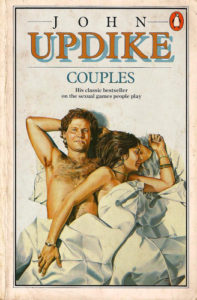
Couples is also cited:  “Eight years after the publication of Rabbit, Run, Updike not only espoused birth control but also identified it by brand name. The first time Piet and Georgene, married to other people, have sex, he worries about ‘making a little baby,” and she’s surprised he doesn’t know about Enovid. ‘Welcome to the post-pill paradise,’ she tells him, and the ‘light-hearted blasphemy . . . immensely relieved him.'”

With only nine entries you’d have to call it a very brief history, but it’s still a fascinating round-up.

Prospect’s Edward Pearce on John Updike

Prospect: The leading magazine of ideas, published an essay in their March 2000 issue (posted online 20 March 2000) by Edward Pearce titled, “You’re not so vain: In praise of John Updike.” In it, Pearce considers Updike-as-reviewer.

“Notoriously, the author of the Rabbit tetralogy, the delectable Bech stories and a compendium of superlative writing, is a kind reviewer. He shares the view of Anthony Burgess (also a victim of loftiness from below) that writing a book is a great toil underground and that to be smashed on the head afterwards—even with a cardboard shovel—is a rotten experience. Decent fellow writers should withhold such smashing.”

Later, Pearce writes, “Updike as a critic has the gift of interest. His scope is continental . . . . Updike is intelligently nostalgic. He is sufficiently independent of the arts community’s requirements to be able to field the latest buzz topic—then turn back to a film star of his childhood, or indeed a mediocre novel of 30 years ago, and write about it with affection.”

“There is also,” Pearce maintains, citing a review of Camille Paglia, “a delightful cross-over from Updike the moviegoer and 1950s nostalgist” in Updike the reviewer.

Read the full essay

Updike one of three to comment on Pamuk novel

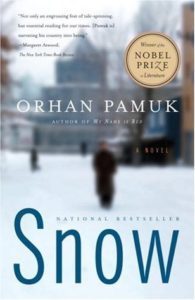
“Back in 2004,” Literary Hub writes, “three literary heavyweights reviewed Orhan Pamuk’s novel of Modern Turkey,” and in the article “Atwood, Updike and Hitchens on Snow the site compiles remarks from three individual book reviews.

In a review published in the August 30, 2004 New Yorker, Updike concluded, “If at times Snow seems attenuated and opaque, we should not forget that in Turkey, insofar as it partakes of the Islamic world’s present murderous war of censorious fanaticism versus free speech and truth-seeking, to write with honest complexity about such matters as head scarves and religious belief takes courage. Pamuk, relatively young as he is, at the age of fifty-two, qualifies as that country’s most likely candidate for the Nobel Prize, and the near-assassination of Islam’s last winner must cross his mind. To produce a major work so frankly troubled and provocatively bemused and, against the grain of the author’s usual antiquarian bent, entirely contemporary in its setting and subjects, took the courage that art sometimes visits upon even its most detached practitioners.”

Read the entire article.

On Rabbit’s alter ego and new LOA editions

On Feb. 21 in New York City at a Library of America event, writer Kevin Morris and Cornell professor Glenn Altschuler took the stage to discuss Updike’s legacy.

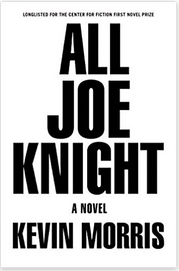
Morris, who had “adopted” John Updike: The Collected Stories through the Guardian of American Letters Fund, is the author of All Joe Knight, a novel in which he “engages in a dialogue with Updike’s famous quartet of Rabbit novels,” as a March 9, 2017 LOA website story summarizes.

“Like Rabbit Angstrom, Morris’s protagonist Joe Knight is from Pennsylvania, is unhappily married to a woman named Janice, and is haunted by the sense that his entire life has been a falling-off since the days when he was a high-school basketball star. Perhaps appropriately for America in the early twenty-first century, however, Joe is even angrier and more profane than his predecessor ever was.

“The resonances between these two characters, along with Updike’s ability to capture the passions, doubts, and longings of America’s post-World War II generation—to ‘give the mundane its beautiful due,’ to use his oft-quoted phrase—were the grist for Morris’s talk with Altschuler.

“Updike fans will be excited to learn that Library of America inaugurates a planned five-volume edition of his novels in 2018; the lead-off volume will include the first book in the Rabbit Angstrom sage, 1960’s Rabbit, Run.

All Joe Knight Amazon link 

Liberty Conservative takeaways from The Coup

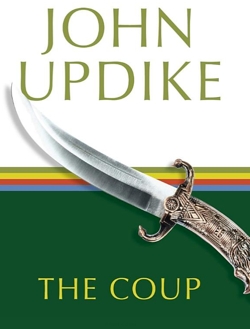
On March 17, 2017, Larsen Halleck shared his thoughts about John Updike’s satirical novel, The Coup, for The Liberty Conservative—another political consideration of an author who, in his lifetime, was often criticized for not being political enough.

“In his life,” Halleck begins, “John Updike was considered to be one of, if not the, premier American novelists of the 20th century—his Rabbit Angstrom books are still considered to be one of the best satires of the archetypal downtrodden American husband and father (the genre arguably started by Sinclair Lewis’ Babbit), full of broken dreams and mediocrity as he struggles against the changes of the world around him.

“But that’s not what I’ve come here to discuss:

“My favorite of his works is the 1978 best seller The Coup, an excellent read in its own right, but so much more than that: For The Coup is quite possibly the only satire of post-colonial Africa (or at least, the only one I’m aware of). More to the point, in satirizing latter 20th-century Marxist states, The Coup shines a light on some aspects of modern leftist ideology that confuse and infuriate us today, and shows that even back then there were competing camps in the leftist ‘big tent.’ And of course, there is an implicit message of ‘Imperialism will hurt the empire in the long run,’ which is most relevant to America in its current decline.”

Read the full article.

New book analyzes writers’ tendencies

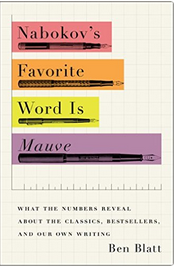
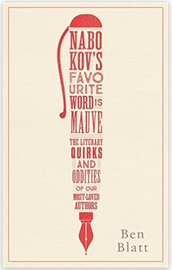
Scholars and would-be writers just got a resource that’s so fascinating they might not be able to get past the data to formulate a thesis of their own. In Nabokov’s Favorite Word is Mauve, Ben Blatt combines statistical analysis and literature to produce a study that quantifies writers’ tendencies. As an article from Publisher’s Weekly notes, “Using a database of thousands of books and hundreds of millions of words, Blatt answers everything from what are our favorite authors’ favorite words to which contemporary writer uses the most clichés to the controversial topic of adverb usage.”

The article “Danielle Steel Loves the Weather and Elmore Leonard Hates Exclamation Points: Literature by the Numbers” shares some of his findings, and of course Updike turns up on the lists.

Which three writers use the least amount of exclamation points per 100,000 words? That would be Elmore Leonard with 49 in 45 novels, followed by Ernest Hemingway with 59 in 10 novels and John Updike with 88 in 26 novels. Who uses the most exclamation points? James Joyce with 1105 in 3 novels, followed by Tom Wolfe (929 in 4 novels) and Sinclair Lewis (844 in 19 novels).

Which three writers use the least number of clichés per 100,000 words? Jane Austen (45 in 6 novels), Edith Wharton (62 in 22 novels) and Virginia Woolf (62 in 9 novels). Purveyors of the most clichés in their writing? James Patterson (160 in 22 Alex Cross books), Tom Wolfe (143 in 4 novels), and Kurt Vonnegut (140 in 14 novels). Updike was rated as producing 96 per 100,000 words over the course of 26 novels, which was one better than Toni Morrison did over 10 novels and six better than Twain did over the course of 13 novels.

What about the weather? Danielle Steel mentioned the weather in the first sentence of her 92 novels a whopping 46 percent of the time, followed by John Steinbeck (26 percent), Nicholas Sparks (22 percent), Willa Cather (21 percent), Stephen King (17 percent), Nora Roberts (16 percent), Tom Clancy (15 percent), Edith Wharton (14 percent), Janet Evanovich (10 percent), Charles Dickens (10 percent), D.H. Lawrence (8 percent), John Updike (8 percent), and Mark Twain (8 percent).

Amazon link-hardcover

Amazon link-paparback


Sunday reflection: Updike on churchgoing

The New Yorker has posted a full article by John Updike titled “The Future of Faith; Confessions of a churchgoer,” which was originally published in the Nov. 29, 1999 issue.

More than a reflection, the essay illustrates the research that Updike did for his articles. As a think piece, it’s superb, but it’s also excellent reporting. In his opening paragraph, Updike situates his remarks in a broader cultural context and notes the irony of a 1999 study by a sociologist at the University of Arizona:  “belief in the afterlife is going up, even as church attendance drops,” and as part of a “do-it-yourself trend, the sales of religious books have risen spectacularly, by fifty percent” from 1990-2000.

Updike goes through a catalogue of examples and concludes, “The welter of religious phenomena is not necessarily comforting to the professor of a specific faith; the very multiplicity and variety suggest that none of it is true, other than manifesting an undoubted human tendency. A Protestant Christian on the eve of the third millennium must struggle with the sensation that his sect is, like the universe itself in the latest cosmological news, winding down, growing thinner and thinner.”

Updike talks about his religious experiences on a trip to Italy and the journalist in him cites additional examples before concluding, “Faith is not so much a binary pole as a quantum state, which tends to indeterminacy when closely examined. In the several New England suburbs where I have lived my adult life, there was no easy telling, from other signs, who was and who was not a churchgoer,” Updike remarks, adding, “I have been struck by the number of unaccompanied men who show up in church, sitting, standing, and kneeling their way through this errand of habit or ancestral homage. A differentiating factor of intelligence is not conspicuous. At the end of the millennium, and of a century that has the Holocaust at its center, the reasons for doubt in God’s existence are so easily come by—His invisibility, His apparent indifference to the torrents of pain and cruelty that history books and the news media report, the persuasive explanations that science offers for almost all phenomena once thought mysterious—that church attendance must be taken, at least in the American Northeast, as a willful decision to evade what G.K. Chesterton called “atheist respectability.”

Updike the journalist cites the health benefits of churchgoing:  “a 1999 Duke University study shows that regular churchgoers were twenty-eight percent less likely to die in a given seven-year period that non-churchgoers. But a church will not last long as merely a health club; other health clubs exist, and other, less demanding means for generating togetherness. The pith and poignance of a church lies in its being a company of believers.”

Updike muses, “Perhaps the religion of the future lies all about us, in the proliferating escapism and induced hysteria of ‘entertainment,’ with all the intimidating, mind-blowing enlargement that electronic media have made possible. We are surrounded by entertainment more completely than medieval man was by the church and its propaganda. Feeling despondent and lonely? Turn on the television set,” Updike writes.

But, he cautions, “The future is not just an extension of the past; like a particle being measured, it eludes prediction. . . . Something might happen in faith’s future. Science might come up with a surprise—a loophole among the quarks or a reinstatement of the cosmological constant. Or the dynamic of human nature, as Earth’s population rolls past six billion, might produce a qualitative change in the frame of faith, or the world’s tired, grotesque, irreplaceable faiths. What occurs won’t be easily intelligible—the Gospels took most of a century to get written—but the hearing, the insistence that there be, to again quote William James, ‘something more,’ will persist. Our concepts of art and virtue, purpose and justification are so tied up with the supernatural that it is hard to foresee doing altogether without it.”

Read the full article.

Rabbit at Rest, Updike remembered

Today John Updike (1932-2009) would have celebrated his 85th birthday, and notable among the remembrances published in commemoration is one by Steve King, written, fittingly, for a books site:  Barnes & Noble.

In “Something Intricate and Fierce,” King begins with a quote from Updike and follows with this quote from reviewer Jonathan Raban:  “Rabbit at Rest is one of the very few modern novels in English . . . that one can set beside the work of Dickens, Thackeray, George Eliot, Joyce and not feel the draft.”

Birthday tributes are a testament to Updike’s cultural importance, but King’s post illustrates something that would make Updike smile if he were still around to blow out the candles:  that he has political relevance, something that in his lifetime, ironically, critics never appreciated.

“Whatever Updike’s own politics—biographer Begley notes that Updike on his deathbed rejoiced at President Obama’s inauguration—some commentators say that Updike lives on as spokesman for embattled Middle Americans, whose current angst and anger he saw coming.” And King concludes with a quote from Charles McElwee, written for The American Conservative magazine:  “‘Revisiting Updike’s Rabbit novels is a rendezvous with prescience, for no collection of postwar fiction could help us better understand how working-class populism—in the form of Donald Trump—prevailed on Election Day 2016.”

Updike—and irony—are still very much alive.

Happy 85th, Mr. Updike!

Miranda Updike featured in upcoming group show

Miranda Updike‘s new work can be seen the in group show “Territory,” which opens March 1 and runs through March 31, 2017 at the Paula Estey Gallery, 3 Harris St., Newburyport, Mass. The opening “PEG party” is scheduled for March 10 from 6-8 p.m. Miranda, the youngest daughter of John Updike, is on the board of The John Updike Childhood Home.


Review: Imagination and Idealism in John Updike’s Fiction

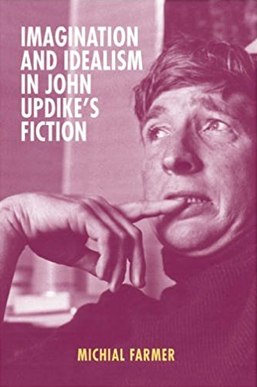
Updike criticism over the past several decades has gravitated toward the Rabbit tetralogy. In Imagination and Idealism in John Updike’s Fiction (Camden House, 2017, cloth, 228pp.), Michial Farmer bucks that trend, leaving Rabbit out of his discussion entirely. Given Updike’s exhaustive (and exhausting) oeuvre, it’s no surprise that, despite the broad title, only a handful of novels make the cut for Farmer’s exploration of Updike and the imagination.

As the back cover note summarizes, Farmer “argues that, while the imagination is for Updike a means of human survival and a necessary component of human flourishing, it also has a destructive, darker side, in which it shades into something like philosophical idealism. Here the mind constructs the world around it and then, unhelpfully, imposes this created world between itself and the ‘real world.’ In other words, Updike is not himself an idealist but sees idealism as a persistent temptation for the artistic imagination.”

In a first chapter, “John Updike and the Existentialist Imagination,” Farmer posits that while Updike “cannot endorse Sartre’s atheism or the nihilism that lurks just beyond his celebration of humanity’s radical freedom,” he nonetheless “uses Sartrean metaphysics as a jumping-off point for his own, more Kierkegaardian, reflections.” The fullest discussion of the latter remains David Crowe’s recent study, but for the intended purpose of this volume Farmer does a nice job of setting the stage for a study of the imaginative nature of Updike’s work, weighing Sartre’s suggestion that the human imagination, “and in particular the aesthetic imagination—can be a way to fight against meaninglessness.”

According to Farmer, Updike’s “job as a fiction writer” is to “use his powerful imagination, and the language that makes up its currency, to falsify the material world” that exists in opposition to the self and “bestow on it an order that does not properly speaking belong to it, but in bestowing that order to preserve and re-present it. The imagination thus counts among the highest and most important human faculties,” Farmer writes.

In the 15 chapters that follow, Farmer treats Updike’s works loosely chronologically but also finds a way to order them topically with the aid of a five-part section structure:

  1. The “Mythic Immensity” of the Parental Imagination
  2. Collective Hallucination in the Adulterous Society
  3. Imaginative Lust in the Scarlet Letter Trilogy
  4. Female Power and the Female Imagination
  5. The Remembering Imagination

Regarding what he calls the “parental imagination,” Farmer argues, “Mothers, in Updike’s early fiction, tend to create imaginative worlds for their sons to live in, and these worlds, when confronted with the world of mere things, tend to crush the sons for whom they were created.” That’s a big claim, and the chapters supporting it are probably the most enticing to consider, yet also the most elusive—especially when Farmer at times seems to conflate “force of will” with “force of imagination.” Still, his analyses of “Flight,” “His Mother Inside Him,” “Ace in the Hole,” “A Sandstone Farmhouse,” “The Cats,” The Centaur, and Of the Farm are engaging.

The chapters themselves read like brief imaginative essays: a combination of scholarship and readability that’s well reasoned and written in such a way as to anticipate reader questions. As a result, the author, while discussing texts that would be familiar to most Updike scholars and aficionados, confidently proceeds without feeling the need to cite a tremendous amount of secondary sources—only those that seem necessary to him. Some scholars may see that as a negative. Nowhere near all of the secondary sources for Updike’s Scarlet Letter trilogy, for example, are cited. Yet, underlying his arguments, Farmer demonstrates an awareness of the range of Updike scholarship throughout his chapter discussions, quoting from both the very first monograph (the Hamiltons) and the most recent one (Crowe).

Some of Farmer’s arguments have an “of course” feel to them, perhaps because the chapters’ arguments are compressed and proceed so methodically—with just enough theoretical grounding, contextual references, and examples from Updike’s works to lead readers to what feels like a foregone conclusion. Sometimes it’s a slightly new twist on familiar theory. For example, Updike’s oft-stated intent “’to transcribe middleness with all its grits, bumps, and anonymities, in its fullness of satisfaction and mystery,’ is,” Farmer writes, “in part a method of keeping the human imagination honest: we may not be able to have perfect access to the material world, but the material world periodically, perhaps even constantly, makes itself known by tearing down the imagination constructions we build on its back. The author’s fidelity to the world is thus held in dialectical tension with his imaginative project; the two are always in dialogue, and the human self is always moving between the two of them—forever building, forever destroying.” Mostly, it’s the attention paid to works that are too often ignored by other scholars that’s refreshing.

In the “adulterous society” section Farmer discusses “Man and Daughter in the Cold,” “Giving Blood,” “The Taste of Metal,” “Avec la Bébé-Sitter,” “The Hillies,” Marry Me, and Couples; in addition to The Witches of Eastwick, for the section on female power he considers “Marching through Boston,” “The Stare,” “Report of Health,” “Living with a Wife,” and “Slippage”; and in the final section he draws on examples from Memories of the Ford Administration, “In Football Season,” “First Wives and Trolley Cars,” “The Day of the Dying Rabbit,” “Leaving Church Early,” and “The Egg Race,” in addition to the more frequently discussed “The Dogwood Tree,” “A Soft Spring Night in Shillington,” and “On Being a Self Forever.”

One of this book’s strengths is that does manage to reconsider old concepts in the pursuit of new, and to explore a satisfying range of critical, theoretical, and philosophical arguments without insulting the intelligence of those readers who might already know the terms and their meanings. That kind of writing is hard to pull off, yet the author manages to do so with grace. As a result, Imagination and Idealism in John Updike’s Fiction is an easy read—one of the more engaging and accessible monographs on an author that I’ve encountered in recent years. It holds appeal not only for Updike scholars, but also for readers with more than a casual interest in Updike. This book helps readers to appreciate the sometimes erratic or unexplainable behavior of many of Updike’s characters, who live in worlds partially created by their own vivid and often conflicted imaginations.

Reviewed by James Plath