Updike’s Villages lauded as one of 17 Great Books

The folks at RealSimple.com have put together a reading list of “17 Great Books You Won’t Be Able to Put Down,” and though John Updike’s Villages has been put down by a number of critics, the novel nonetheless made their list.

In choosing it, the editors called Villages an “intriguing commentary on sexuality in 1970s suburbia.”

As Amazon summarizes, “John Updike’s twenty-first novel, a bildungsroman, follows its hero, Owen Mackenzie, from his birth in the semi-rural Pennsylvania town of Willow to his retirement in the rather geriatric community of Haskells Crossing, Massachusetts. In between these two settlements comes Middle Falls, Connecticut, where Owen, and early computer programmer, founds with a partner, Ed Mervine, the successful firm of E-O Data, which is housed in an old gun factory on the Chunkaunkabaug River. Owen’s education (Bildung) is not merely technical but liberal, as the humanity of his three villages, especially that of their female citizens, works to disengage him from his youthful innocence. . . . “

In Memoriam: former Knopf editor Judith Jones

Judith Jones, who retired as senior editor and vice president at Alfred A. Knopf in 2011 after a 54-year career at the fabled publishing house, died Wednesday, August 2, at the age of 93 as a result of complications from Alzheimer’s disease, according to a New York Times story by Robert D. McFadden.

Although Ms. Jones was most famous for discovering Julia Child and co-writing three books of her own with her food-critic husband Evan, devoted readers of John Updike knew her as the two-time Pulitzer Prize-winning author’s editor responsible for shepherding “all but one of Mr. Updike’s scores of books of fiction, short stories, poetry and essays to publication.”

Ms. Jones was also responsible for the publication of the American version of Anne Frank: The Diary of a Young Girl while she worked in Doubleday’s Paris office prior to joining Knopf. Among her many honors was the James Beard Lifetime Achievement Award, named for another writer she edited during her distinguished career at Knopf. While at Knopf Ms. Jones also “commissioned and edited regional and ethic food books for the ‘Knopf Cooks American’ series.” Among other writers she edited were Anne Tyler, John Hersey, Elizabeth Bowen, Peter Taylor, and William Maxwell. But it was her working relationship with Updike, Knopf’s most successful and lauded author, that put her in the conversation of important authors and their equally important editors. One hopes that her correspondence with Updike will one day be published, as the Max Perkins/Ernest Hemingway letters have been, so readers can get a fuller understanding of their working relationship.

The literary world has lost another one of its giants, but she will be appreciated well into the future. Photo: Chester Higgins Jr./The New York Times.

“Judith Jones, editor of Julia Child, dead at 93” (AP)

“The Side of Judith Jones You Didn’t See” (Food 52)

“Judith Jones got the best out of her authors. I know: I was one of them” (Washington Post)

“Remembering Culinary Giant Judith Jones” (Daily Beast)

Updike scholarship still going strong

Authors’ literary fortunes seem to rise and fall over time, but critical interest in John Updike has remained fairly steady over the years. Two books were published in the ’60s and six in the ’70s, when his reputation was still growing. The spike in interest came in the ’80s, when 16 critical books were published. The ’90s saw 11 more books on Updike published, and the 2000s another 10. So far this decade 10 books have been published on Updike, with two more forthcoming later in the year.

Updike Society members and Updike lovers are encouraged to ask their public and university libraries to purchase copies of the most recently published books on John Updike:

Batchelor, Bob. John Updike: A Critical Biography. Westport, Conn.: Praeger, 2013.

Begley, Adam. Updike. New York: HarperCollins, 2014.

Crowe, David. Cosmic Defiance: Updike’s Kierkegaard and the Maples Stories. Mercer, Ga.: Mercer University Press, 2014.

De Bellis, Jack. John Updike’s Early Years. Bethlehem, Pa.: Lehigh University Press, 2013.

Farmer, Michial. Imagination and Idealism in John Updike’s Fiction. Melton, England: Camden House, 2017.

Mazzeno, Laurence W. Becoming John Updike: Critical Reception, 1958-2010. Rochester, N.Y.: Camden House, 2013.

McTavish, John. Myth and Gospel in the Fiction of John Updike. Eugene, Ore.: Cascade Books, 2016.

Naydan, Liliana M. Rhetorics of Religion in American Fiction: Faith, Fundamentalism, and Fanaticism in the Age of Terror. Lewisburg, Pa.: Bucknell Univ. Press, 2016.

Plath, James. John Updike’s Pennsylvania Interviews. Bethlehem, Pa.: Lehigh University Press, 2016.

Rodgers, Jr., Bernard F., ed. Critical Insights: John Updike. Pasadena, Calif.: Salem Press, 2011.

About that David Foster Wallace-John Updike thing . . .

John Updike Society president Jim Plath appeared as a guest on an episode of The Great Concavity podcast that was recorded live in front of attendees at the fourth annual David Foster Wallace conference at Illinois State University in Normal, Ill. Roughly one hundred people were in the audience to hear ISU’s Charlie Harris and Plath, from nearby Illinois Wesleyan University, talk about the life and legacy of Wallace . . . and, of course, Wallace’s infamous scathing review of Updike’s Toward the End of Time.

The podcast, which is dedicated to DFW, is hosted by Matt Bucher and Dave Lair. Anyone who saw the DFW biopic The End of the Tour (2015) knows that Charlie Harris not only hired Wallace, but was a close personal friend whose daughter also dated Wallace. Plath was part of the Bloomington-Normal literary community when Wallace first arrived, and recalls introducing him at the Bloomington Parks and Rec “WordsFair” and running into him at parties and literary gatherings. As an Updike scholar, he also offers insight into Wallace’s anti-Updike remarks.

“Episode 29: Live from the ISU David Foster Wallace Conference, featuring Charlie Harris and Jim Plath”

Registration opens for Updike conference in Serbia

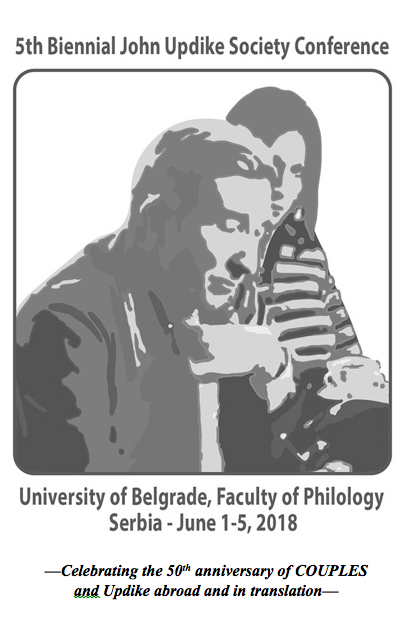
Registration is now open for the 5th Biennial John Updike Society Conference, June 1-5 2018, hosted by the University of Belgrade, Faculty of Philology. The conference celebrates the 50th anniversary of Couples and Updike abroad and in translation. All are welcome to participate. Society members include not just professors, but teachers, members of the clergy, college presidents, writers, editors, librarians, lawyers, entrepreneurs, Updike family and friends, and the just plain lovers of books that Updike so appreciated. Below is a PDF featuring the registration form and all the information you need regarding the preliminary schedule, featured speakers, call for papers, things to do, and lodging (Important: you MUST book a room by March 1, 2018). See you in Serbia!

Added 23 August 2017:  Information on Schiff Travel Grants for scholars needing financial assistance to be able to participate.

Updike in Serbia registration

On writers and reflections on birds

In a review-article of As Kingfishers Catch Fire: Books and Birds by Alex Preston and Neal Gower that was recently published in the Financial Times (subscription required), John Updike merits a mention:

“The book is in 21 short sections, each based on a single species and the varying inspirations it has brought for previous authors, Ted Hughes, Mary Oliver and Kathleen Jamie to the fore, and, through them, for Preston himself. The style seems fey at first and the self-referencing somewhat clumsy, but the form is potent.

“Each section, from Peregrine to Peacock, Robin to Wren, is illustrated by the artist, Neil Gower. These pictures, most intensely of Swift (above right) and Waxwing, are alone worth the price of a book beautifully presented in matt orange cloth. A blue sky full of gulls introduces a poem by John Updike where the birds ‘stand around in the dimpled sand like those melancholy European crowds that gather in cobbled public squares in the wake of assassinations and invasions, heads cocked to hear the latest radio reports.’ After the terrorist strike on London Bridge, we who were working nearby saw countless such gulls on the sands of the Thames and Preston, through Updike, reminds us that we did.

“Birds, more than mammals or fish, are the great reminders in literary history. An individual sight or song of a bird means most by bringing back the last time of seeing or hearing. Gulls gain added force for poets because they were for centuries the sole companions of sailors, the only life for men to observe in so much air and their only sharer of it.

“Those white clouds over trash pits today were once almost humans. Preston notes Updike’s glowing seaside conclusion in which ‘plump young couples . . . walk capricious paths through the scattering gulls, as in some mythologies beautiful gods stroll unconcerned among our mortal apprehensions.'”

Of COURSE Updike makes a list of books about adultery

Only 247 people voted for “The Best Books About Adultery” thus far, but those folks don’t seem to be familiar with John Updike’s Rabbit novels, none of which made the top 100. That includes two Pulitzer Prize winners—Rabbit Is Rich, in which Harry “Rabbit” Angstrom engages in wife-swapping (but is maneuvered into getting a different woman from the one he was lusting after), and Rabbit at Rest, in which he famously has sex with his daughter-in-law.

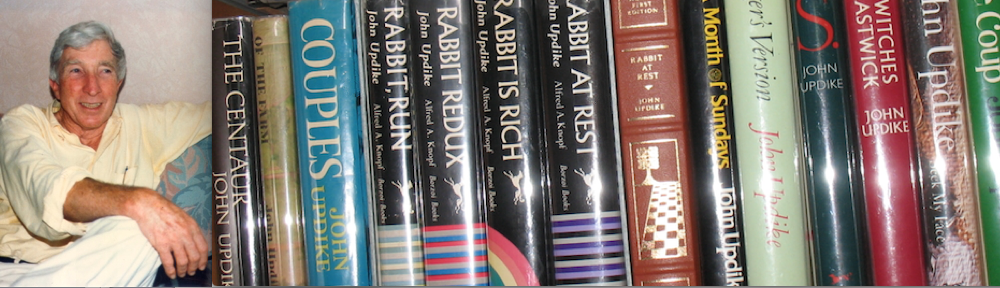
But Updike’s 1968 novel Couples made the list, clocking in at #8, no doubt helped by the notoriety the book initially generated when it put Updike on the cover of Time magazine as the spokesperson for the “post-pill society.”

Topping the list? Tama Janowitz’s Peyton Amberg, followed by The Scarlet Letter (Nathaniel Hawthorne), Jude the Obscure (Thomas Hardy), Madame Bovary (Gustave Flaubert), Anna Karenina (Leo Tolstoy), A Child’s Book of True Crime (Chloe Hooper), and The Quickie (James Patterson). Rounding out the Top 10 are The Little Women (Katharine Weber) and Lying (Wendy Perriam).

Here’s the full Ranker list, where you too can vote a book up or down.

PureWow recommends 50 funny books

Updike lovers might be hard pressed to cite their favorite “funny” Updike book.

Is it A Month of Sundays, with its comedic premise of a clergyman sent to a curative retreat for wayward ministers because he was getting a little too intimate with his flock . . . and then can’t help himself from trying to seduce his overseer through journal entries he knows she’s reading? Or S., another book in Updike’s Scarlet Letter trilogy in which he pokes fun of the notion of suburban housewives needing to “find” themselves in a commune, only to discover another form of male dominated servitude?

Is it The Coup, with its hilarious satire of a Third World dictator and American consumerism?

Is it one of the sardonic, tongue-in-cheek books on Updike’s Jewish alter ego, Henry Bech (Bech: A Book, Bech Is Back, Bech at Bay)?

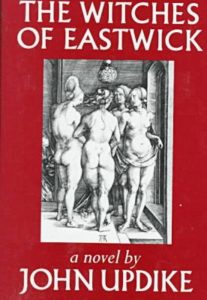
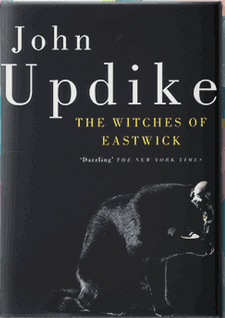
PureWow went with The Witches of Eastwick.

In a list-story on “The 50 Funniest Books We’ve Ever Read,”  they picked Updike’s tale of female vs. male power as their #6 funniest book: “The movie version is fabulous, but Updike’s original source material about three spurned women is even more satirical and wonderful.”

The bottom line is that there are a number of funny Updike books to choose from—enough for him to be considered not just one of America’s great writers, but one of America’s great comic writers as well.


Literary Takes on the Visual Arts? Look to Updike, et alia

Writing for Signature: Making well-read sense of the world, Tobias Carroll comes up with a list of “Literary Takes on the Visual: 10 Novelists on Fine Art.” 

Of Updike, he writes:

“When John Updike’s name is mentioned, most readers initially think of him as a novelist, and it’s certainly through fiction that he established his reputation as a writer. But Updike also wrote an abundance of art criticism: the posthumous Always Looking is his third such collection of work, following 1989’s Just Looking and 2005’s Still Looking. Delving into this side of Updike’s writing shows an entirely different side to him than you might experience if you’re only familiar with his fiction.”

Below are Amazon links to the three Updike volumes on art, with the posthumously published third volume edited by Christopher Carduff:

Just Looking: Essays on Art (2000)

Still Looking: Essays on American Art (2005)

Always Looking: Essays on Art (2012)

Your own Golf Dreams should include a course in Essex, Mass.

Pamela Tomlin recently posted a travel article on “14 Places to Explore on Massachusetts’ North Shore,” and included was Cape Ann Golf Course in Essex:

“Looking to tee it up? Here is a North Shore hidden gem of a small golf course. The family-run public, nine-hole course has been open since 1913, and golfers agree the sweeping views of the Essex River and Marsh make any bad game good. The number four hole is their signature that famed author John Updike enjoyed frequently playing. Learn more here. Updike, of course, wrote a book about his love of the game (Golf Dreams: Writings on Golf, 1996).

Though Updike wasn’t mentioned by name, other entries also apply. Those who attended the Second Biennial John Updike Society Conference in Boston and enjoyed a group dinner at Woodman’s of Essex know that Updike loved the fried clams there. He also enjoyed getting some sun at Crane Beach in Ipswich.