President’s challenge: Smile in 2018

John Updike Society president Jim Plath reports that he earned $10.70 for the society just by listing The John Updike Society as the charitable beneficiary on his account. He spent no more money, and did nothing special after the initial sign-up. All he did was bookmark Amazon Smile and the site automatically credited The John Updike Society for any purchases made. $10.70 might not sound like a lot, but if all of the 300 members shopped via Amazon Smile? It adds up. Go to https://smile.amazon.com to get started….

2018 Schiff Travel Grant winners announced

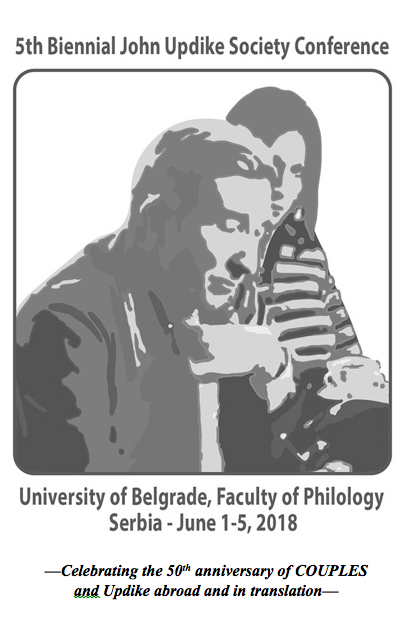
Thanks to the Robert and Adele Schiff Family Foundation, the John Updike Society was able to offer grants to scholars to help them travel to Serbia to present their work at the 5th Biennial John Updike Society Conference in Belgrade, June 1-5, 2018.

The society is pleased to announce the recipients of the $1500 Schiff Travel Grants for young scholars under 40 and also the recipients of the $1000 Schiff Travel Grants for members to help defray travel expenses so they can share their projects in Belgrade:

2018 Schiff Travel Grant Recipients ($1500)

Matthew Asprey Gear (“Mustered Opinions: John Updike’s Non-Fiction Collections”)

Natia Kvachakidze (“‘Words, words words’ Or Some Peculiarities of the Georgian Translation of John Updike’s ‘Tomorrow and Tomorrow and So Forth'”)

Lynn Leibowitz-Whitehead (“The Religion of Sex: An Evaluation of Its Effects on the Family Unit in Updike’s Couples“)

Gideon Nachtman (“Artificial in Essence”: Reevaluating the Critical and Academic Reception of John Updike’s Light Verse”)

2018 Schiff Travel Grant Recipients ($1000)

Louis Gordon (“Updike’s Middle East”)

Jon Houlon (“The Ballad of Henry Bech”)

Wei Lun Lu (“Translating, Rendering and Reconstructing Updike’s Stream of Consciousness: The Case of ‘A&P’s Translations into Mandarin”)

Continue reading

PECO Foundation continues its John Updike Childhood Home support

The PECO Foundation has supported The John Updike Society’s efforts to restore The John Updike Childhood Home in Shillington, Pa., since 2012, and they continue to support the society’s efforts to turn the house at 117 Philadelphia Ave. into a literary landmark and museum with a new $10,000 donation.

Society members who attended the May, 2017 American Literature Society conference in Boston got to meet Roemer and Constance McPhee, who attended the society’s business meeting. At that time they were honored with the society’s Distinguished Service Award in recognition of their continued support.

Through their PECO Foundation, Roemer and Connie have contributed more than $80,000 these past five years to help with the restoration, making them the second largest donor, behind the Robert and Adele Schiff Family Foundation, whose initial donation enabled the society to purchase the home. This latest donation comes at a time when money is needed to purchase museum cases and to mount exhibits.

Updike and David Foster Wallace societies to sponsor ALA panel

The David Foster Wallace and John Updike societies are co-sponsoring a session on “Great Male Narcissists” at the 29th Annual Conference of the American Literature Association, May 24-27, 2018, in San Francisco, Calif.

The purpose of the panel is to explore “Great Male Narcissists,” a phrase Wallace used to describe Updike, Philip Roth, and Norman Mailer in his acerbic review of Updike’s late work, Toward the End of Time. This panel intends to explore the connections and disparities between Updike’s and Wallace’s work, especially with regard to their depictions of masculinity. The aim is to complicate and introduce new ideas to both fields.

Here are more details.

Please note that the deadline for abstracts of no more than 300 words is January 15. Include your name, institutional affiliation, and contact information and attach your abstract as a Word document. Also indicate if you’ll need AV equipment and remember that scholars are limited to one presentation at this conference. Send your abstracts to:  info@dfwsociety.org.

ALA Annual Conference information

Wanna get away to Serbia? Schiff Travel Grant deadline approaching

The November 30 deadline is fast approaching for those Updike scholars and up-and-coming Updike scholars wanting to apply for a Schiff Travel Grant to help them attend the 5th Biennial John Updike Society Conference in Belgrade, Serbia. The conference, hosted by the Faculty of Philology at the University of Belgrade, will take place the first week in June 2018. The conference is shaping up to be one of the most memorable.

First-time programs always get fewer applicants than one imagines. Don’t miss out on an opportunity of a lifetime. Propose a paper to present! Up to four $1500 grants will be awarded to scholars under 40 and up to three $1000 travel-to-conference grants will be awarded to society members needing assistance. And these days, who doesn’t?

The travel grants are the result of a generous donation from The Robert and Adele Schiff Family Foundation, whose support has enabled The John Updike Society to purchase and restore The John Updike Childhood Home in Shillington, Pa. Applicants need not be members at the time of application, but must join the society before grants can be paid.

Both types of grants are merit- and need-based.

TO APPLY:  Interested scholars should send to James Plath (jplath@iwu.edu):

—a one-page proposal for a 15- to 20-minute paper appropriate for the conference

—one additional paragraph about yourself, what grant you are applying for, and why the grant is important to you.

The selection committee will make their decisions and announce successful applicants by the end of the first week of December 2017.

Registration and conference information

Updike, basketball, and Reading forever linked?

Writing for The Inquirer and its online version, Philly.com, Frank Fitzpatrick relates just how big a recent high school basketball championship was for the City of Reading, what a single basketball star can mean to a beleaguered city, and how evocative the whole thing is of a world John Updike described many years ago.

In “Reading is on the rebound, thanks to a basketball star” (Nov. 21, 2017), Fitzpatrick introduces non-area readers to Lonnie Walker, who led Reading Senior High School’s Red Knights to a state basketball title seven months ago and returns soon as a University of Miami freshman for a pre-season D-I game against LaSalle “that will bring 7,300 fans to Santander Arena, a facility that just a few years ago was a lone jewel in a drab and decaying downtown.

“Residents and civic leaders have portrayed this first Division I basketball game ever here as something more than an athletic contest. In their view, it is, much like last spring’s groundbreaking championship and the parade that followed, another sign that Reading is rebounding at last.

“‘I’ve really seen so much positive activity and change since that basketball championship,’ said Robin Costenbader-Jacobson, whose Reading roots go back 10 generations. ‘There’s a lot going on downtown. It looks brighter and cleaner. People are believing again. It’s wonderful to see the city being embraced.’

“Last April, when the champion Red Knights were feted with a parade along 13th Street, consciously or not mirroring a route Reading-born author John Updike famously described in a short story about 1940s’ high-schoolers here, the population of this red-brick city joyfully amassed, as if drawn by an unseen force.

“‘[The parade] was almost a utopian moment for Reading. It was one of the most stunningly good moments I’ve seen in my lifetime,’ recalled Donna Reed, a 65-year-old native and a five-term member of City Council. ‘For a city that’s had so much distress financially, socially and economically, and all the other stuff we’ve gone through, it was a moment where everybody got together, everybody was happy together.”

Read the whole article. 

Related WFMZ-TV story: “Lonnie Walker returns to play in front of hometown fans”

Follow-up:  On Wednesday, Nov. 22, Walker “struggled in his return home,” the Sun-Sentinel reports. “Part of Miami’s recruiting pitch for the projected NBA lottery pick was a game in his hometown. Walker was held to five points and 2-of-8 shooting. . . .”

New De Bellis book is now available

If you haven’t already pre-ordered a copy, you can go to Amazon right now and get a copy of John Updike Remembered: Friends, Family and Colleagues Reflect on the Writer and the Man, edited by Jack A. De Bellis.

The Amazon “Look inside” link gives a full rundown on the contents. The book features 19 interviews with Updike’s classmates (from kindergarten through high school), four essays on Updike’s time at Harvard and his early years as a writer, two essays on Updike in Ipswich, 25 personal reminiscences from “writers, fans, friends,” three reminiscences from Updike’s children, and a reprinted transcript of the Updike Family Panel from The John Updike Society’s first conference at Alvernia University in Reading, Pa.

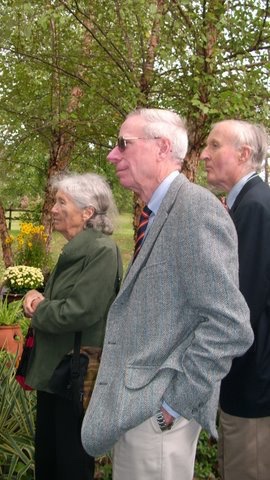
De Bellis (pictured) is best known in Updike studies for writing The John Updike Encyclopedia and for compiling, with Michael Broomfield, the definitive Updike bibliography.

The Poorhouse Fair: A retro review

The county alms house was located just a few blocks from The John Updike Childhood Home, and it famously provided the inspiration for Updike’s first published novel. In a review of it, published in Commentary on March 1, 1959, David Fitelson wasted no time in pronouncing it a failure. His review begins,

“John Updike, one of the more talented of the New Yorker‘s resident storytellers, has had a hearty but not very successful try at a first novel. The failure of The Poorhouse Fair lies largely in its adherence to established New Yorker conventions regarded in many quarters as rather OK. One does not mind the OK archness and urbanity that occasionally creeps into Updike’s prose. He has a genuine way with words and usually rises above that. Other OK things, however, are more disturbing: in particular, a rather mannered way of exploring character, and a distaste-for-the-sight-of-blood daintiness that he shares with certain other New Yorker contributors (e.g., John Cheever and Harold Brodkey). Most disturbing is that New Yorker-like critical remoteness which enables one to be awfully aware of, say, the ‘ridiculous’ build-up in nuclear armaments, and then (having exercised one’s social conscience) to go on to chuckle at the ‘ridiculous’ oversight of an Iowa proofreader. In being aware of impending perils, one is relieved of responsibility for heading them off: in being aware of the existence of ideas, one is absolved from thinking about them.”

Here’s the full hatchet job.

Updike on the ghost particle of the universe

In an article titled “In search of the neutrino, ghost particle of the universe,” The Guardian turned to John Updike again.

“Every second,” Robin McKie writes, “billions of neutrinos pass through our bodies. The sun sends trillions streaming across space every minute. Uncountable numbers have been left over from the Big Bang birth of the cosmos 13.8 billion years ago.

“In fact, there are more neutrinos in the universe than any other type of particle of matter, though hardly anything can stop these cosmological lightweights in their paths. And this inability to interact with other matter has made them a source of considerable frustration for scientists who believe neutrinos could bring new understandings to major cosmological problems, including the nature of dark matter and the fate of our expanding universe. Unfortunately, the unbearable lightness of their being makes them very difficult to study.”

The article notes, “Three different forms of the particle are now known to exist: the electron neutrino, the muon neutrino and the tau neutrino and until relatively recently it was thought that none of them had any mass at all. They were the ultimate in ephemeral ghostliness, a bizarre situation that was celebrated by John Updike in his poem, ‘Cosmic Gall.'”

Neutrinos, they are very small.
They have no charge and have no mass
And do not interact at all.
The earth is just a silly ball
To them, through which they simply pass,
Like dustmaids down a drafty hall

Updike’s baseball poem recalled

A blogger on The Nature of Things posted an entry titled “Houston, we have a World Series champion! in celebration of the team’s (and city’s) first World Series championship.

“Baseball is a game that will break your heart two times out of three,” Dorothy Borders writes. “But, oh, that third time is worth waiting for.

“John Updike knew and loved the game and explained it best of all. Let’s give him the last word and then, let the off-season begin!”

Baseball

by John Updike
It looks easy from a distance,
easy and lazy, even,
until you stand up to the plate
and see the fastball sailing inside,
an inch from your chin,
or circle in the outfield
straining to get a bead
on a small black dot
a city block or more high,
a dark star that could fall
on your head like a leaden meteor.

The grass, the dirt, the deadly hops
between your feet and overeager glove:
football can be learned,
and basketball finessed, but
there is no hiding from baseball
the fact that some are chosen
and some are not—those whose mitts
feel too left-handed,
who are scared at third base
of the pulled line drive,
and at first base are scared
of the shortstop’s wild throw
that stretches you out like a gutted deer.

There is nowhere to hide when the ball’s
spotlight swivels your way,
and the chatter around you falls still,
and the mothers on the sidelines,
your own among them, hold their breaths,
and you whiff on a terrible pitch
or in the infield achieve
something with the ball so
ridiculous you blush for years.
It’s easy to do. Baseball was
invented in America, where beneath
the good cheer and sly jazz the chance
of failure is everybody’s right,
beginning with baseball.