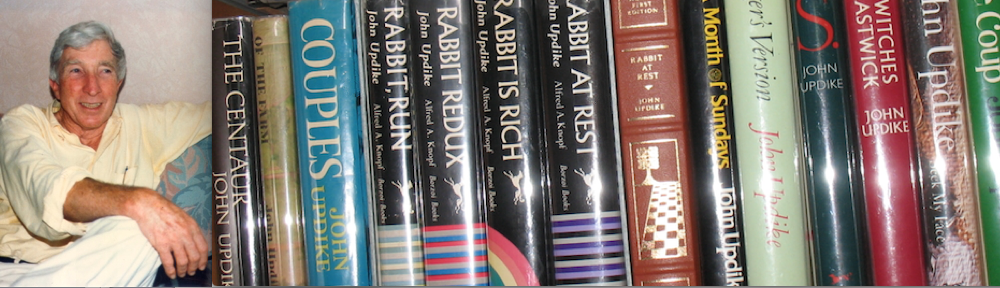
Rabbit is one of 25 books that inspired writers to write

Round-up stories are popular features, and for an article that appeared in Nylon Kristin Iversen rounded up 25 writers and asked them what book inspired them to want to be a writer.

“For me,” responded Siobhan Vivian, author of Stay Sweet, “that book was Rabbit, Run by John Updike, which I read during my first semester of undergrad. I was studying to be a screenwriter, and most of my classes were about film but I took a narrative fiction class as an elective, and this was the first book we were assigned.

“I loved how dark and sexy it was, how Rabbit—the protagonist—stayed unlikeable and irredeemable and petulant to the very end. It was unlike anything I’d been assigned to read in high school, a big beautiful middle finger to an English department cannon. And the prose is so lovely, I can still quote lines of description from memory.

“Reading it made me want to subvert expectations, break rules, be a little naughty . . . unsurprising, as I’ve always had a soft spot for bad boys.”

Read the full Nylon article.

Updike recalled in well-known painter-writer’s short story collection

Born in 1946 in Ressen,Bulgaria, Dimitri Vojnov is a well-known artist (oils, acrylics, pastels, sculptures) living in Germany who is recognized by The Europa Authentica Cultural Organization as a Magister Artis.

In 2020, he published a collection of short-short stories and illustrations, Ready for New York (Norderstedt, Germany: Kelkheim, 2020). One of the stories is devoted to John Updike, whom Vojnov said “was a great inspiration to me.”

His website features a poem that in English reads, “I have pledged myself to painting, / like a monk to his church. / I do not preach, I confess. / I am not a painter, / I am a confessor”. Below is that story, “John Updike: Our Sex Instructor.” Ready for New York, is available in an Amazon Kindle edition.

Any more Updike movies in the works?

The Hastings Tribune‘s Rich Heldenfels (Tribune News Service, Nebraska) was asked by a reader, “Do you know of any plans to make (remake) a film based on any John Updike novels?”

Heldenfels replied, “I do not know of any plans. There have been a few adaptations of the works of Updike, one of the most admired American writers. There’s a 1970 movie of his novel Rabbit, Run, with James Caan, TV-movie Too Far to Go (1979) from Updike short stories, movies and TV productions inspired by the novel The Witches of Eastwick and a few shorter productions.

“Shortly after Updike died in 2009 at the age of 76, Scott Timberg pondered Updike’s ‘dozens of novels and several hundred short stories’ for TheWrap.com and saw several reasons why Updike did not make it to the movies much. One was style: ‘His writing is so visual, at the level of image and metaphor, it’s almost redundant to put it into a visual medium.’ In addition, ‘The “American small town, Protestant middle class” as he described his milieu, has not been of very big interest, personally or cinematically, to the Hollywood establishment.’ (The Witches of Eastwick with its supernatural element was thought more accessible for audiences.) Nor has Updike had a film-industry champion eager to put his work onscreen the way some other writers of his era have, Timberg wrote.

Blogger gives Updike’s Hub Fan essay an E for Effort

John Updike’s “Hub Fans Bid Kid Adieu” is widely regarded by sportswriters and sports fans everywhere to be the best piece of sports writing ever done by anyone. Hall of Fame sportswriters have said as much, though the essay’s monumental status was no doubt helped by Ted Williams. The Bosox slugger hit a home run in his very last career at-bat, and Updike was in the stands to memorialize the moment with what became one of his most famous pieces of prose.

But blogger Roger W. Smith was not as impressed:

“What is wrong—in my ‘contrarian’ opinion—with Updike’s piece?

It is too long (it needs pruning)

It is too fine (typical of New Yorker pieces); too ‘literary and (at times) too flowery.

It is the work of a brilliant, undeniably talented writer whose dazzling performance—like that of some virtuosos—comes between you and the subject matter, i.e., the focus of the piece: the great baseball player Ted Williams, his last game.

One tires of Updike’s verbal pyrotechnics, his asides (authorial interventions, commentary).

Is this reportage or an essay? Updike tried to do both. I think it was a mistake.

‘Hub Fans Bid Kid Adieu’ is regarded as a classic. I would say, ‘Great effort.”

Late New Yorker writer called Updike the last of his kind

New Yorker writer Ved Mehta died on January 9, 2021 at the age of 86, a venerable writer who became an American citizen in 1975 and whose opus magnum was an 11-volume autobiography. He was a meticulous wordsmith (each New Yorker piece was read 16 times) who, according to a National Herald (India) obituary, would work on close to a hundred drafts of every chapter before sending it off to the publisher.

“Now people don’t know how to write letters,” he once complained. “I think hardly anyone writes formal prose these days. John Updike was the last writer I know who wrote formal prose. By formal prose I mean writing that is elegant, precise, clear. Now the writing has become quite a bit like schoolgirls writing to their mums—letters about what’s going on in their schools. It’s different,” the obituary quoted him as saying.

Blogger: Updike’s Thurber Dog Went to Harvard

Pets weren’t allowed in the dorm when John Updike went to Harvard in the fall of 1950, but he took his dog anyway . . . that is, James Thurber’s drawing of a dog made especially for young Updike, whose first ambition was to become a cartoonist. Updike had written a fan letter to the famed cartoonist asking for a drawing to hang on his bare wall, and Thurber obliged.

Last week the Ink Spill: New Yorker Cartoonists News and Events blog featured Updike’s Thurber cartoon, courtesy of Miranda Updike; this week, the blog adds a letter that Updike had written home to his parents and other “Plowvillians,” provided by Michael Updike.

In that letter dated September 29, 1952, young Updike writes, “This room is always cold and in shadow, for it faces the moon, whereas last year’s room faced the sun. I have the window open to admit the warmth. Coming in to our room is like entering a cave, dank, mossy, but without drawings (beyond Thurber’s) on the wall . . . .”

Read the entire letter and blog post.


Musician Rufus Wainwright fights Covid with Updike

In the recent Rolling Stone feature “Year in Review: So, How Was Your 2020, Rufus Wainwright?” the musician responded to a series of questions, including whom he’d want to quarantine with (“Carrie Fisher—mainly because I miss her so much”), an old album he turned to for comfort (Randy Newman’s Trouble in Paradise), and his favorite TV show to stream while in isolation (Victoria. Good old family Royal fun without the drugs and divorces).

And the best book he read during quarantine?

Rabbit, Run by John Updike.

Photo: Tony Hauser

New Yorker cartoonist blog features Updike’s Thurber

New Yorker cartoonist Michael Maslin posted an entry today on Ink Spill: New Yorker Cartoonists News and Events titled “Updike’s Thurber.” In it,  readers get a rare glimpse of the cartoon dog that Thurber drew especially for a young ‘tween fan named John Updike (courtesy of Miranda Updike).

“For those of us who treasure Thurber’s art, there is I would suggest, nothing  more wonderful than a Thurber drawn dog. In Updike’s Introduction to Lee Lorenz’s The World of William Steig, he tells us that in 1944, when he was 12 years old, he wrote Thurber a fan letterThurber responded with the drawing you see at the top of this post”.

In musing about the relationship between Updike and Thurber, Maslin shared his “favorite Updike description of Thurber’s art: ‘…oddly tender…a personal art that captured in ingenous scrawls a modern man’s bitter experience and nervous excess.'”

Updike book a perfect read for the Covid holidays?

As the pandemic rages on, many people are tending toward rage as well. Or at least a profound feeling of being “over it all.” Or disappointment that the usual holiday gatherings had to be abandoned. But the 746 Books blog reminds us that John Updike’s offbeat Christmas book might be just what the epidemiologist ordered.

In “Alternative Christmas Reading!” 746 Books recommends Updike’s The Twelve Terrors of Christmas:

“John Updike’s wry observations paired with Edward Gorey’s off-kilter illustrations make for a decidedly different festive reading experience! From impractical miniature reindeer to alcoholic Santa’s Updike expores the more disappointing side of this most wonderful time of the year!”

When Updike waded into Nigerian politics

BBC News recently ran a story by Adaobi Tricia Nwaubani about Nigerian blogger Teslim Omipidan, whose passion for history and all things Nigerian has connected famed American writer John Updike to his country’s politics. Here is one of Omipidan’s stories:

In October 1961 a young American named Margery Michelmore caused a stir when, in the midst of Peace Corps training at the University of Ibadan in southwestern Nigeria, she decided to send a postcard to a friend back home. In it, she described the “squalor and absolutely primitive living conditions” of her new environment. “A Nigerian saw the postcard before it was mailed; distributed photocopies around the campus—sparking riots from the students who found the private message outrageous, and an international incident that eventually drew the involvement of then US President John F. Kennedy.”

Where does Updike come in?

“Back in 1961, acclaimed writer John Updike absolved Margery Michelmore of blame in the postcard incident. ‘Miss Machelmore did not sin in saying in a personal missive that she was startled, coming fresh from Foxboro, Massachusetts, to find the citizens of Ibadan cooking in the streets,’ he wrote in the 28 October issue of that year’s The New Yorker. ‘And the fellow student who picked up the dropped card and, instead of mailing it, handed it to the local mimeographer seems guilty of a failure of gallantry. One may or may not cook in the streets, but one does not read other people’s mail and then demonstrate because it is insufficiently flattering,'” Updike had written in “The Talk of the Town.”

Read the whole article:  “The Nigerian blogger scouring the past to inform the future”