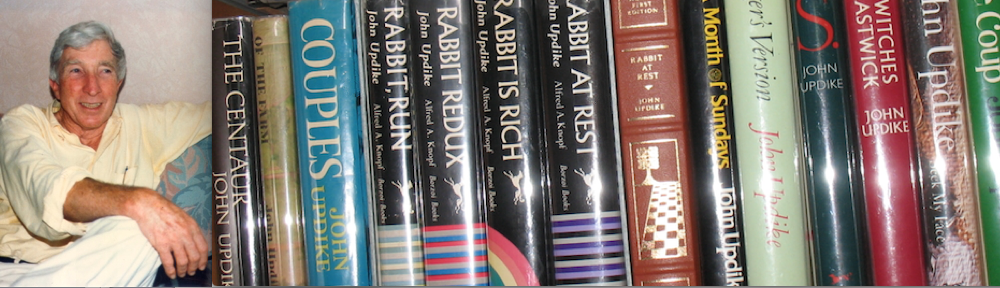
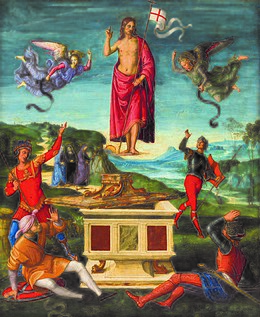
“At 28, novelist John Updike got to the bottom of the Resurrection,” Simmons wrote. “Updike would fear death throughout his life. His sober awareness of this surely led him to write “Make no mistake: if He rose at all / it was His body; / if the cells dissolution did not / reverse, the molecules / reknit, the amino acids reignite, / the Church will fall.”
“Updike realized that the scandal of the resurrection, that a human could raise the dead, had to be true or the faith had to be abandoned. He wouldn’t want to make a metaphor out of it or redefine it or make it less of a stumbling block. He seems to have believed that he could only be saved from eternal death by a Savior who had conquered it himself,” Simmons wrote.
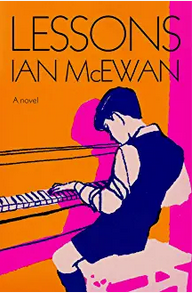
Elle magazine’s Riza Cruz asked award-winning author and book lover Ian McEwan (Atonement, Lessons) to name favorite books in 18 different categories—a bit more fun than the usual Top 10 format. His non-annotated responses are below. For the Full Monty you’ll need to read the Shelf Life books column article . . . on the book that:
Made him miss a train stop: The Caine Mutiny (Herman Wouk)
Made him weep: Madame Bovary (Gustave Flaubert)
He would recommend: The Dead (James Joyce)
Shaped his worldview: The Female Eunuch (Germaine Greer)
Made him rethink a long-held belief: The Radetzky March (Joseph Roth)
He read in one sitting, it was that good: Youth (Joseph Conrad)
Currently sits on his nightstand: We Don’t Know Ourselves (Fintan O’Toole)
He’d pass on to his kid: God is Not Great (Christopher Hitchens)
He’d gift to a new graduate: On the Origin of Species (Charles Darwin)
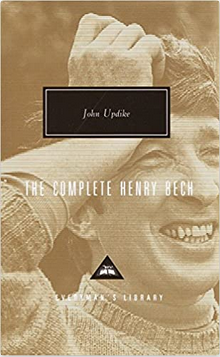
Made him laugh out loud: The Bech Trilogy [The Complete Henry Bech] by John Updike. Bech is Updike’s Nobel Prize-winning, Jewish alter ego, whose literary career rises, nosedives, and rises again. By the end, Bech murders his various hostile critics and is heroically damned by a dying victim.
He’d like to turn into a Netflix show: We Had to Remove This Post (Hanna Bervoets)
He first bought: Under the Net (Iris Murdoch)
He last bought: The Darkroom of Damocles (Willem Frederik Hermans)
Has the best title: What Katy Did (Susan Coolidge)
Has the best opening line: Herzog (Saul Bellow)
Has the greatest ending: Reunion (Fred Uhlman)
Everyone should read: Middlemarch (George Eliot)
Holds the recipe to a favorite dish: Appetite (Nigel Slater)
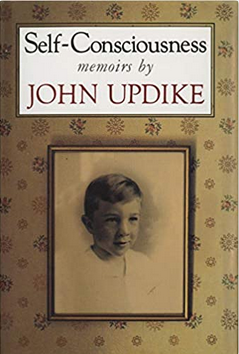
On September 18, 2022, Flashbak (Everything Old Is New Again) posted “John Updike On Death, Writing And the Last Words,” in which Paul Sorene gave some thought to Updike’s memoir and the relationship between the author’s preoccupations with writing and death.
“Memory is like the wishing-skin in fairy tales, with its limited number of wishes,” Updike wrote, prompting Sorene to wonder, “Can writing preserve memories and keep death at bay? Who gets to tell Updike’s story after he’s gone, and how will he be remembered?”
Sorene, quoting liberally from Self-Consciousness, noted that “Updike saved almost everything. His papers, stored at Harvard, include his golf scorecards [the John Updike Childhood Home has several of these on display], legal and business records [the JUCH also has his travel log, many of his cancelled checks, and a number of business correspondences with publishers], fan mail, video tapes, photographs, drawings [plenty of those on display at JUCH], and rejection letters. Was saving and preserving the past done so we could remember him, and he could better remember himself, and try again?”
That interesting question prompts another: What is the relationship between the collecting impulse, the writing impulse, and the impulse to somehow live forever?
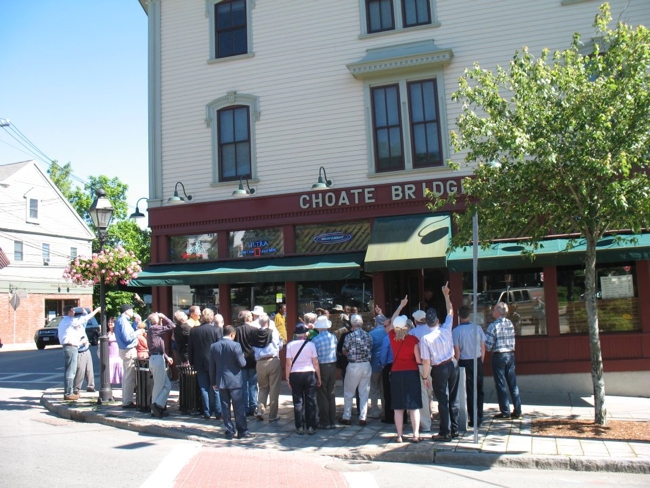
Participants in the 2nd Biennial John Updike Society Conference locate the second story office Updike rented in Ipswich above what was then known as the Blue Dolphin
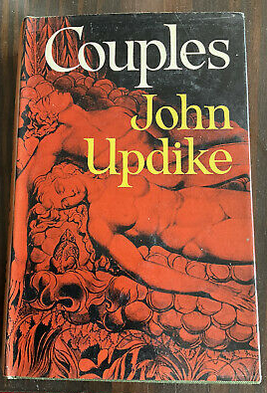
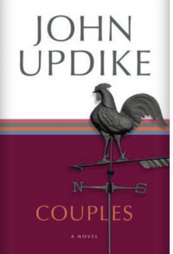
In an article updated in 2022, the New England Historical Society wrote, “In 1968, John Updike blew the cover off a high-living, raucous little group of people in Ipswich, Mass., with the publication of his novel, Couples. The book told the graphic and salacious tale of the couples of Tarbox, Mass., who had made sex the focus of their lives.”
“John Updike in ‘Couples’ Titillated America with Tales of his Neighbors” noted that Updike “gave America a look at these upper-middle-class elites through their dinner party conversations and bedroom squabbles. He showed how they neglected their children. And, most shockingly, how they made swapping spouses in the bedroom a regular part of their lives.”
According to the historical society article, “John Updike, a former columnist to the local newspaper, tried his hand at damage control. He sent a letter to the paper flatly denying that Tarbox was Ipswich. But no one bought it.
“While politeness prevented much outright discussion of who was who, many in Updike’s circle seethed over his inclusion of their adventures in his work. They fumed partly because they didn’t want their behaviors known and partly because he had spoiled their fun.
“In the end, Updike found it convenient to head off on a European trip. Then he moved out of Ipswich altogether to the tonier environs of nearby Beverly Farms. But he would continue to visit Ipswich throughout his life, lunching at one of the downtown clubs and avoiding the scowls from some residents that would follow him until he died.”
In an obituary for Legacy.com, Linnea Crowther wrote that Spanish novelist Javier Marías, “considered by many to be the greatest living Spanish writer,” died at his home in Madrid of pneumonia on September 11, 2022 at the age of 70.
Like Updike, Marías found literary acclaim early in life. Only 20 when his first novel, Los Dominios del Lobo (Dominions of the Wolf) was published, he wrote 16 more novels and numerous short stories and novellas. “He won the Fray Luis de León Translation Award for his translation of Laurence Sterne’s Tristram Shandy, and he also translated works by authors including John Updike and Henry James.” And like Updike, he was widely considered to be a top candidate for the Nobel Prize in Literature . . . an honor that would never come, but should have.
The nearly 500-page novel, which mentions the fatwa against Rushdie, is “far longer than McEwan’s characteristically ‘short, smart and saturnine’ novels, as John Updike summed up in a 2002 review of Atonement,” Allardice wrote. “McEwan’s ambition with Lessons, his 18th novel, was to show the ways in which ‘global events penetrate individual lives,’ of which the fatwa was a perfect example. ‘It was a world-historical moment that had immediate personal effects, because we had to learn to think again, to learn the language of free speech,’ he says.”
“Billed as ‘the story of a lifetime,’ it is in many ways the story of McEwan’s life. ‘I’ve always felt rather envious of writers like Dickens, Saul Bellow, John Updike and many others, who just plunder their own lives for their novels,’ he explains. ‘I thought, now I’m going to plunder my own life, I’m going to be shameless.'”
“‘I’ve read so many literary biographies of men behaving badly and destroying their marriages in pursuit of their high art. I wanted to write a novel that was in part the story of a woman who is completely focused on what she wants to achieve, and has the same ruthlessness but is judged by different standards,’ he explains. ‘If you read Doris Lessing’s cuttings they will unfailingly tell you that she left a child in Rhodesia.'”
Asked whether, at age 75, he worries about his legacy, McEwan responded, “I’d like to continue to be read, of course. But again, that’s entirely out of one’s control. I used to think that most writers when they die, they sink into a 10-year obscurity and then they bounce back. But I’ve had enough friends die more than 10 years ago, and they haven’t reappeared. I feel like sending them an email back to their past to say, ‘Start worrying about your legacy because it’s not looking good from here.'”
Allardice wrote, “He was greatly saddened by what he describes as ‘the assault on Updike’s reputation’; for him, the Rabbit tetralogy is the great American novel. Saul Bellow, another hero, has suffered a similar fate for the same reasons, he says. ‘Those problematic men who wrote about sex—Roth, Updike, Bellow and many others.'”
“We’ve become so tortured about writing about desire. It’s got all so complex,’ he says. ‘But we can’t pretend it doesn’t exist. Desire is one of the colossal awkward subjects of literature, whether it’s Flaubert you’re reading or even Jane Austen.'”
On the 50th anniversary of JFK’s assassination, the Dallas Observer‘s Jim Schutze wrote a column titled “Umbrella Man, Umbrella Man, Please Stay Away. Don’t Come to Dealey on JFK Day.” The title itself is pure, poetic, fun with language, so it’s perhaps no surprise that Updike turns up.
“Louie Steven Witt, are you still out there somewhere, alive? Would you tell me if you were? You know you’re back in The Dallas Morning News this morning, but only as a ghost,” Schutze began. Witt was identified as the “umbrella man” during the House Select Committee on Assassinations in 1978. The umbrella man was one of the closest bystanders when the assassin’s bullet struck President Kennedy, and the only one in the area with an umbrella who was opening and closing it. A signal?
“You have something in common with the old rich Dallas people sponsoring the 50th whatever-it-is-this-year. A half century ago all of you were abducted and transported into the bizarre quantum universe of Kennedy assassination conspiracy theory. When he wrote about you in particular, Mr. Witt, in The New Yorker in 1967, the late great novelist John Updike described the alternative reality that consumed you as ‘a sub-atomic realm where laws are mocked, where persons have the life-span of beta particles and the transparency of neutrinos, and where a rough kind of averaging out must substitute for absolute truth.”
The blog Flowers for Socrates said August 20 was World Mosquito Day, and if you missed out on your usual celebration (ahem), here’s an Updike poem on the subject that blogger Nona Blyth Cloud posted that day.
Updike had us at “I was to her a fragrant lake of blood / From which she had to sip a drop or die / A reservoir, a lavish field of food”.
“The Mosquito” was first published in the June 11, 1960 edition of The New Yorker.
In “Rereading: Couples by John Updike review—a melancholy anatomy of adultery,”David Mills began, “John Updike’s 1968 novel Couples has a notorious reputation: it is regarded as a sex book, an explicit manual of swinging high jinks in the ‘post-pill paradise’ of the early 1960s.” He conceded, “There certainly are passages that come across as route-one porn” and provided examples, but took exception with David Foster Wallace’s well-known description of Updike as “just a penis with a thesaurus.”
Within Couples‘ “five-section structure, one unconventionally focuses entirely away from the main character of Dutch builder Piet Hanema, and the prose itself can be tricky, with Piet given stream-of-consciousness interior monologues of almost Joycean complexity.
“Above all, this is a novel about sexual dynamics that in its choreography of shifting relationships becomes a melancholy anatomy of adultery,” Mills wrote, with this qualification: “Of course, it is a white, phallocentric novel with moments of racial stereotyping and casual male violence that make us blench now, but if its social attitudes and assumptions haven’t aged well, then neither have Jane Austen’s.”
Read the full review published in The Sunday Times [UK].
Yes, he was a literary giant, but literary giants have comic moments and can become the butt of jokes just like anyone else. This week two news pieces provided laughs at the late John Updike’s expense.
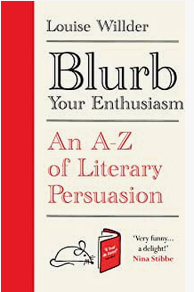
“I’ve got this letter from John Updike, which is one of my prized possessions,” Willder said. “I’d written a blurb for Couples and I can’t even remember the copy I wrote. I’m sure I would hate it now if I looked at it, but it’s a lovely letter from him. And at the end he just says, and he’s clearly not sure about it, ‘Oh my, have it your way.’ That’s how he signs off the letter!”
Closer to Updike territory, humor columnist Doug Brendel was inspired by the drought-exposed Lake Mead (Calif.) discoveries to speculate on what might be found in Ipswich under similar circumstances. In “Outsidah: If the dam goes, I’ll probably learn too much about Ipswich,” Brendel wrote, “The implications for Ipswich are clear. If the dam comes down, declining riverfront real estate values could be the least of people’s problems.
“In addition to a muddy hellscape of irate turtles and confused fish, decades’ worth of local mysteries will be suddenly and perhaps gruesomely solved.
“Children playing on the newly dried-out riverbank find a soggy box containing copies of John Updike’s novel Couples rounded up and chucked into the river by outraged neighbors in 1968.
“Hikers otherwise minding their own business stumble upon the carcass of that noisy dog that mysteriously disappeared from your neighborhood a couple years ago.