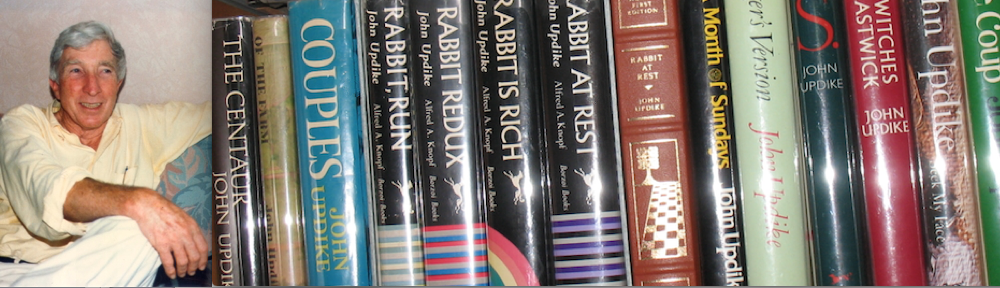
Museum & Woman: A reminiscence

Mary Houck Yuhasz was a Reading native who attended Reading High School and grew up with memories of John Updike that “skip thru our childhood and touch at various times through the years,” because Updike was a longtime friend of her family’s. Her parents and John’s were classmates at Ursinus and remained friends all their lives. In recent years, Yuhasz says she began a correspondence with Updike over the old days and she sent pictures, especially if they included images of his parents. And to the Society she sent a more recent recollection of a visit Updike made to Denver. Here it is:

John Updike Researched at Denver Museum of Nature and Science

In February 1986, John Updike was invited by the Friends of the Denver Public Library to read from some of his works. In preparation for the reading, he asked me (a lifelong friend) to take him to the then Denver Museum of Natural History. He headed for the old Dinosaur Hall and ambled around, studying the names on the exhibits. After a while I learned that what he had hoped to find was a pronunciation guide with each specimen. Since this was not included in the display, I suggested that we head back to the main information booth and ask to speak to a curator.
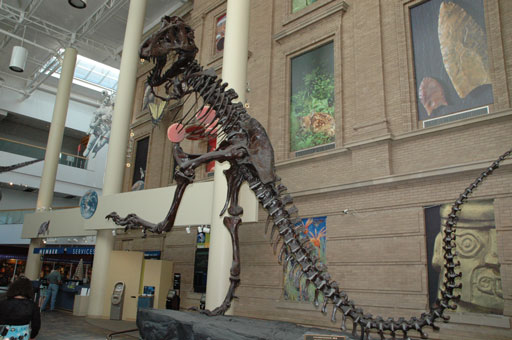
The person I spoke to was notably disinterested in responding to my request. John stood by, in his usual modest manner. Finally, in frustration I pointed to John and said: “Do you know who this is? John Updike, the author.” That produced a quick retreat behind the scenes and a curator arrived to discuss John’s pronunciation questions.

One of the short stories he read that evening was “The Man Who Loved Extinct Mammals,” (previously published in The New Yorker). He quoted from Harvey C. Markman’s book, Fossil Mammals. Markman had been the Curator of Geology and Paleontology from 1936 to 1954 and the Museum had published his book. John was hoping to find an answer by going to the source. In a recent interview for an article in National Geographic Updike mentioned that he had a basic knowledge in “dinosaurisms,” having written a few other such stories. Apparently such familiarity had come to him later than his 1986 reading here in Denver.

There was a bit of a dust-up over John’s visit that evening. A newspaper reporter took him to task for checking his watch too often. In his own defense, John wrote to the newspaper that he was simply trying to fall within the time period that “my sponsor and I had agreed upon.” He continued that he resented the implication that he was giving “short rations” when he had spent considerable time visiting with people after the reading. Local readers, differing with the reporter, came to John’s defense in letters to the paper afterwards. In his thanks to me he wrote of “how nicely I pronounced all those difficult terms.”

by Mary Houck Yuhasz
Member requests help with research

Member Maria L. Mogford, an Instructor of English at Albright College who’s a doctoral student at Alvernia University, would like to use the first Society conference in October to launch her research. The conference will celebrate the 50th anniversary of the publication of Rabbit, Run, and Maria is going to write her dissertation on the moral and spiritual leadership aspects present in Rabbit, Run.

“I was thrilled to find out that Alvernia will be hosting the first John Updike Society Conference this October,” Maria writes. She would like to set up and run a volunteer-only focus group consisting of Updike scholars to discuss the nature of leadership in Rabbit, Run. “The opportunity to work with experienced academics in John Updike’s hometown is very exciting. I would greatly appreciate the chance to use this focus group to explore my own ideas and perhaps crystallize and build upon those of others at the same time.”

Updike scholars who are planning on attending the Society’s first conference in October and who would like to help Maria can contact her directly to express a willingness to be a part of her focus group. Here’s her email: mmogford@alb.edu.

On the first anniversary of John Updike’s passing

In his poem, “Late January,” which was published in Tossing and Turning, John Updike ended with the line, “Time’s sharp edge is slitting another envelope.” How eerily prescient that poem feels now, a year after his passing on January 27, 2009.

Family, friends, and readers all over the world are still feeling his loss. Sure, we received our annual gift from him—three books, in fact: Endpoint and Other Poems, My Father’s Tears and Other Stories, and The Maples Stories. But it wasn’t the same, knowing that there will come a year for the first time in more than half a century when we won’t have a new book by John Updike.

We all have our favorites, but for me, one book of his remains special: Marry Me: A Romance. That’s because in April of 1995 I used that book to propose to my wife . . . with John’s help.

I still remember how he laughed when I phoned to tell him my plan and ask, “Would you help me propose to my wife?”

“You mean . . . like Cyrano?” he said, with that unmistakable bit of mischief that you heard in his voice when something amused him.

“Not quite that bad,” I said, explaining that I wanted to propose to Zarina atop the Empire State Building but hesitated to give her the ring there, afraid that it might get dropped in the nervousness of the moment and be lost in the dusk. “If I send it to you, would you be willing to inscribe my copy of Marry Me so I could use it to propose?”

“Oh, why not,” he said. “To my knowledge the book has never been used that way—though it’s a little ironic, isn’t it, since they don’t exactly live happily ever after in the book? I wouldn’t want it to jinx you.”

“It won’t,” I said. And he got the book to me just in time for a trip that Zarina and I were taking to New York City, where we were going to double date with my best friend from college—Gerry Hoey, who’s the Inspector General of New York City. The first stop was the Empire State Building, where we lingered at the top to allow some of the people to leave. Then I pulled out a small cassette player and set it on the railing. While “Arthur’s Theme” played and Gerry took pictures, I began slow-dancing with Zarina, then said, “I have something to give you.” She was expecting a ring, of course, but instead I reached behind my back and pulled out a plastic bag. I took out Marry Me and handed it to her.

Inside, John had written, “Dear Zarina, If you say ‘yes,’ you might get a ring in the Rainbow Room. Hope it all works out. Felicitations, John Updike.” And he dated it the day that I told him I was going to propose, 4/28/95. Four months later, for a wedding gift he sent us a copy of the limited edition of The Afterlife short story, in which he wrote, “For Zarina Mullan and Jim Plath, May you live happily ever after.”

Today, I’m wishing the same for him.

(Photo and text by James Plath)

The John Updike Review calls for submissions

Society board member James Schiff has been working hard to get The John Updike Review up and running, and he announced today that as editor he is ready to begin accepting submissions. This scholarly journal, published by The John Updike Society and the University of Cincinnati, will specialize in scholarship on the writings, life, and literary and cultural significance of John Updike.

The Review welcomes all critical approaches and publishes full-length articles as well as shorter notes, book reviews, bibliographical updates, professional postings about conferences, calls for papers, scholarships, and other items of interest pertaining to Updike.

Submissions will be reviewed by an editorial board comprised of Updike scholars and others knowledgeable on Updike and his writings. Work considered for publication is subjected to blind peer review by at least two outside readers and the editor.

Subscription information and submission guidelines are available at the quick-click left menu on the Society website.

Panels set for ALA

The John Updike Society will sponsor two panels and hold a business meeting at the 21st American Literature Association Conference, May 27-30, 2010, which will be held at the Hyatt Regency San Francisco in Embarcadero Center.

Here are the sessions the Society is sponsoring, and the members who are participating:

John Updike and American Pop Culture

Chair: Sally L. LeVan, Gannon University

“‘The Bright Island of Make Believe’: Updike on the Movies,” Peter Bailey, St. Lawrence University

“Returning to the Catacombs: Revisiting John Updike’s ‘Adulterous Society,'” Matthew Shipe, Washington University

“The Music of Your Life: Updike’s Visiono of Travel, Tourism, and Foreign Contact as Manifestations of American Pop Culture’s Ubiquity,” Edward Allen, The University of South Dakota

Updike Abroad

Chair: James Schiff, University of Cincinnati

“Updike’s Many Worlds, Local and Global, in Towards the End of Time,” Judie Newman, University of Nottingham

“The Cynic Tyrannies of Honest Kings: John Updike and the Use of Melville’s Verse in The Coup,” Kevin Frazier, independent scholar, Finland

“Updike’s Ambivalent Reception in France,” Sylvie Mathé, Université de Provence

All sessions will be on Thursday, May 27, with John Updike and American Pop Culture scheduled for 10:30-11:50 a.m., Updike Abroad for 1:30-2:50 p.m., and the business meeting of The John Updike Society from 3-4:20 p.m.

We hope to see many of our members there, especially those on the West Coast. But if you can only afford to travel to one conference this year, the First Biennial Updike Society Conference in Reading, Pa., is the one to go to this coming October! Those of you who can attend ALA should click on the link on the left menu for information about registration and hotels.

The next Updike volumes to be published?

Andrew Wylie, whom Martha Updike hired to act as literary agent for the Updike Estate, told The New York Observer that a collection of Updike’s essays would be given to Knopf this fall. Observer reporter Leon Neyfakh also wrote in his January 5 article that Max Rudin, publisher of the Library of America series, has been in discussions with Wylie about Library of America editions of Updike’s work, “something the author was very eager to do while he was alive but couldn’t because such editions would compete directly with Knopf’s Everyman’s Library series.” As for the essays, we asked Andrew Wylie if he could tell us whether the volume would be a compilation of previously published material, ala More Matter and Due Considerations, or if they were previously unpublished essays that came closer to Self-Consciousness. “It’s premature to say more now,” Wylie responded. “Sometime in the fall there may be more news.”

For another story about Wylie’s acquisition of the Updike account, see the January 6 Daily Finance article by Sarah Weinman.

Talk with other members on the JUS Facebook page

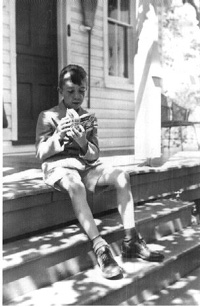
The John Updike Society now has a Facebook page, and there are two photo galleries so far and a discussion board where members can start topics and engage each other and Updike fans in discussions ranging from teaching Updike and interpreting texts to collecting Updike. The link is on the left column menu. Let us know what we can do to improve the Facebook page and this one. The photo here is from one of the galleries. It’s John at age 7, taken by his mother, Linda. Courtesy of Jack De Bellis.

So visit the John Updike Society Facebook page and become a “fan.” And don’t forget to send me your news to post on the Society’s website!

It’s official: Alvernia to host Society’s first conference

Today, Alvernia University and The John Updike Society announced that Alvernia will host the Society’s very first conference October 1-3, 2010. The conference will celebrate the 50th anniversary of the publication of Rabbit, Run, and it’s appropriate that Alvernia is hosting. The University was founded in 1958, the very same year that Updike saw publication of his first book, The Carpentered Hen and Other Tame Creatures. A Call for Papers will be issued soon, and information on the program, hotels, tours, etc., will be posted on the Conference Information page on the Society website left menu as details become available. They will also be posted on the Official Conference Web Page. The full press release is on the Conference Information page.

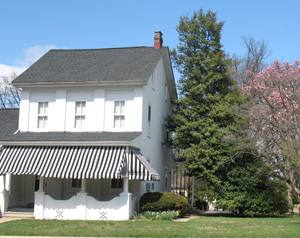
The conference will include the usual offering of panels featuring papers presented by Updike scholars and aficionados, along with panels with Updike’s Shillington High School classmates. It’s expected that at least some Updike family members will attend, and that the keynote speaker will be a writer who knew Updike. But for members of The John Updike Society, the real treat will be seeing Updike’s childhood home in Shillington, as well as remnants of the old poorhouse wall, sites mentioned in Rabbit, Run, and the farmhouse in Plowville. The owners of Updike’s childhood home and the Plowville farm are members of the Society, and they’ve graciously offered to open their doors to members for a tour. Visitors can also see the Reading Eagle where Updike worked summers as a copy boy, and eat at the Peanut Bar across the street where Updike and journalists hung out. And of course there’s the famed Pagoda rising above Reading, which Updike renamed the Pinnacle in Rabbit, Run, and the Reading Public Library, whose balconies Updike deemed “cosmically mysterious.”

The directors for the First Biennial John Updike Society Conference are Society co-founders Jack De Bellis, who will assemble the program, and Updike’s Shillington contact, Dave Silcox, who will serve as site director. So members, put October 1-3 2010 on your calendars and start saving for a trip to Pennsylvania for this doubly historic conference: the first for the Society, and a 50th anniversary celebration of Rabbit, Run.

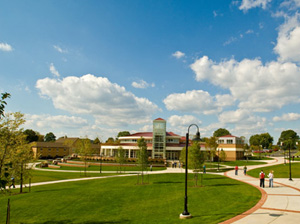
Pictured: The Quad at Alvernia University; a young John Updike reading on the front porch of his home in Shillington; and the house as it looked in May 2009, when the Reading Public Library hosted a tribute to the author.

John Updike Society turns 100 . . . members, that is

Though The John Updike Society was formed fewer than seven months ago and launched with only 35 members, we’ve hit the 100 mark with the addition of Liliana Naydan, a doctoral candidate at SUNY-Stony Brook.

“I became interested in Updike a few years ago,” Naydan writes, “after studying his work with my now dissertation director, Prof. Stacey Olster (editor of The Cambridge Companion to John Updike). My dissertation, titled Fictions of Faith: American Literature, Religion, and the Millenium, includes a chapter on Updike (as well as Philip Roth and Don DeLillo).”

Her chapter on Updike considers “how Updike’s understanding of faith transforms on the eve of the second millennium. I argue that in In the Beauty of the Lillies Updike attempts to bridge apparent divide that fanatical believers, especially early fundamentalists, created between believing in God and embracing the developments of the 20th century as fruitful, not mere signs that an increasingly immoral American nation is rapidly devolving in the face of a fast-approaching, apocalyptic end.  I consider Updike’s earlier works, especially the Rabbit tetralogy, proposing that Updike’s focus in it is on the distinction between faith and good works as means by which to attain salvation.  In the Rabbit novels, only true faith appears to have the power to redeem man.  But in In the Beauty of the Lilies, Updike comes to distinguish between different kinds of faith, and he critiques religious fanaticism, specifically as it has emerged in the latter part of the 20th century.  Even though a fanatic’s faith is true, the intensity of that true belief creates the potential to transcend the bounds of what Updike views as characteristically good. Ultimately, I suggest that Updike comes to advocate for justification through temperance by way of his allusions to biblical and cinematic narratives.  He makes reference to the biblical Book of Esther, which suggests that God exists in the world even in the absence of clear evidence of His existence.  More to the point, he turns to Frank Capra’s Lost Horizon (1937) for his key message of temperance in all things.”