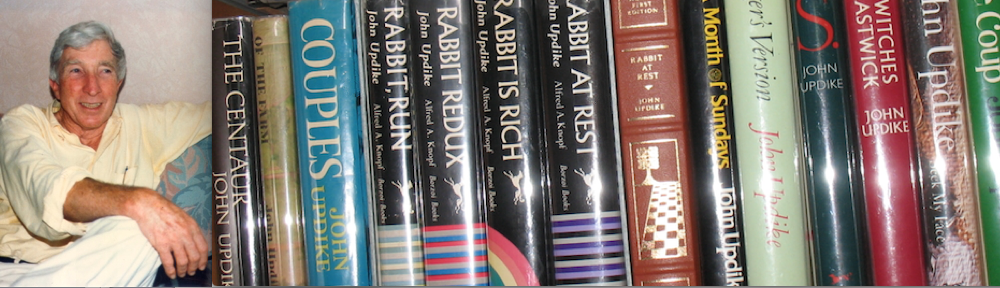
That morsel would be a tiny bit of oatmeal cookie, as it turns out.
The Sept. 10, 2024 entry on the Best American Poetry blog by Nin Andrews features “Advice to Young Poets and a Poem by Kelli Russell Agodon” . . . but also a brief note on writers’ habits that includes Updike:
“Like Timothy Touchett, I enjoy studying other writers’ habits. I want to know what kinds of sorcery they employ. As a result, I can tell you that John Updike ate so much when he wrote, he didn’t like to go out to lunch and worried about his figure. He was partial to oatmeal cookies. Joan Didion edited at the end of the day with a drink in hand (Liquor, of  course, played an important role for a lot writers—no need to list them all here.) John Ashbery enjoyed a nice cup of tea and classical music when he wrote, which was usually in the late afternoon. Charles Simic enjoyed writing when his wife was cooking. Eudora Welty could write anywhere—even in the car— and at any time, except at night when she was socializing. Flannery O’Connor could only write two hours a day and her drink was Coca Cola mixed with coffee. Simone de Beauvoir wrote from 10AM-1PM and from 5-9PM. Louise Glück found writing on a schedule “an annihilating experience.” A. R. Ammons wrote only when inspiration hit—he compared trying to write to trying to force yourself to go the bathroom when you have no urge. Anne Sexton took up writing after therapy sessions. Jack Kerouac had various rituals at different times—one was writing by candlelight, and another was doing “touch downs” which involved standing on his head and touching his toes to the ground. Ernest Hemingway and Virginia Woolf wrote standing up. Wallace Stevens composed poems while walking to work. Gabriel García Márquez listened to the news before writing. Amy Gerstler sometimes listens to recordings of rain while writing. I tried that once, and the rain put me into a deep and dreamless sleep.”

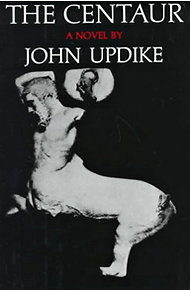 Greatest Books of All Time on Teachers,” and it’s no surprise that John Updike’s 1963 novel, The Centaur, ranks high on the list. His tribute to his father (and teacher), Wesley Updike, did win the National Book Award, after all.
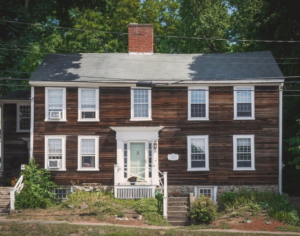
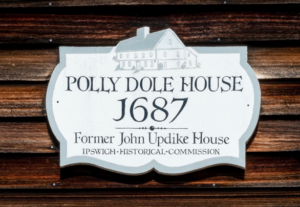
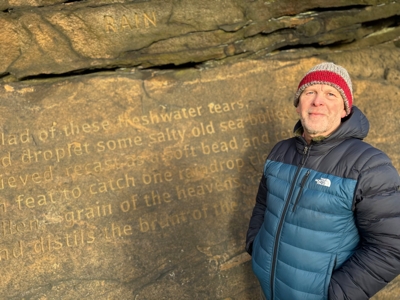 With heavy hearts we report the death of longtime John Updike Society member Andrew J. Moorhouse, whom many members first met when he attended the society’s second biennial conference in Boston in 2012.
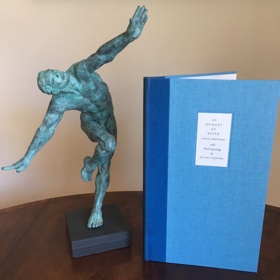 Inspired by Updike and Updike small-press limited edition publisher William Ewert, Andrew contacted UK Poet Laureate Simon Armitage, whose work he collected, asking if he’d be interested in working with him to produce fine press editions of his works. Armitage was interested, and in October 2013, Andrew started
  Chase Replogle, pastor of Bent Oak Church in Springfield, Mo., posted a chapter excerpt that didn’t make the final cut of his book, A Sharp Compassion. “I think it still matters, he wrote. “It is taken from the chapter on affirmation and examines how the church has been tempted to avoid what offends.”
 In
In  Phoenixville (Chester County) Pa.’s Excursion Ciders “uses local apples that are presssed and made in-house, also utilizing other locally-grown ingredients to make their drinks. Currently, the star of the show is Of the Farm: Core. This cider has an ABV of 7.5 percent and is made with apples from Plowville Orchard. Author John Updike spent time there and they named this cider after his novel, Of the Farm.” Here’s the