The Other John Updike Archive focuses on objects

UpdikebillPaul Moran writes,

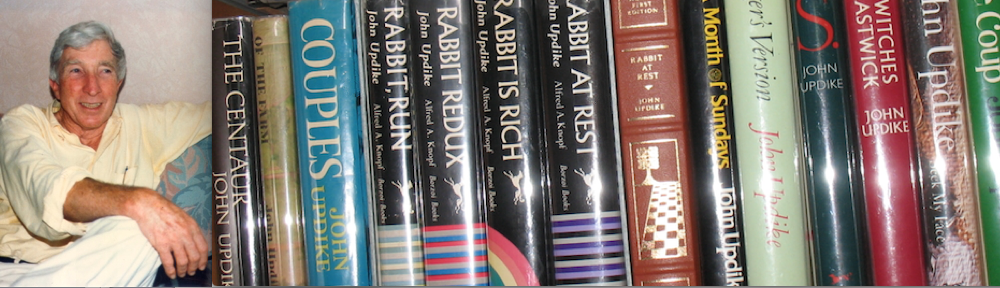
The Other John Updike Archive is a collection of objects that formerly belonged to John Updike.

“Each posting will contain another piece from the collection.

“This is part of the Kula Art Project, which consists of a return to the importance of relics and the biography of ordinary things.”

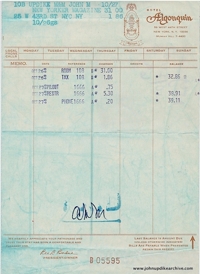
Some of the things are actually quite extraordinary, such as a royalty statement from Knopf showing domestic and foreign sales for Rabbit, Run. Or a hotel bill detailing what room the Updikes stayed in.

Amazon now accepting pre-orders for the Begley Updike bio

begleyAmazon recently began accepting pre-orders for Adam Begley’s much-awaited unauthorized biography of John Updike.

Begley is traveling abroad and couldn’t provide details, but he confirmed via email that the title of the book is simply Updike and that the publication date is as listed: April 8, 2014.

No cover art is provided, but the hardcover dimensions are 9x6x1.2″ and the book is listed at 400 pages, with a SRP of $29.99. Currently Amazon is selling it for $23.58 (21 percent off). Here’s the link.

Garrison Keillor reads Updike’s “Baseball”

Citi FieldThe Writer’s Almanac for Tuesday, June 25, 2013, featured Updike’s poem “Baseball,” which seems even more appropriate to share as Tuesday’s All-Star Game  draws nearer.

In fact, it’s tempting to contact starting NL first basemen Joey Votto to ask him how accurate Updike’s second-stanza simile seems—if he was ever “scared / of the shortstop’s wild throw / that stretches you out like a gutted deer.”

“Baseball” appeared in Endpoint, confirming Updike’s sustained interest in the Great American Pastime throughout his life.

Updike scholarship gets a boost with the release of “The Collected Stories”

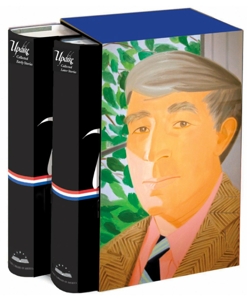
UpdikestoriescoverAs much as Adam Begley’s forthcoming biography, Updike enthusiasts have been anticipating the September 12 publication of John Updike: The Collected Stories by the Library of America. The two volumes can be bought singly (John Updike: Collected Early Stories, John Updike: Collected Later Stories) or in a set that includes a sturdy and colorful slipcase designed by Chip Kidd, featuring the 1982 oil-on-canvas portrait by Alex Katz that’s housed at the National Portrait Gallery.

I received an advance copy of the set and am happy to report that it’s extremely well done. Christopher Carduff, who put together the special book publication of Hub Fan Bids Kid Adieu and edited Higher Gossip: Essays and Criticism (2011) and Always Looking: Essays on Art (2012), has arranged the stories in the order of their composition—a task made easier, Carduff writes, because “Updike signed a first-reading agreement” with The New Yorker when he was 22 years old and “habitually marked the date of submission on the first page of the typescript copy he kept for his files.” Almost all these typescripts from Updike’s personal files are now in the collection of Harvard’s Houghton Library.   Continue reading

Updike places high on EW’s Top 100 Books list

Screen Shot 2013-07-07 at 7.40.20 PMIf you open up the July 5/12 2013 Special Double Issue of Entertainment Weekly magazine and go to page 96, you’ll see that Updike’s Rabbit quartet was named the  #8 novel of all time.

“‘Rabbit’ Angstrom runs from marriage and responsibility and runs smack into them again in Updike’s masterful chronicle of a man’s four-decade race against the American zeitgeist,” the editors write.

Only F. Scott Fitzgerald and Willa Cather placed higher among American writers, with The Great Gatsby earning 2nd place and My Antonia 6th.

Toni Morrison’s Beloved came in at Number 9, right behind Updike, followed by E.B. White’s Charlotte’s Web (#10—children’s books, popular books, genre books, and international authors were all considered), William Faulkner’s The Sound and the Fury (#12), Harper Lee’s To Kill a Mockingbird (#13), E.L. Doctorow’s Ragtime (#15), Cormac McCarthy’s The Road (#17), Herman Melville’s Moby-Dick (#18), Vladimir Nabokov’s Lolita (#19), Larry McMurtry’s Lonesome Dove (#20), Theodore Dreiser’s An American Tragedy (#21), Ralph Ellison’s Invisible Man (#26), Richard Wright’s Native Son (#30), J.D. Salinger’s Catcher in the Rye (#32), John Irving’s The World According to Garp (#34), Ayn Rand’s Atlas Shrugged (#36), and Ernest Hemingway’s The Sun Also Rises (#37).
Screen Shot 2013-07-07 at 7.27.59 PMMorrison was the only American writer to place twice, with Song of Solomon coming in at #52. Alice Walker’s The Color Purple made the list at #45, as did Mark Twain’s The Adventures of Huckleberry Finn (#62), Philip Roth’s Portnoy’s Complaint (#63), David Foster Wallace’s Infinite Jest (#64), Saul Bellow’s Herzog (#65), and Joseph Heller’s Catch-22 (#85). Amy Tan’s The Joy Luck Club barely made the list at 100.

The article, which runs from pages 94-103, generated so many reader complaints that the editors felt compelled to defend their selection process (click here). Topping the list? Leo Tolstoy’s Anna Karenina. That Updike is so well thought of by the staff of an entertainment magazine speaks to both the literary merit of the Rabbit novels and their popular appeal.
Belated: 2009 tributes are worth reading, rereading

Sometimes it takes a while for things to rise to the top in that massive cache of Internet offerings, as happened with two 2009 tributes to John Updike—one written by Michael Dirda for The Chronicle of Higher Education, and the other posted by “an Indian fan.”

“John Updike, 1932-2009”
Dirda’s tribute, posted on February 13, 2009, includes some interesting observations. “Updike recognized that American literature and American art often occupy a realm between fantasy and reality, that they rely on mystery and symbolism as much as on apt observation, that our greatest novelists and painters are constantly edging into the magical and dreamlike,” Dirda writes, concluding, “Updike’s own fiction feels grounded in archetypes, touched with romance and myth.” Here’s the link to the full essay.

“An Indian fan of American writer John Updike”
Journalist Shevlin Sebastian, who has worked for magazines and newspapers in Kolkata, Kochi, and Mumbai and now writes for the New Indian Express in Kochi, posted his Updike tribute on February 4, 2009. “At the American Centre library in Kolkata, where I was a regular visitor, there would always be a row of Updike books,” Sebastian writes. He expresses one “enduring regret”—that Updike’s death removed him from consideration for the Nobel Prize. Here is a link to the full post.

Blogger notes “A Child’s Calendar” revisions

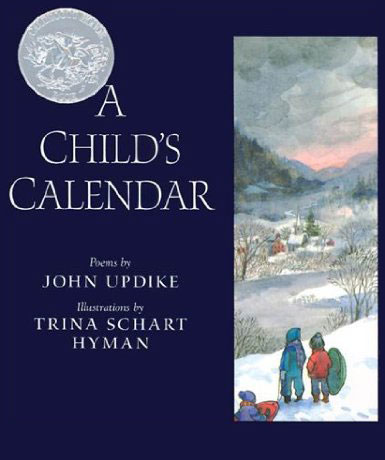
updikechildscalendar1Scholars haven’t done much with Updike’s children’s books, but blogger Maria Popova (“Brain Pickings”) notes that Updike’s A Child’s Calendar, originally published in 1965, was updated for a 1999 re-release to be more racially inclusive.

Trina Schart Hyman’s illustrations feature mixed ethnicities that were absent from the original book. Popova observes that Updike even made slight changes to the text in order to “celebrate diversity,” and cites examples.

Here’s the article—“A Child’s Calendar: John Updike’s Vintage Children’s Book, Updated to Celebrate Diversity”—with poems and illustrations.


Updike referenced in assessment of rising female literary star

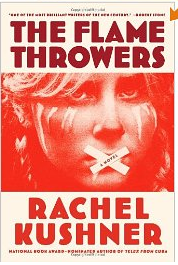
Screen Shot 2013-06-17 at 10.44.19 PMIf you haven’t heard of Rachel Kushner, then you probably haven’t heard that, according to Salon‘s Laura Miller, she’s written the Great American Novel. So says Miller in her June 5, 2013 review-article, “Rachel Kushner’s ambitious new novel scares male critics.” 

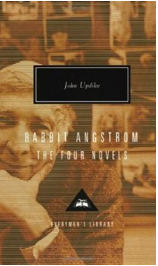
John Updike is mentioned several times as one of the old guard writers expected to have produced such a work . . . but maybe he already has. Published as a collection by Everyman’s Library, Rabbit Angstrom: A Tetralogy tells the sweeping saga of an ordinary, middle-class man in 20th Century America. That in itself would seem a marvelous enough achievement to qualify for the title, but then to have it validated with two out of four books receiving the Pulitzer Prize?

Updike Society honors Shillington realtor

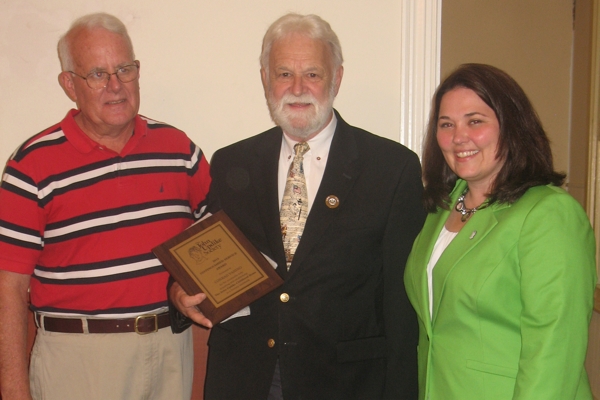
On Monday, June 10, Shillington realtor Conrad Vanino received The John Updike Society’s second Distinguished Service Award—an 8×10” plaque thanking him “for his invaluable help acquiring and converting The John Updike Childhood Home into a museum.”

Vanino (pictured below with society co-founder Dave Silcox and curator Maria Mogford) helped the society go through proper channels and worked pro bono. He continues to serve the society behind the scenes, maintaining a lock box on the property so work crews can enter and checking on the house several times per day. Vanino is also in the process of looking for a suitable tenant for the annex added by Dr. Hunter, who lived in the house after the Updikes. The society has divided the annex so that three rooms of the building used for patient exams can be rented as office space to help cover the expenses of maintaining the house. The doctor’s office will be used as a gift shop, and the waiting room will be the educational room, for watching videos or for class presentations.

Vanino is a lifelong resident of the Shillington area who has served on Borough Council for over 30 years and is also on the board of the Shillington Lions Club and the board of Crime Alert Berks. He is a member of the Shillington Business Association and a graduate of Governor Mifflin High School. Like many Shillington youngsters, he learned to swim in the pond that provided the water supply for the poorhouse Updike wrote about, just blocks away from the house at 117 Philadelphia Avenue.

Vanino

Continue reading