Milwaukee blogger adds another Updike story commentary

recreadingMilwaukee Journal Sentinel blogger Jim Higgins writes, “I’m reading and commenting on a story from the Library of America’s recently published John Updike: The Collected Stories each Wednesday until I finish the collection or give up.”

On January 1, 2014, he posted “Reading the John Updike stories: ‘Intercession,'” but if you scroll down you’ll find links to other Updike story commentaries. On January 8 he promises “a discussion of Updike’s story ‘The Alligators” and gives two stars to a story that “would go in my hypothetical Best of John Updike collection.” So far “His Finest Hour” and “Tomorrow and Tomorrow and So Forth” have made the grade, but not the frequently anthologized “Snowing in Greenwich Village” or “Friends from Philadelphia.”

Boston area adult extension course on Updike stories announced

Screen Shot 2014-01-03 at 11.56.07 AMJudith Wynn, who reviewed several of Updike’s books for The Boston Herald, will teach a six-week course, “The Short Fiction of John Updike,” at the Cambridge Center for Adult Education in Harvard Square.

The classes will run from 6-7:30 p.m. on Mondays, beginning January 13. The main texts will be John Updike: The Early Stories, 1953-1975, selections from the later stories, and Self-Consciousness.

For further information or to enroll, go to CCAE.org or phone (617) 547-6789.

Guardian review of a book critic’s essays mentions Updike prominently

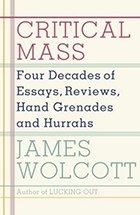
More-Dynamite-Essays-1990-20And we start the new year with an interesting post:  a book critic (Leo Robson, The Guardian) reviewing a book critic (Craig Raine, and also James Walcott) who’s reviewing Updike’s book and art criticism, among other things.

In “More Dynamite: Essays 1990-2012 by Craig Raine—review,” posted on The Guardian online on Friday, December 27, 2013, Robson notes of both the main title reviewed and Critical Mass: Four Decades of Essays, Reviews, Hand Grenades and Hurrahs that “the only writer given extensive treatment in both these books is Updike.

“Wolcott praises the ‘deft, polite scalpeling’ Updike performs on Saul Bellow (he peels away the ‘rugged prettiness’ to locate an ‘agitated sluggishness’), and his capacity to ‘dig beneath the hype and confetti of a book’s reception’ (in this case, Kundera’s The Book of Laughter and Forgetting). But he also notes a ‘lack of heat and force,’ exactly the Critical massqualities Wolcott himself aims for and attains, and calls for more ‘plainspokenness, even a whiff of woodsmoke from the old slash-and-burn,’ just as Raine, writing about Updike’s essay on Andrew Wyeth, complains that at a certain point he ‘caves in,’ and dismisses as ‘ludicrously indulgent’ Updike’s comparison of Fairfield Porter to Matisse and Piero della Francesca.

“Updike stands as an object of worship to both Raine and Wolcott, a model of what can be done, except on those occasions when magnanimity limits honesty—cardinal virtue of any critic.”


Newly published Iranian five-story collection features Updike

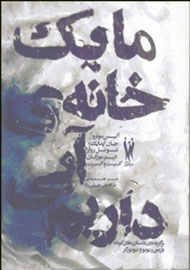
n00189765-bFrom the Iran Book News Agency comes the announcement that “‘Blue House’ House to Stories of Noted Writers” was recently published in Persian, a five-story collection featuring authors Alice Munro, John Updike, Alistair Morgan, and Kate Walbert.

Titles of the stories included in the 164-page collection are not mentioned.

Those with bibliographical information on this item, please contact Jack De Bellis, who is working on a supplement to the 2008 bibliography: bjd1@lehigh.edu.

Lost and found: Sam Tanenhaus essay on Updike’s politics surfaces

Screen Shot 2013-12-28 at 8.40.23 AMIn a November 8, 2012 essay on “John Updike’s ‘Rabbit Redux’ and White Working-Class Angst” published under the shortened name “Man in the Middle”—an essay that many may have missed—New York Times Book Review Editor Sam Tanenhaus reports,

“John Updike visited The New York Times a week before Election Day in 2008. Whom, I asked him, would Rabbit Angstrom most likely vote for? ‘I’m so for Obama,’ Updike replied, that I can’t imagine creating a character who wouldn’t vote for him.’

“And yet in ‘Rabbit at Rest’—the last novel in the cycle, which concludes with the hero’s death—we discover he cast his final vote for George H.W. Bush.

“When I reminded Updike of this, he looked startled. But he was right about 2008. Obama carried Reading that year, and he did it again on November 6 [2012].”

Postmodern Deconstruction Madhouse explores Updike “signage”

‘Twas six nights before Christmas and all through the Postmodern Deconstruction Madhouse there were signs from Updike’s “Rabbit” novels.

Blogger Peter Quinones takes note of the “Signs and Signage in Updike’s ‘Rabbit’ Novels” and offers a count and speculation for their frequent inclusion . . . and variation. Some of his conclusions seem like leaps—”Similarly, how do we go from 8 signs in one novel to 19 in the next? I would suggest that Angstrom’s reticular activating system has begun to be lit up to pay attention to signs, signage, and printed messages because he now works as a typesetter—it’s unavoidable”—but it’s fascinating to see what catches people’s attention from the “Rabbit” series.


Updike lauded in The Common Review

In a reflective critical essay titled “Updike Redux,” published in Vol. 8, No. 2 (Fall/Winter 2009/2010) of The Common Review, William Giraldi writes, “Of all the American literary titans who have died within the past several years—Saul Bellow, Arthur Miller, Norman Mailer, William Styron, Susan Sontag—John Updike was the most beloved.” Giraldi considers Updike’s popularity, oeuvre and literary legacy and draws a number of conclusions—among them, “We can classify the likes of Goethe and D. H. Lawrence as nothing other than men of letters, masters of many genres, and Updike was their descendant.”

The Common Review, The Magazine of the Great Books Foundation, was founded in 2001 but ceased as a print publication with the Fall/Winter 2011 issue. Thanks to Larry Randen, here’s a PDF of the full Giraldi essay.

PECO Foundation donates $20,000 to help restore The John Updike Childhood Home

The John Updike Society has received a $20,000 donation from the PECO Foundation, a charitable trust based in New York City, “to help support the John Updike Society’s project to preserve the Updike family house.”

H. Roemer McPhee, who is on the board, is a huge Updike fan—not just familiar with all the novels and short stories, but able to quote from them. This past summer he toured the house and Shillington-Plowville sites with his mother, Updike Society president James Plath, and John Updike Childhood Home curator Maria Mogford. And he saw firsthand the work that needed to be done.

Last year the PECO Foundation contributed $3000 but upped their donation this year to help with much-needed house repairs and restoration, which are expected to cost some $300,000.

The contribution looms even larger than that, because it’s the first major donation other than ones received from The Robert and Adele Schiff Family Foundation, whose generosity enabled the society to buy the house and begin the restoration. “It paves the way for other major donors to climb onboard and together create a literary landmark that can be appreciated for many generations to come,” Mogford said.

Mogford said that the exterior of the house has been painted this fall, and that work inside will begin again in the spring and continue throughout summer of 2014, in anticipation of being at least “presentable” for the Third Biennial John Updike Society Conference to be held the first week in October of 2014. That conference, like the first, will be hosted by Alvernia University.

Animated Updike? PBS Digital Studios presents John Updike on Family Affairs

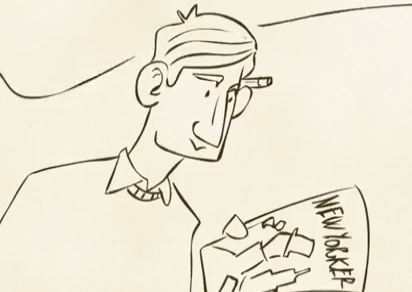
Screen Shot 2013-12-18 at 3.39.03 PMYesterday PBS Digital Studios posted a five-minute animated short titled “John Updike on Family Affairs,” part of their Blank on Blank series.

It’s animated from a previously unheard spring 2002 interview by John Freeman, in which Updike talks about his decision to live away from New York City and the impact of family on his writing life. Blankonblank.org is a nonprofit digital studio in Brooklyn, founded by David Gerlach, that transforms lost audio interviews with cultural icons into a new animated series for PBS.

Here’s the link, with thanks to David Lull for calling it to our attention.