Florida publication features Updike short story analyses

UpdikeFlaglerLive.com, an online Florida publication named after the man whose railroad brought tourists to the Florida Keys, has published a series of summaries and analyses of short stories from the recent Library of America editions of Updike’s short fiction.

“This series is a re-reading of John Updike’s short stories in the wake of publication of ‘The Collected Early Stories’ and ‘The Collected Later Stories,’ the twin-volume set by the Library of America (2013).” It includes a “comprehensive table of the complete stories with links to each story summary” and a consideration of the Maple and Bech stories, “most of which are excluded from the Library of America edition.”

Thirteen summaries/analyses have been posted thus far:

John Updike: The Complete Stories (Click on Links for Summaries and Analysis)

Journal features an article on Updike and second-wave feminism

Screen Shot 2014-05-25 at 10.23.49 AMFeatured in Volume 5, Issue No. 4 [2014] of the International Research Journal of Management Sociology & Humanity, is an article by Anshu Chaudhary titled “Analysis of the Select Novels of John Updike from the Perspective of the Second Wave Feminism,” which appears on pages 84-91.

In it, Chaudhary writes, “It can’t be ignored that Updike was reflecting the point of view of male characters of a particular age and class, and in that context they demonstrated psychological insight. But if we analyze Couples and Marry Me the two most interesting and sympathetic novels in which the women characters are most keenly drawn we see that he has presented the mystery of man’s sexuality from the perspective of the female characters. In both these novels he entered the mystery of woman’s sexuality as well.

“Updike’s views and depiction of female characters may be prejudiced but are not misogynistic. His works don’t show him to be against the growth and liberalization of domestic women. He just reflects the ‘other’ side of things.”

She concludes her essay, “Thus, female characters exist and develop and survive in his fiction. They also help the male characters to find their own identity and ‘Search for the Self.’ Although he fails to give them their own identity but as he himself says,

“‘American fiction is notoriously thin on women, and I have attempted a number of portraits of women, and we may have reached that point of civilization, or decadence, where we can look at women. I’m not sure Mark Twain was able to.'”


Summer reading list includes Updike biography

Jim Higgins, of the Milwaukee Journal Sentinel, has posted “96 books for your summer reading,” and topping the category titled “12 Editor’s Picks” is Updike, Adam Begley’s “sympathetic but honest biography of the writer, which pays close attention to the ways John Updike frequently transmuted real-life incidents into his fiction.”

Other categories:  “14 Books We’ve Already Liked,” “8 Books for Recent Graduates,” “11 Books by Wisconsin Writers,”  “10 Visiting Writers,” “8 Mysteries and Thrillers,” “5 Pop Culture Books,” “7 Visually Appealing Books,” “18 Books for Children and Teens,” and “5 Books for Baseball Fans.”

Theses and dissertations on Updike now number 256

If you do a WorldCat search for subject: John Updike, thesis/dissertation you’ll get 26 pages of entries that are sortable by relevance, author A-Z, etc., and you might recognize quite a few names in this list. As of May 25, 2014, there have been 256 theses/dissertations written about Updike.

Here’s the WorldCat link to the first page. The link has been added to the bibliography in the left menu.

One of the theses—”The protagonists of John Updike,” by Charles Monroe Cock (Spring 1971) is even available as a PDF in full form: The protagonists of John Updike, which makes you wonder how long it will be before everything is available at a keyboard’s touch.

Updike poem inspires tuba composition

The San Jose Mercury-News ran a story about a physics professor and composer named Brian Holmes who says he was inspired to write a piece for chorus and tuba by John Updike’s poem, “Recital.”

That composition will have its world premiere on May 31 at Lincoln Glen Church, featuring Symphony Silicon Valley tuba player Tony Clements as soloist.

“Updike was inspired to write the poem after seeing a headline in the New York Times that read ‘Roger Bobo Gives Recital on the Tuba’ on a story about the tuba virtuoso who spent 25 years with the Los Angeles Philharmonic.

“‘I agree with Updike that the words ‘Bobo’ and ‘tuba’ are immensely silly in one headline,’ Holmes says.

“Updike took this silliness and ran with it; the first stanza of ‘Recital’ reads, ‘Eskimos in Manitoba / Barracuda off Aruba / Cock an ear when Roger Bobo / Starts to solo on the tuba.’

“Holmes’ piece sticks to the poems text but plays with Bobo’s name a bit more.”

According to the article by Anne Gelhaus, it’s not the first time that Holmes has found inspiration in Updike.


Head to Crane Beach for a chance to find Michael Updike “sand dollars”

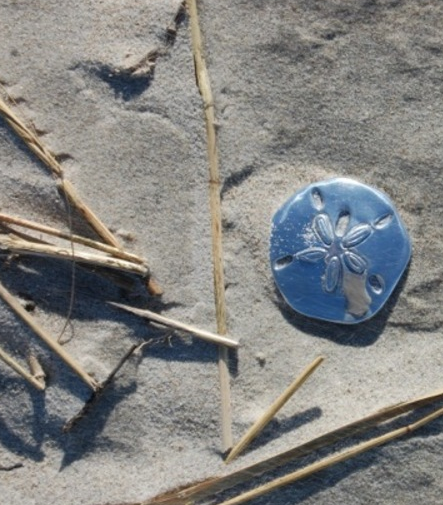
Screen Shot 2014-05-21 at 4.15.02 PMStarting Memorial Day 2014 and continuing through the summer, 50 silver-and-blue sand dollars designed by sculptor Michael Updike will be strewn across Ipswich’s Crane Beach, where Michael’s novelist father used to enjoy spending time. It’s a promotion for the local chamber of commerce, and the sand dollars are meant to be redeemed for prizes by the lucky finders. But there are more than a few members of The John Updike Society who would think one of those sand dollars treasure enough, and display it among their other Updike collectibles.

Here’s the story by Ethan Forman that appeared in the Salem News: “Dotted with treasure; Sand dollars on Crane Beach make beach-goers, businesses winners.”

The Other John Updike Society?

UnknownMembers have grown used to seeing posts from The Other John Updike Archive, a treasure trove of lost-and-found paper objects related to all facets of Updike’s life. Now it seems there’s an Other John Updike Society—or at least another incarnation of one.

New member Norm Carlson, who retired in 2001 as an Associate Professor of English at Western Michigan University, writes in his letter asking to join, “Actually, what I’ll sort of be doing—in military-speak—is ‘re-upping,’ since I was a member of the original John Updike Society back in the 1970s.

“That organization, in my memory, was more-or-less owned and operated by Joyce Markle, whose Fighters and Lovers (1973) was one of the earliest scholarly books about Updike’s work. She produced a mimeographed newsletter and arranged for annual John Updike Society sessions at MLA meetings.”

Longtime Updike scholar Don Greiner had no knowledge of this previous Updike Society, so we asked search-engine wizards David Lull and Larry Randen—Jim Yerkes’ editorial team for The Centaurian, who are now diligently finding Updike-related news for the Society website and Facebook page—to see what they could find out.

They came up with two relevant bios from John Updike: A Collection of Critical Essays edited by David Thorburn and Howard Eiland (Prentice-Hall, 1979), the first critical anthology devoted to Updike’s work:

Dean Doner is academic vice-president of Boston University and a writer of stories and criticism. He edits the newsletter of the John Updike Society.”

Joyce Markle has taught English at Loyola University. A founder of the John Updike Society, she was a consultant in the filming of Updike’s story ‘The Music School,’ which was televised nationally by the Public Broadcasting System in 1977.”

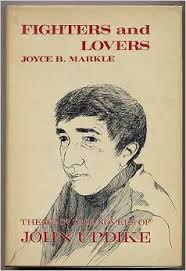
So there you have it: the first artifacts of The John Updike Society’s early history. Hopefully more information will surface. Pictured is the hard-to-find dust jacket from Fighters and Lovers, featuring artwork by Markle’s sister, Susan Bonners, an American Book Award-winning illustrator.

UT’s Ransom Center acquires McEwan archives

Screen Shot 2014-05-19 at 11.59.47 AMThe Harry Ransom Center at the University of Texas at Austin announced days ago that they have acquired the archive of writer Ian McEwan, and an email from an employee at the Center confirmed that they believe “there is some correspondence with Updike in there. We will know more once the collection has been processed and catalogued.”

“Acclaimed Writer Ian McEwan’s Archive Acquired by Harry Ransom Center”

McEwan has written frequently “On John Updike,” as he did for the March 12, 2009 issue of The New York Review of Books. After Updike’s death, his remarks were included in a round-up of well-known writers published by The Guardian on January 27, 2009:

“He was a modern master, a colossal figure in American letters, the finest writer working in English. He dazzled us with his interests and intellectual curiosity, and he turned a beautiful sentence. Religion, sex, science, urban decay, small-town life, the life of the heart, the betrayals—who can follow him? Updike gave the impression he had a lot more writing to do. We are all the poorer now.”

Maybe the McEwan archive will shed some light about what other writing Updike had in mind.

The Harry Ransom Center was in the running for the John Updike archives, which eventually went to Harvard.


Begley bio sparks “Uptick in Updike Interest”

If you’ve been following The John Updike Society on Facebook or on this website you’ve noticed that the news as of late has been dominated by responses to the Adam Begley biography of John Updike. But what we haven’t considered is that every article and every review needs photos to go with the copy, and as Writer Pictures, a source that provides copyrighted material for the media, observes, the Begley biography has sparked an “Uptick in Updike Interest.”

You’ve no doubt read that the Begley-Updike connection is Begley’s father, Louis, who was a Harvard classmate of Updike’s, and the article also includes a photo of the elder Begley.