Still Looking . . . Still Vermeer: Columnist wishes Updike could see new Vermeer exhibition

The new (and largest ever) Vermeer exhibition in Amsterdam is apparently as hard to get tickets for as a football championship. A World Today News columnist recently said, “I had given up all hope of a ticket for Vermeer, until an attentive, art-loving one NRC reader managed to get my wife and me in after all, even without having to smash a window of the Riijksmuseum.”

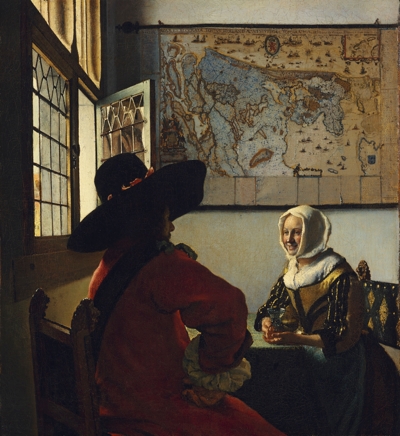
Officer and Laughing Girl. 1657-58, oil on canvas. The Frick Collection, New York: Photo: Joseph Coscia Jr.—from the Riijksmuseum press website

The writer lamented, in a column titled “Still Vermeer” (in apparent reference to Updike’s second published volume of art criticism, Still Looking),”If only John Updike, the American writer (1932-2009), could experience this exhibition. I mention him because of all literary writers he has been the greatest connoisseur and admirer of Vermeer. . . . Updike became interested in Vermeer as a schoolboy. He wrote a nice, autobiographical story about it: ‘The Lucid Eye in Silver Town.’ In it, a boy, together with his father, visits an older brother of that father in New York. The boy’s father is a passive man, the older brother is a successful businessman. It is the boy’s first visit to New York, where he wants to buy a ‘good book’ about Vermeer.

“The wealthy uncle listens to him skeptically and starts bragging about four paintings by Degas that he has hanging in his living room in Chicago. ‘Yes,’ says the boy, ‘but don’t Degas’ paintings remind you of colored drawings? When it comes to it to look to things in terms of paint, with a sharp eye, Degas can’t match Vermeer.’

“The uncle says nothing and the father apologizes: ‘That’s how he and his mother always talk. I can not reach it. I never understand any of it.'”

The writer talks about walking through the new exhibit and wondering what Updike had thought of his personal favorite, The soldier and the laughing girl . . . “a painting that seems made for Updike and his ‘lucid eye.'”

Aspen Times letter writer invokes Updike

Writing to the Aspen Times about the “doldrums of mid-January,” Andy Stone of Missouri Heights shared an Updike poem that he thought appropriate for seasonal contemplation:

Slum Lords
The superrich make lousy neighbors—
they buy a house and tear it down
and build another, twice as big, and leave.
They’re never there; they own so many
other houses, each demands a visit.
Entire neighborhoods called fashionable,
bustling with servants and masters, such as
Louisburg Square in Boston or Bel Air in L.A.,
are districts now like Wall Street after dark
or Tombstone once the silver boom went bust.
The essence of superrich is absence.
They like to demonstrate they can afford
to be elsewhere. Don’t let them in.
Their riches form a kind of poverty.

John Updike

Yahoo! feature identifies celebrities living with psoriasis

Surely there were more than 21 celebrities who had psoriasis, but a writer for news aggregate site Yahoo!’s “women’s health” section settled on that number . . . among them, John Updike (#20).

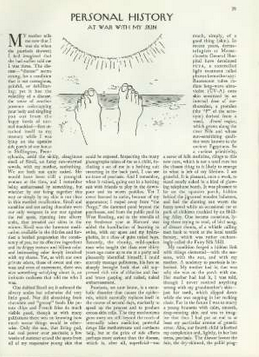
“The Pulitzer Prize-winning novelist and poet penned a 1985 essay for The New Yorker aptly titled ‘At War With My Skin,‘ where he addressed his struggles with the autoimmune disease. In his essay, Updike wrote, ‘Why did I marry so young? Because, having once found a comely female who forgave me my skin, I dared not risk losing her and trying to find another.'”

Read the entire article.

Blogger turns to Updike for Thanksgiving thankfulness

Patrick Kurp, who writes Anecdotal Evidence: A blog about the intersection of books and life, yesterday turned to Updike for his Thanksgiving post, “Give Thanks for Gradual Ceaseless Rot.”

“Everything I have is more and better than I deserve,” Kurp wrote. “I like expressions of gratitude for things that have never occurred to me. Take John Updike’s thankfulness for decomposition in ‘Ode to Rot’:

“All process is reprocessing;
give thanks for gradual ceaseless rot
gnawing gross Creation fine while we sleep,
the lightning-forged organic conspiracy’s
merciful counterplot.”

Read the full blog post.

North Carolina pastor considers Updike’s remarks on the resurrection

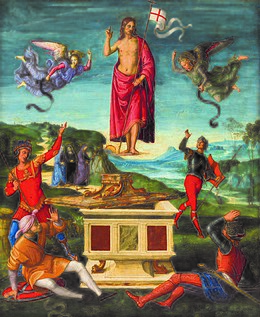
Raphael’s Resurrection of Jesus Christ (1502)

God’s Truth for Today published a short contemplation by Dr. Chris Simmons, a member of the pastoral team at Frye Regional Medical Center in Hickory on “Resurrection: Our Impossible Anchor — Faith and Values.” John Updike’s often-quoted “Seven Stanzas at Easter” were immediately invoked.

“At 28, novelist John Updike got to the bottom of the Resurrection,” Simmons wrote. “Updike would fear death throughout his life. His sober awareness of this surely led him to write “Make no mistake: if He rose at all / it was His body; / if the cells dissolution did not / reverse, the molecules / reknit, the amino acids reignite, / the Church will fall.”

“Updike realized that the scandal of the resurrection, that a human could raise the dead, had to be true or the faith had to be abandoned. He wouldn’t want to make a metaphor out of it or redefine it or make it less of a stumbling block. He seems to have believed that he could only be saved from eternal death by a Savior who had conquered it himself,” Simmons wrote.

Read the whole meditation.

Flashbak considers Updike’s thoughts on death and writing

On September 18, 2022, Flashbak (Everything Old Is New Again) posted “John Updike On Death, Writing And the Last Words,” in which Paul Sorene gave some thought to Updike’s memoir and the relationship between the author’s preoccupations with writing and death.

“Memory is like the wishing-skin in fairy tales, with its limited number of wishes,” Updike wrote, prompting Sorene to wonder, “Can writing preserve memories and keep death at bay? Who gets to tell Updike’s story after he’s gone, and how will he be remembered?”

Sorene, quoting liberally from Self-Consciousness, noted that “Updike saved almost everything. His papers, stored at Harvard, include his golf scorecards [the John Updike Childhood Home has several of these on display], legal and business records [the JUCH also has his travel log, many of his cancelled checks, and a number of business correspondences with publishers], fan mail, video tapes, photographs, drawings [plenty of those on display at JUCH], and rejection letters. Was saving and preserving the past done so we could remember him, and he could better remember himself, and try again?”

That interesting question prompts another: What is the relationship between the collecting impulse, the writing impulse, and the impulse to somehow live forever?

McEwan talks about the assault on Rushdie and on literary reputations

Lisa Allardice recently interviewed Ian McEwan for The Guardian (“Ian McEwan on ageing, legacy and the attack on his friend Salman Rushdie: ‘It’s beyond the edge of human cruelty'”). The occasion was the release of Lessons, the new novel by McEwan, who was the keynote speaker at the 5th Biennial John Updike Society conference at the University of Belgrade, Serbia.

McEwan at the University of Belgrade

The nearly 500-page novel, which mentions the fatwa against Rushdie, is “far longer than McEwan’s characteristically ‘short, smart and saturnine’ novels, as John Updike summed up in a 2002 review of Atonement,” Allardice wrote. “McEwan’s ambition with Lessons, his 18th novel, was to show the ways in which ‘global events penetrate individual lives,’ of which the fatwa was a perfect example. ‘It was a world-historical moment that had immediate personal effects, because we had to learn to think again, to learn the language of free speech,’ he says.”

“Billed as ‘the story of a lifetime,’ it is in many ways the story of McEwan’s life. ‘I’ve always felt rather envious of writers like Dickens, Saul Bellow, John Updike and many others, who just plunder their own lives for their novels,’ he explains. ‘I thought, now I’m going to plunder my own life, I’m going to be shameless.'”

“‘I’ve read so many literary biographies of men behaving badly and destroying their marriages in pursuit of their high art. I wanted to write a novel that was in part the story of a woman who is completely focused on what she wants to achieve, and has the same ruthlessness but is judged by different standards,’ he explains. ‘If you read Doris Lessing’s cuttings they will unfailingly tell you that she left a child in Rhodesia.'”

Asked whether, at age 75, he worries about his legacy, McEwan responded, “I’d like to continue to be read, of course. But again, that’s entirely out of one’s control. I used to think that most writers when they die, they sink into a 10-year obscurity and then they bounce back. But I’ve had enough friends die more than 10 years ago, and they haven’t reappeared. I feel like sending them an email back to their past to say, ‘Start worrying about your legacy because it’s not looking good from here.'”

Allardice wrote, “He was greatly saddened by what he describes as ‘the assault on Updike’s reputation’; for him, the Rabbit tetralogy is the great American novel. Saul Bellow, another hero, has suffered a similar fate for the same reasons, he says. ‘Those problematic men who wrote about sex—Roth, Updike, Bellow and many others.'”

“We’ve become so tortured about writing about desire. It’s got all so complex,’ he says. ‘But we can’t pretend it doesn’t exist. Desire is one of the colossal awkward subjects of literature, whether it’s Flaubert you’re reading or even Jane Austen.'”

Read the whole interview.

Dallas columnist invokes Updike in writing about infamous conspiracy theory

On the 50th anniversary of JFK’s assassination, the Dallas Observer‘s Jim Schutze wrote a column titled “Umbrella Man, Umbrella Man, Please Stay Away. Don’t Come to Dealey on JFK Day.” The title itself is pure, poetic, fun with language, so it’s perhaps no surprise that Updike turns up.

“Louie Steven Witt, are you still out there somewhere, alive? Would you tell me if you were? You know you’re back in The Dallas Morning News this morning, but only as a ghost,” Schutze began. Witt was identified as the “umbrella man” during the House Select Committee on Assassinations in 1978. The umbrella man was one of the closest bystanders when the assassin’s bullet struck President Kennedy, and the only one in the area with an umbrella who was opening and closing it. A signal?

“You have something in common with the old rich Dallas people sponsoring the 50th whatever-it-is-this-year. A half century ago all of you were abducted and transported into the bizarre quantum universe of Kennedy assassination conspiracy theory. When he wrote about you in particular, Mr. Witt, in The New Yorker in 1967, the late great novelist John Updike described the alternative reality that consumed you as ‘a sub-atomic realm where laws are mocked, where persons have the life-span of beta particles and the transparency of neutrinos, and where a rough kind of averaging out must substitute for absolute truth.”

Read the whole article.

World Mosquito Day prompts return to Updike poem

The blog Flowers for Socrates said August 20 was World Mosquito Day, and if you missed out on your usual celebration (ahem), here’s an Updike poem on the subject that blogger Nona Blyth Cloud posted that day.

Updike had us at “I was to her a fragrant lake of blood / From which she had to sip a drop or die / A reservoir, a lavish field of food”.

“The Mosquito” was first published in the June 11, 1960 edition of The New Yorker.

Pennsylvania History considers The Pennsylvania Updike

In retrospect, maybe it was a perfect storm of sorts, with Jack De Bellis’s John Updike’s Early Years coming out in 2013, Adam Begley covering some Berks County ground in his biography Updike in 2014, and James Plath collecting and commenting on John Updike’s Pennsylvania Interviews in 2016. But it took Richard Androne to see the connections and to take a page from Updike’s book reviews and treat them in a single article.

“The Pennsylvania Updike” was published in Pennsylvania History: A Journal of Mid-Atlantic Studies 85:1 (Winter 2018), though it first came to our attention recently.

“The centrality of Pennsylvania, and especially of his native Berks County, in author John Updike’s life, literary achievement, and ultimate vision comes through vividly in Adam Begley’s biography Updike, Jack Debellis’s more specialized study John Updike’s Early Years, and James Plath’s collection of Updike’s Pennsylvania interviews, many of which were done in Updike’s home county,” Androne wrote.

“Until he was eighteen and left for Harvard, Updike said, ‘there were hardly twenty days that I didn’t spend in Pennsylvania,’ and while after that departure he no longer lived in Berks County for an extended period, he said, ‘though I left Pennsylvania, Pennsylvania has never left me. It figures in much of my work, and not just the earlier.'”

Androne wrote, “just as James Joyce had to leave Ireland to write about it in many of his finest works, Updike had to leave Berks County. Updike told one interviewer, ‘There comes a time when you must test yourself against the world,’ and to another he said, ‘I think I couldn’t have had my writing career if I had stayed in Pennsylvania. On the other hand, I couldn’t have had my writing career if I hadn’t had all that Pennsylvania experience.”

“De Bellis argues even more strongly than Begley for the influence of the physical and cultural Shillington—and especially for that of Updike’s high school classmates—on his work, uncovering numerous parallels between persons and places in life and art. Especially useful in this regard is material in the chapter, ‘Inspirations and Models,'” Androne wrote. Plath, meanwhile, “supplies a perceptive and useful introduction and conclusion in which he synthesizes some of the material in this anthology of interviews. He is particularly good at identifying common denominators in Updike’s comments on Berks County and Pennsylvania in a larger sense.”

Androne wrote that the three Updike books “complement each other and can profitably be read together both by scholars and general readers seriously interested in Updike. Among the many instances of this is Plath’s inclusion of William Ecenbarger’s June 12, 1983 article, ‘Updike Is Home,’ a Shillington interview Begley also uses in his first chapter as illustrative of Updike’s artistic method of turning his own experience into art, in this case a July 4, 1983, New Yorker story called ‘One More Interview’ published less than a month after Ecenbarger’s article, and both the interview and Begley’s treatment of Updike’s story are enhanced by the Shillington detail in De Bellis’s book.”